Twinklebox from Aaron Bradbury on Vimeo.
secondary attention and the ghosts in the corner
Mechanical engineers always talk about the importance of background noise. About how, looking back to when something went wrong, they actually, unconsciously knew it was about to happen because the quality of the background noise had changed. It's a well understood phenomenon; we absorb huge amounts of information about the world through background noise. That's why movie soundtracks and sound effects are so important. Something that - with the notable exception of games designers - digital folk seem to miss quite a lot.
I remember seeing a talk once from a guy who did sound for the ER (on TV, not in actual hospitals). He was telling stories with the sound - foreshadowing moments, enhancing themes, adding drama - all via secondary attention. And I've always wanted to try and use sound as a way of telling you what's going on in/on/with the web. We've been mucking about with a few varients of this - from the abstract and arty to the slightly less abstract and arty - and we're going to try them out via some boxes which Adrian's building for us.
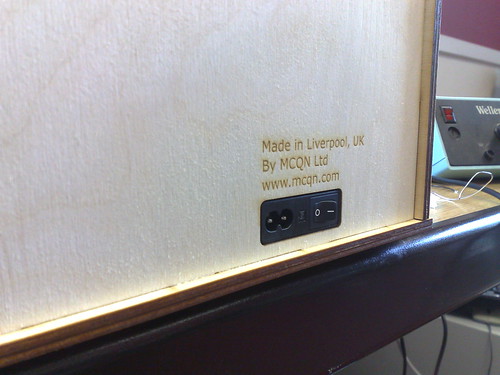
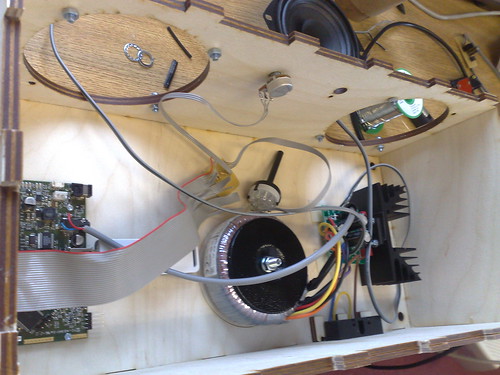
They're designed to be dead simple - they have an on/off/volume switch and three channel options. Each of those channels points to a different audio source on the internet. When you turn them on sound comes out of whichever channel you're currently tuned to. They're like internet radios but without all that annoying choice. The first prototype is in this quite big box but later versions might just go inside old radios, or much smaller boxes. I like the idea of them being hidden in the corner of a room, like an ornament rather than an appliance.
We've been thinking of things to put through them. Things with purpose and without.
It Can't Be Called Ghost Box
Our working name for channel one has been Ghost Box, because Warren Ellis was going on about the record label when we started thinking about it. The idea is something that sits in the corner of a room, is silent most of the time but slips out sounds that change the atmosphere every now and then. Or that acts like an aural version of Matt's Presence Machine. Not quite like ambient music, less constant than that, but low-level or occasional sounds that punctuate the room every now and then. This could, obviously, be very annoying, it won't suit everywhere all the time. It might not work anywhere.
I've been experimenting what it might sound/feel like by adding lots of silence and the occasional sound effect, musical fragment and soundscape to this S3FM channel and playing it in the background a lot. I quite like it. It has that effect of being unnoticeable most of the time but waking you up every now and then and making you wonder if you're in a forest. (If you try to listen to it don't worry that it seems broken, it's mostly silence.)
It can't be called Ghost Box though. Too many things are already called that and it's not for contacting the dead. We'll think of another name.
Audio Growl
There's a magnificent project called Peep: The Network Auralizer which is designed to let sysadmins "monitor their network with sound". Natural sounds are used to represent system events, so that this represents a bad DNS query and a heavy load of traffic sounds like a very busy pond being stalked by a fox. I'd love to be able to do that with my social network and my networked devices. Probably not with natural sounds though.
I'd like interesting and distinctive pings for nearby checkins, when it's my turn on WWF, when certain folders in my dropbox have updated, when I've been @d or DMd, when the local BorisBike station's full-up or empty, you know the kind of thing. Stuff that I'd like to be vaguely aware of, rather than be actively informed of. And stuff that doesn't require my computer or device to be on, in the room and attention-hogging.
I've been prototyping this by switching all my system alert sounds on and switching all the sounds on in growl. It's not the same but it's starting to work. I'm starting to hear what's going on in my networked world, rather than watch it.
The Third Space
And I'm not quite sure about the third channel yet.
I like what Matt's talking about here; some sort of semi-collaborative, semi-hands off music listening thing.
Or, I'd still like to solve ambient speech.
Maybe it's an aural version of what ambient devices used to do. One-bit displays with sound. Or there's birdsong. Or, I don't know.
We've been thinking about Radio Club for a long time now, maybe it's that. We'll see.
secondary attention and the little boxes of sound
It's struck me recently that I'm a little obsessed with screenless design. I bought this book the other day, and it's great - but it's depressing how much of it depends on a gloomy room. Screens and projections are lovely but they tend to demand an accommodating context. It's all about them.
On reflection that's one of the things I like about the bikemap. It mostly just sits there, inert and quiet, like an ornament or a piece of furniture. It doesn't glow. (Much)
Anyway. Sound is also screenless design. It's a great way to connect computation and people - it's just not used much. I'm always really struck at design conferences how many designers didn't seem to have an audio channel.
SAP from russelldavies on Vimeo.
I was trying to get at that a bit with this SAP idea. Yes, some of the time it's an active thing - the bit illustrated here - but most of the time it's supposed to be just a little radar ping at the back of your attention.
And this brilliant post from Phil made me realise how much the device oriented bits of sound design and behaviour is also focused on Primary Attention. The Walkman gave us personal soundtracks, I wouldn't be without mine, but they're a powerful drug and there's a difference between listening to sound in your head and listening to sound in the world. Maybe, in fact, there's a more important difference - between listening and hearing.
(I suspect this explains some of the reason why 'the kids' listen to their music through the speakers on their phones. Obviously it's partly just because it annoys the rest of us, but some of it must also be about creating a shared social space, a shared soundtrack.)
RJDJ and Papa Sangre, for example, are both brilliant and fun but they're both about Primary Attention. They're designed for headphones. They're tools for listening.
But sound should be about more than that. It does other stuff, stuff that needs exploring. How about media that aspires to the condition of Woman's Hour, of radio. Stuff that sits in the background, creating quiet context and occasionally snagging attention.
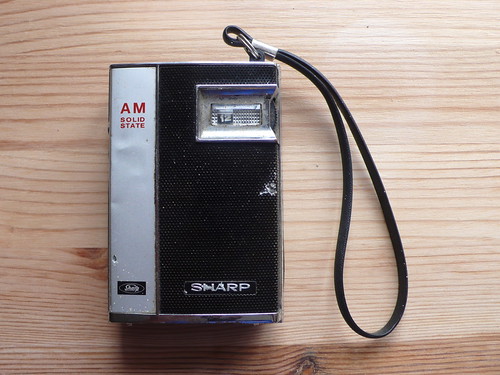
One version of this I love is the idea of a small box of sound. Something that embodies a particular channel, that contains all it needs, speaker, power, media, the minimum of buttons to press, no menus to scroll through. Like a transistor radio that only receives one channel.
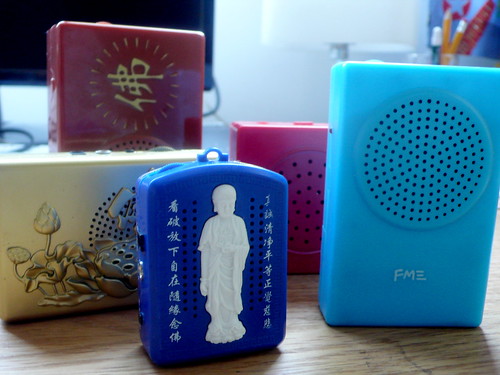
The best examples are the various versions of the Bhudda Machine, which are splendid (as are the original cheap, plastic inspirations). But, these days, you really want a stream of media coming out of a box, not a fixed block of it. I do anyway. I want an In Our Time Machine, or a Solid Steel Machine. So I built some prototypes with some charity shop ipods.
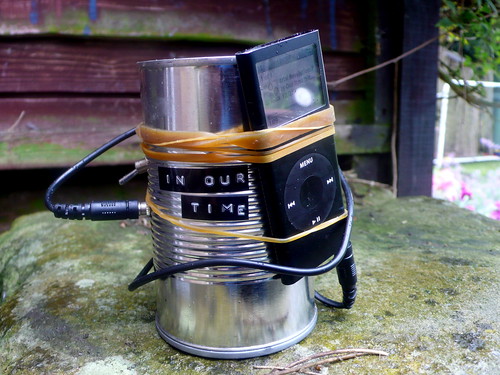
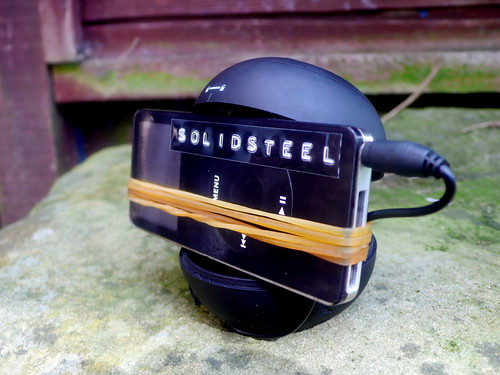
Admittedly they don't sync over the air but my backlog of listening to both Solid Steel and In Our Time is so extensive that it feels neverending. And it works. They both sit there on the shelf, like dense packages of high-quality radio ready to be unfurled, not always for listening but for creating the particular audio background I'm after, in the kitchen, in the bathroom, wherever.
I could of course, just use a regular ipod plugged into a regular speaker but there's something about all that choice, all those options, those MENUs. I just want to switch it on and for the right sort of sound to come out.
It's different. There's something to doing less, having less, building something for just a little bit of attention.
And it's made me wonder whether you can use sound to do more useful or interesting Secondary Attention things...
secondary attention and the coming super abundance of screens
We've been lucky enough to work with Kevin on some second screen thinking and one of the things he's made me realise is - it's not the nature of the screen that's important, it's the nature of the attention. Secondary Attention is a different beast and one we'll have to think about differently.
Our default habit is to design media that trys to grab all the available attention. (Normally meaning all the optical attention.) And that's getting us into trouble. It's why Dentsu/BERG's work here is so clever -it's designed to be respectful of our primary attention, offering something quick, quiet, useful or rewarding in the moments we can spare it some mind. That's why it offers such an attractive alternative to the Blade Runner/Cillit Bang scenario.
Those of us with backgrounds in advertising should already be thinking about this because we've all read Robert Heath on Low Attention Processing and should have realised how much we can communicate with someone who's not really watching. But, it seems, we can't learn those lessons, we refuse to be humble and quiet. We want all the attention, for as long as possible.
And, Kevin's presentation here, made me wonder if that's part of the problem with AR. It's trying to insert itself right in the middle of your primary attention when a lot of the stuff it's trying to deliver is only worthy of being around the edges.
So maybe what's actually interesting now is experimenting with secondary attention, in various different ways, playing with modes like glancing rather than staring.
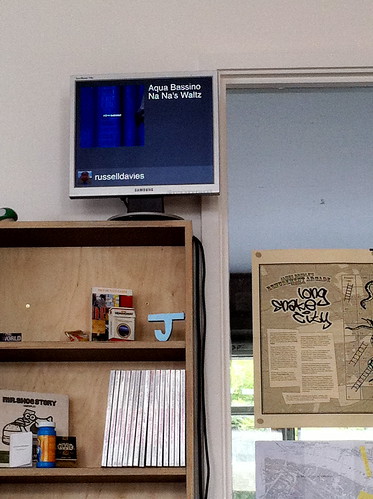
Many of my favourite examples of Secondary Attention apps seem to get auditioned on this little screen in the BRIG. There's always something interesting up there, varying from dashboardy stuff to the playful or restful.
Above, for instance, is James Wheare's BRIGTunes, which the RIG has been happily been living with for a while.
And, inspired by You Are Listening To Los Angeles, space shuttle activity tends to see the screen tuned to NASA TV accompanied by a drum and bass podcast to create a sort of joyful-wistful-ambient-science-show.
And, the ipads in the office, or the laptop screens next to the monitors tend to be tuned to dextr or some other little attention toy.
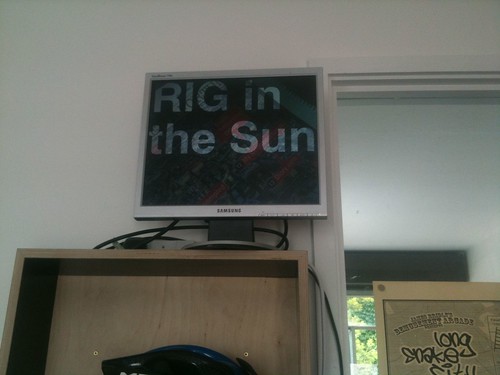
James Bridle is the master of this stuff. He's been building all these lovely things, designed for the coming super-abundance of screens, when they won't be burdened with the obligation to deliver important attention-grabbing information but will be superfluous and cheap enough to be left in the corner and glanced at occasionally.
Romance has lived too long upon this river, for instance, shows you, quietly and beautifully, the height of the Thames tide. It's somewhere between art, craft and technology, between a snow-globe, a screensaver and a painting.
Or there's Robot Flaneur - which Chris has neatly described as Ambient Tourism.
Thinking about Secondary Attention properly will yield new uses for screens; Slow Television might be one, but the thing that's exciting me most will be elsewhere, it'll be screenless. It'll be based on sound.
But that's a post for a different day.