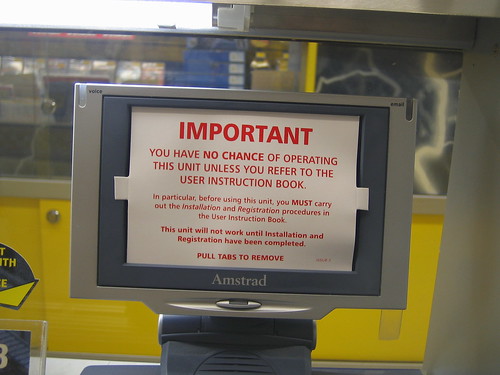
I'm reminded of this magnificent example of product design whenever The Apprentice rolls round again. Well done Sir Alan, an example to us all. Originally found in 2004.
I'm reminded of this magnificent example of product design whenever The Apprentice rolls round again. Well done Sir Alan, an example to us all. Originally found in 2004.
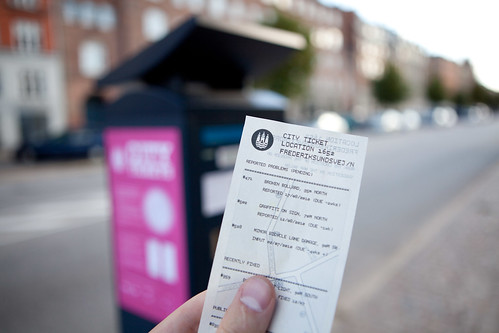
If you're a fan of those BERG films and the use of tickets and recepits, here's another bit of brilliant thinking. City Tickets by Mayo Nissen. Very good stuff.
Just finished reading Stewart Lee's How I Escaped My Certain Fate. It's absolutely brilliant. A good, funny and touching book. I've always liked 'behind the scenes' things and lots of this book is made of transcripts of his comedy with extensive footnotes and explanations. What he was thinking, what he thinks of it now, it's really interesting.
Brilliant stuff. It might also help if you're of that certain age that finds this bit very resonant:
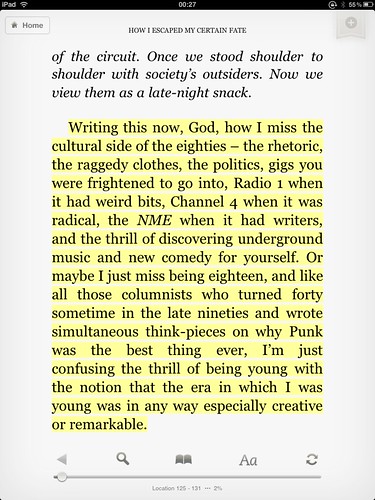
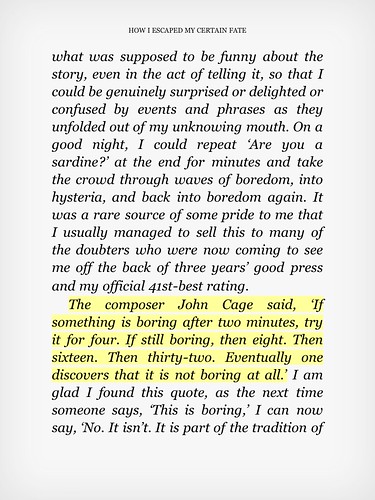
These are the other bits I highlighted. Not sure there's a pattern to them, or if they're especially typical, but here there are:
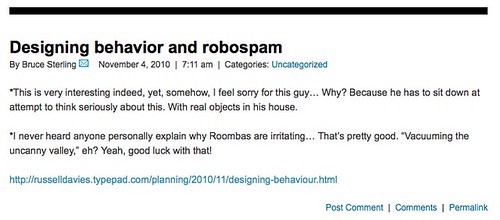
Always nice to get a nod from Chairman Bruce. What's really sad is that I don't have to think about this at all, I do it because it's interesting to me.
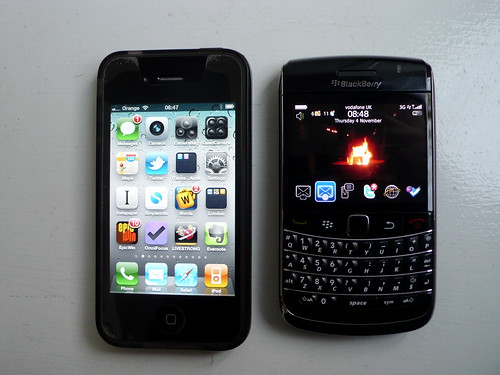
Being less freelance and more employed has meant the recalibration of various things in my life. One is the devices I use.
The iPhone above is what I use for life. I pay the bills for it. The BlackBerry is what Ogilvy gave me. They pay for that. It's great actually, a very efficient machine for the delivery of email. And you can talk on it in places where the iPhone/Orange doesn't seem to get good coverage - like Earth.
But the best bit is that those aspects of my life are neatly compartmentalised. The emotional differences are embodied in the objects. I think that's one reason why we'll never have truly converged devices - the idea of a really general device doesn't make emotional sense to us. And perhaps it's a reason why no computer in our house is ever called 'he' or 'she' whereas a vacuum cleaner with less intelligence that knows less about us is instantly personified. General purpose computing is too far from human-ness. Or something.
Anyway.
Media surfaces: Incidental Media from Dentsu London on Vimeo.
As usual Dentsu/BERG have completely nailed something in these two videos - the idea of polite media. It's a great expression of a thought that was floating around at 2screen - designing for inattention, for second screens you're not really watching. (You should watch all those talks). A great expression and an important one - because if we apply media's usual instincts to all the screens that are going to arrive in our world we'll be drowned by the shouting. We have to learn to be polite.
The films they make are brilliant; doing design by doing media, it's such a clever way forward. I've always thought that one of the last cards regular agencies have to play is that we make films - and films are enormously quick and persuasive. It's one of our last edges versus design/digital/consultancy businesses. But right now the BERG/Dentus cabal are making the best films.
And it suddenly occured to me, this morning, that once again they've out-rigouroused us. We (and the broader BRIG gang) have been mucking about with various second screen / polite media things for a while but have never stopped to think about the theories and ideas within them.
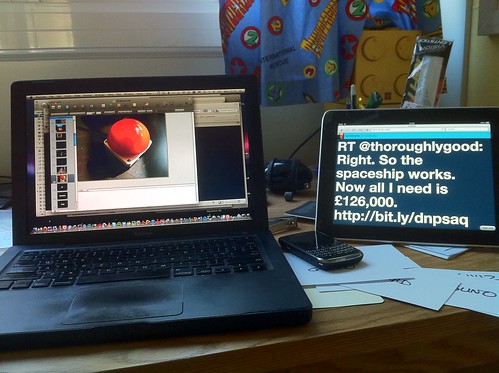
For instance, we've finally got round to building the Big Twitter client I first mentioned in 2008. It's a glanceable, readable version of twitter that you can run in a browser window on a second screen - and read from across the room. (Working name Dougls {now dextr}, coming soon to an internet near you.)
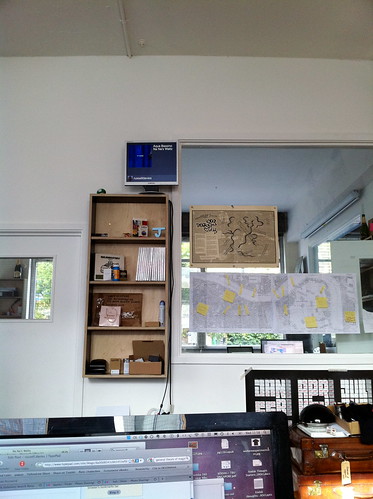
And I nudged James into building BRIGtunes, which he's made rather lovely.
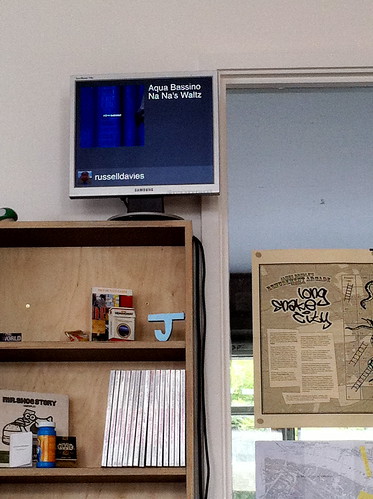
We have these shared AirTunes speakers in the office, hi-jacked by different people at different times and we were all always wondering what was being played. So, now, on a screen high on the wall, we have a little display that shows you who's playing what. Glanceable, quiet, polite. James explains the Technical Achievement here.
These are little things but they're useful experiments. Ways of thinking about Apps For Screens rather than Applications For Computers. That might come in handy.
Anyway - you should watch those Dentsu/BERG films. That's proper media thinking that is.
So, it's been about six weeks of Ogilvy so far. And I have to admit, I'm enjoying myself. It's weird - dialling into the scale and the layers - but it's made a lot less weird by the fact that everyone's nice. And it's fascinating to hang out with planners a lot, I haven't done that for years. What a thoughtful, interesting bunch of people.
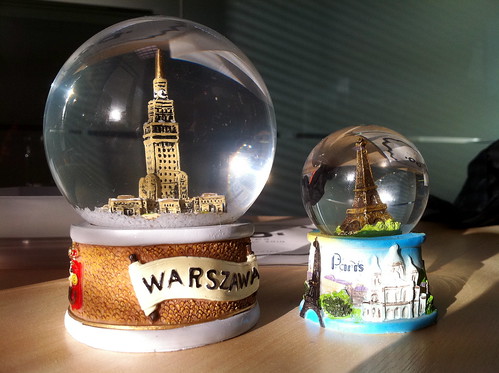
I've never had a properly international job before and it's rather exciting. I was asked to go and help our office in Warsaw on a pitch and it was immensly cheering to just turn up and be able to help. They seemed to need external validation more than they needed actual help with thinking or strategy - just someone who'd done this lots before to say yes, you seem to be going in the right direction. Again, nice people, smart people. Clever planners in that office.
One of the reasons I gave up writing about planning on the blog was the effect of my various trips to Romania. It made me realise how useless all that wibbling about esoteric theories is to someone who just has to write a brief for a Carpet City ad in the next half hour. (Or whatever is the local equivalent of Carpet City. Rug Region for instance, or Mat Metropolis). There are only a few markets in the world where there's the carrying capacity for Floaty Planny Theory and I'm mostly not going to be working in those markets. It's good to get back to that craft stuff and to find places where the fact that I've been doing this since the 17th century is of some use to someone.
Restarting in this world has also made me realise that I don't know many planners any more. I was never that good at the industry hobnobbing but doing the coffee mornings etc meant I did know a bunch of interesting juniorish planners, many of whom now seem to be very interesting very senior planners.
Maybe we should start them again. Perhaps the networking tendency will have dropped away and they can just revert to being coffee and chatting. That'd be nice.
This is, somewhat, another pre-Wired panic deadline post. But possibly not, because I'm not sure there's enough here. Well, actually, I'm convinced there's loads here but I don't really know how to come at it. (I also have a slight feeling I've already written this but i can't bring myself to look back at my old copy - it's too inevitable I'll find some horrible mistake in there.)
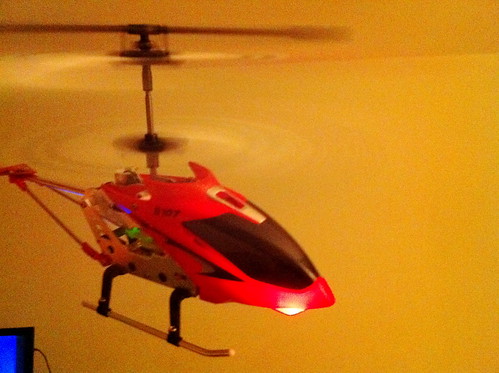
Let's start with something potentially over the top. I just bought three things - a Roomba, a Sony Rolly and an RC Helicopter - and together they sort of make me feel like when I downloaded the mosaic browser or telneted to some bookshop to buy a book. They feel like early indications of something.
These are just notes towards working out what that is.
They all seem to suggest there's going to be an interesting job coming - somewhere between design and communications - expressed in behaviour. And something to do with animation and something to do with choreography.
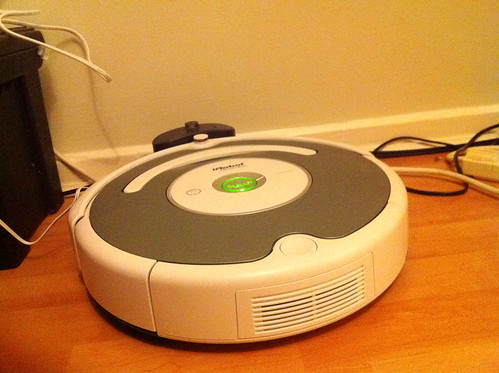
Let's start with the Roomba. I know I'm reporting known phenomena but it's different reading about something versus having it in your house. The Roomba - despite being explicitly designed not to be personified - was instantly known as 'he' the minute he entered the house. That makes design decisions different.
And it cleans efficiently but frustratingly. It sweeps a room like a machine intelligence would do - which, it turns out, is grating to a human intelligence if you're in the same room.
Look, for instance, at this brilliant BotJunkie post, the top shot shows the pattern the Roomba used. The second one down shows the Neato. The Roomba pattern may be more efficient, but it just doesn't look right to a human brain. It's not how a human would do it. The Neato pattern looks more like how I would clean.
That's going to be a thing - not just designing efficient, effective behaviour - but designing behaviour that's emotionally satisfying to the owner and appropriate to the character of the object. There's a component of that that's like branding.
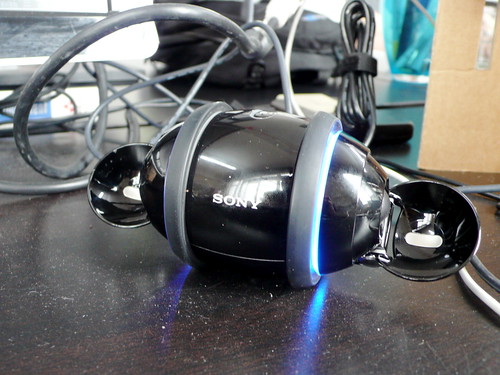
I've written about the Rolly before. It's obviously an odd and mostly useless thing. But I decided to sit down and work out how to choreograph it - I wanted to get it to recite a poem convincingly. And I realised how much character you can get out of it, if you really know what you're doing. (I could only do it briefly and by accident.) You have to work out which machine bits we read as human bits (what are the shoulders? what are the eyes?) you have to get them to move convincingly, then you realise you can make them move grumpily or happily or whatever. Then you realise that you have to decide who this object is.
That's going to be a thing - regular consumer products will be coming to life, they'll be getting behaviours and then all that planning nonsense about 'what's the personality of the product' will finally be useful. All those personalities we've been trying to inject remotely via advertising and design cues will just be baked into the product's behaviour.
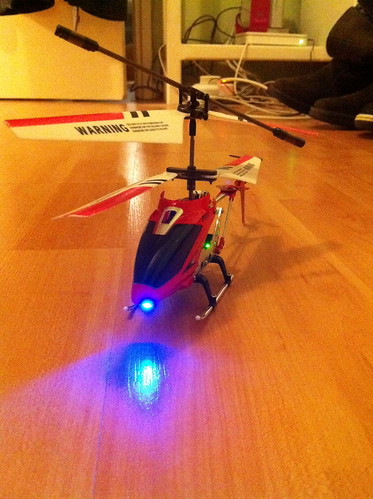
And then we bought one of these RC helicopters. And, versus all those slightly unsatisfiying, cheap microhelicopters you'd bought before, this one just works. The gyroscope in it means it'll just hover where you want it to. And it's only £25. Think of that. It's cheap, almost disposable, not far off being machine controllable. It'll get cheaper.
This seems like a potential darkside in waiting. Aside from all the surveillance concerns you've suddenly got objects that can swarm in three dimensions and might get cheap enough for the economics of spam to apply. Never mind walking past a Starbucks gets you a coffee voucher on your phone - we'll just soak the area with robovouchers that'll get in your hair until you buy a cappucino.
But it points at something to do with object independence. About how they'll find their way into our world, on their own.
Like I say - these aren't connected thoughts. But there's something about the collision of products, services and media here - not expressed through screens but expressed through the designed behaviour of objects. And it's interesting.