Russell Davies

As disappointed as you are
About | Feed | Archive | Findings | This blog by email

interesting ticketing protocols

Order Confirmation for Interesting2009 — interesting tickets etc

Dear Everyone Who Was Kind Enough to Buy an Interesting Ticket

You will have had an email from eventbrite with the above text in it. It's quite near the bottom, not in large letters, so you can be forgiven for not noticing it. But please take a moment and notice it. You will not be receiving any form of printed ticket from me. Just the print out, that's all you need. Bring that along to the event entrance.

Bless you for your cooperation in this matter.

Just so you know.

August 04, 2009 in interesting2009 | Permalink | TrackBack (0)

ageing blogs

found of the year

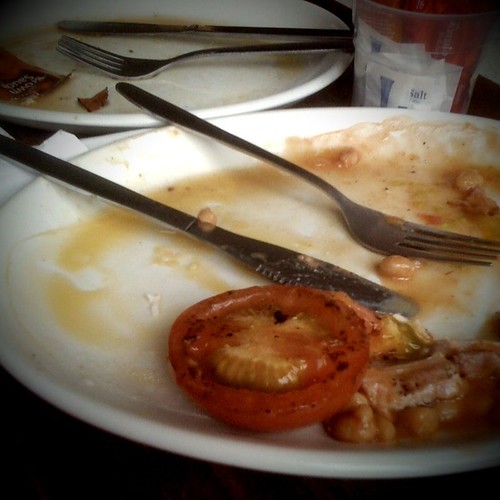
I found this in a box the other day, it reminded me how much egg bacon chips and beans and a good place for a cup of tea and a think nag away at my conscience. Every time I think I've got to the end of my to-do list they sit there, accusingly, un-updated.

Realistically they're not going to be updated much any more. I still go to lots of cafes but they tend to be cafes I've already written up. I don't have a sufficiently peripatetic lifestyle to be adding new places all the time. Which I can live with; no-one's clamouring for new updates and when I do occasionally add a cafe, RSS handles the rest.

But what worries me is all the out-of-date content on there. Some of these places must have closed, improved, worsened, whatever, but my pages are still among the top hits for many of them, and the blog gives very little indication of how old the entry is. Certainly there's the date, but who looks at that? It's probably not enough.

Which, of course, is where print succeeds so well. If these blogs were on paper you'd instantly get a good clue how old the information is. Yellowing, brittle paper. A distinct smell. The only places these blogs should now show up should be second-hand shops and libraries - again giving you a sense of the age of the information.

I guess I should stick up a disclaimer of some sort but that seems too unsubtle.

Chatting with Mr Gyford we both thought maybe someone should build an agify service (rather like cornify) that would look at the date on a page and add coffee stains, curled up pages and other aging cues as appropriate. That'd be nice. Maybe it could even be a MT plug-in or something.

Anyway.

August 03, 2009 | Permalink | TrackBack (0)

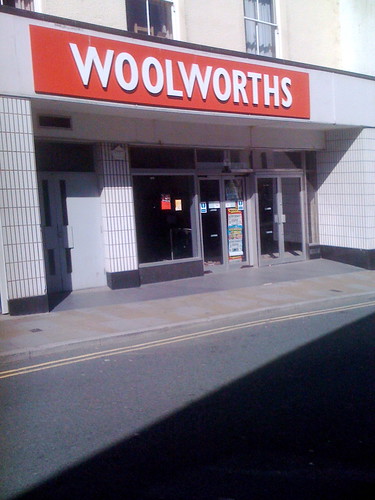
woolworthsless summer

tenby

We were in Tenby last week and it struck me how much the country's going to miss Woolies this summer. Because Woolworths was the essential small town store, especially at the seaside. Somewhere you could buy wellies, tea-towels and Star Wars figures. Now you have to go to the pound store, or drive to the massive Asda. I've missed Woolies a lot since it went, suggesting to me that it was the business infrastructure that was buggered, not what they were trying to sell to people. I bet we're going to see a few of those in the next few years.

July 31, 2009 | Permalink | TrackBack (0)

result

breakfast with dave

July 23, 2009 | Permalink | TrackBack (0)

the other things

DSC00066.JPG

I went to see Moon at the weekend. Fantastic in many ways. But I was sad that all that creative energy went into recreating a fondly-remembered aesthetic  (Silent Running, Dark Star etc) instead of imagining a new one.

You get some of the same sense with the Moon Day celebrations. It’s all well-worth remembering but I wonder if the US Space Program is now popular in the same way that Elvis or Marilyn or Michael Jackson are popular – because it seems to be dead.

I hope we emerge from the 40th anniversary with more than a nostalgic appreciation of the way it all looked and felt. It’d be good if we found a new sense of purpose for space exploration.

July 20, 2009 | Permalink | Comments (0) | TrackBack (0)

ambient speech

new piccadilly pasta

I've always liked the idea of 'Ambient Speech', the spoken word equivalent of ambient music.

It's the background sound of a cafe or a bus. A conversational, human noise that lets you know you're alive and not alone but doesn't intrude too much.

The shipping forecast is a great example, and Test Match Special, and baseball commentary, and Dan recently reminded me of Alan Licht's New York Minute which is a splendid example (and you can listen to it on last.fm). And there are some perfect ambient speech moments in Giles Turnbull's lovely sound fragment portrait of London.

I used to think that what you wanted from Ambient Speech was the rhythm of conversation but that you didn't need the meaning, like Charlie Brown's teacher.  But I was awake in a hotel room once listening to the sounds of conversation from a corridor and it's deeply frustrating if you can't hear the words. So there have to be words, but it's best if they're slightly abstract and part of something flat and extended. That's why cricket and baseball work but football commentary doesn't. Cricket commentary's like Norfolk, football commentary's like Soho. Or something. You need to be able to tune in periodically, but the sound should be slippy, so your mind can slide off somewhere else.

I periodically experiment with tacking bits of old spoken word vinyl together to make such a piece but it hasn't really worked yet. It's too jarring when the textures change.

Anyway.

July 19, 2009 | Permalink | TrackBack (0)

vague, telescoping reminiscences

Realms of memory_ rethinking the french past

Pierre Nora - Realms of Memory

July 18, 2009 | Permalink | TrackBack (0)

mugs

mugs

Get your fully-customisable, JKFtastic mugspirations here.

July 17, 2009 | Permalink | TrackBack (0)

moon pilots strike

moon pilots strike

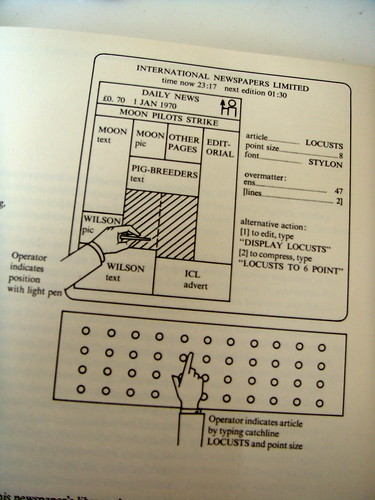
Because we're doing this newspaper stuff I paid special attention to this diagram of an Automatic Newspaper Page Composition System in the 1969 Penrose annual.

Then I noticed the fake headlines they'd inserted for the news of 1 Jan 1970. 'Moon Pilots Strike' and 'Pig-Breeders'. Moon pilot strikes and pig-breeding, that's proper news, that's the world I would have liked to have grown up in.

(Is that counter-factual or atemporality? I can't tell any more.)

July 16, 2009 | Permalink | TrackBack (0)

straight lines and the man

on roads

Went to see a fantastic couple of films at the Barbican yesterday. There was a linking theme of domes and 'organic' structures as structures for utopian and outsider communities. It got me wondering when straight lines started to equal 'the man'. (Setting aside, for a minute, all that nonsense about 'there are no straight lines in nature'.)

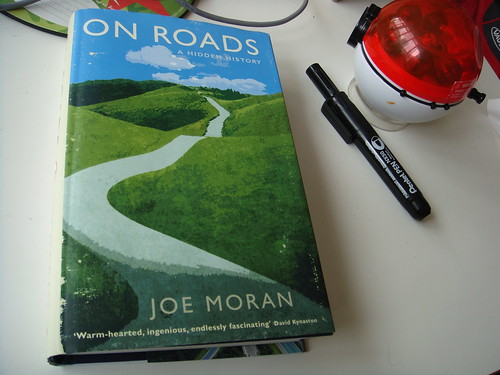
Then, last night, I was reading On Roads by Joe Moran, which is excellent, and I suspect I'm going to be quoting lots of it. (Hopefully not so much as to cause offence.)

Mr Moran quotes Roger Deakin talking about how he hates the straightness of the M1. And then goes on;

"Deakin's dislike of the motorway's undeflecting line forms part of an enduring strain in English cultural criticism. Ever since enclosure commissioners realigned the old parish roads in the eighteenth and nineteenth centuries, running them along the new land boundaries, straight roads have been a symbol of political coercion. 'Improvement makes straight roads,' wrote William Blake in The Marriage of Heaven and Hell, 'but the crooked roads without improvement are roads of genius.'...

...In the early years of the motor car, the poet and pioneering eco-critic Edward Thomas continued this war against the straight road, arguing that if we 'make roads outright and rapidly, for a definite purpose, they may perish as rapidly...and their ancient predecessors live on to smile at their ambition'. One of the first militant pedestrians, Thomas resented the bullying way in which the motor car was monopolising the highway and ironing out its creases, turning 'the road that sways with airy motion and bird-like curves' into a 'road cut by a skimping tailor'.

So far, very splendidly put but not entirely surprising. You'd expect the likes of Blake and Thomas to object to straightlineism. As Mr Moran points out:

'In the long tradition of English landscape criticism, the straight road remains a recurring motif of cold-hearted modernity. It is almost the reverse of the iconography of the American road, with its classic narrative of the road trip - which is all about escaping from the rhythms of mundane existence along the dead straight, two-lane blacktop stretching out into vanishing point.'

(It's also a tradition that ignores the magic of the moment when you chance across a length of pure, straight A or B-road after hours of winding around country lanes.)

A few pages on though, and Mr Moran introduces us to someone else, reading something else into the landscape:

"The most audacious attempt to impose a retrospective pattern on our road network was made by a sixty-six-year-old Herefordshire businessman called Alfred Watkins. On 30 June 1921, he was driving along a road in Blackwardine, a small village near Leominster, when he stopped his car to look at a map. Suddenly he had a vision of a series of allignments of human-made landmarks and natural features 'like a chain of fairy lights'. Watkins had discovered Blackwardine Ley, the first known leyline. His 1925 book, The Old Straight Track, argued that prehistoric trackways were built straight, using objects such as standing stones, tree clumps and hillside mounds as sighting points...He was a dedicated preservationist, deep patriot and anti-modern who had already published a broadside against decimalisation in 1919 titled Must We Trade in Tenths? He was as keen as any medieval historian to deny the Romans credit for inaugurating our road system. His book inspired an amateur army of leyline hunters and 'straight track clubs', sharing theories and arguing over what constituted a straight line."

I love that. I love that both the gentle curves of old English roads and the perfectly straight lines of surveyors-cum-soothsayers can be interpreted as signs of some deeper, ancient wisdom. (Especially when both ideas are further muddled by wooly-headed NewAgeists.) Maybe soon someone will discover an even more ancient curvy, knobbly pattern beneath the leylines - and so on, recurring.

Maybe that's one of the joys of the British landscape, it's so completely distant from it's 'climax vegetation', and so sat on by centuries of cultural stuff that you can look at it and find evidence for anything you want.

It doesn't help me though, to determine, conclusively, if straight lines = the man.

Anyway.

July 15, 2009 | Permalink | TrackBack (0)

« Previous | Next »