Russell Davies

As disappointed as you are
About | Feed | Archive | Findings | This blog by email

work avoidance II

Car

I was at a conference the other day, and we were talking about consumer research and pre-testing. And someone trotted out that old thing Henry Ford said: "If I'd have asked my customers what they'd wanted, they'd have asked for a faster horse".

I'd normally agree with that sentiment, but it occurred to me that, based on what we know now about the internal combustion engine, a faster horse might have been a better answer.

March 29, 2007 in fmsg | Permalink | Comments (2) | TrackBack (0)

work avoidance

Aagh

I noticed something about myself today (Hurrah, you think, how fascinating). Tomorrow morning I've got to hand in my copy for next week's Campaign and I've got nothing. No words. No clue. Thing is, I've got quite a good idea for it. I know what I want to write about. It's quite interesting and there are things to be said. But I just can't start.

It doesn't normally work this way.

Normally I have no real clue what I'm going to write about, but something churns away at the back of my head all week and at some stage a sentence or phrase pops out. So I write that down. Then plaster stuff to the front and back of it until it gets to 440 words. Then I look at what I've written, try and work out what it's about and tweak, nudge and massage it until it actually is about that. Then I send it off.*

Can't do that this week. I've started with a strategy. I'm screwed.


*And please don't tell me that's how it reads, I know.

March 29, 2007 in diary | Permalink | Comments (2) | TrackBack (0)

schtick 2.0

Blahblah

If you're not doing anything tomorrow there's an exciting opportunity to see three eccentrically coiffed  tallish people talk about brands at the Warc Creativity In Advertising conference - me, John Shaw and John Grant. I'll be doing a version of schtick 2.0 but I bet John and John will be good and there's other interesting people like Tess Alps and Matt Smith.  Details here.

March 28, 2007 in events | Permalink | Comments (2) | TrackBack (0)

kiwi spam

Serious

A correspondent in New Zealand has a question for us all. Anyone got any thoughts?

"Down here in New Zealand the local city councillors of Auckland are proposing a total ban on all outdoor media city-wide in a belief that such commercial messages are screwing up the city, destroying the ambience of our architecture, and generally can be blamed for all things bad that has stopped the city from becoming "Paris in the Pacific" yadda yadda etc.

Obviously both advertisers and outdoor companies are doing their nut and as you can imagine kittens are being born all over town, and to be honest so much has been said on the subject to date it doesn't need further thinking about, but one journo down here has picked up on a recent speech by Stephan Loerke, MD of the World Federation of Advertisers (who?) who opened an address in Auckland recently by saying "Perhaps, industry's greatest challenge today is an anti-brand, anti-corporate, anti-advertising sentiment that is pervading society...........  It is time for us to face the truth that on many levels, and in increasingly influential circles, attacking advertising has become fashionable not just among consumer and pressure groups but in society as a whole"

The local journalist is writing an article that "attacking advertising has become fashionable and that restricting advertising has become a populist, vote-winning policy measure with no heed taken for the unintended consequence of such restrictions"

I have been asked to respond to the journo by Monday next week.

My open question to those such as myself who read your fabulous blog is this:

"Does society as a whole actually hate advertising as proposed by Loerke in his recent address?

My thoughts:

Is advertising welcomed as a form of entertainment? (Superbowl break being the most extreme example)

40% of those with Tivo who technologically could avoid ads still choose not to (recent Nielsen study)

Is the question instead that people don't hate "advertising" but hate irrelevance?"

March 28, 2007 in urban spam | Permalink | Comments (21) | TrackBack (0)

fractiousness live

Bekind

There are many reasons why I'm exactly the wrong person to be writing this blog. I can't spell or punctuate. I'm starting to be horribly exhausted by the sight of the word 'brand'. But perhaps, most damningly, I absolutely cannot bear any form of disagreement. I'm massively conflict-averse. So I've not read any of the debate about whether blogging's killing planning. And I'm not going to the IPA to see the fractiousness live.

But that's a personal failing, you may be less squeamish, and Rob asked me to post the details. So here they are. Hope it's good.

March 27, 2007 in events | Permalink | Comments (4) | TrackBack (0)

bright green

Idea

So, I'm sitting at home trying to work out what I'm going to say at the D&AD thing tomorrow. And I'm not getting very far. So I thought I'd see if I can work it out as a blog post instead.

I think most of the evening will be a panel/debatey thing, which doesn't require much preparation of stuff, but does need me to work out what I think about things, which I always find hard in the absence of conversation, so this is maybe part of that conversation.

The actual presentation bit is supposed to be about 5 minutes and this is the brief:

Brief introduction – who/what/where

What is the biggest hurdle your country has to overcome to turn the tide of climate change

Show 3 examples, from within your country/region, of creative branding that demonstrates good  practice (preferably work by other agencies/companies rather than your own)

What lessons can others take from your country/region

I'll be very surprised if anyone sticks to 5 minutes.

Introduction

Here's what I've been thinking following the conversation starter here.

At the moment we're caught between the need to do something serious and drastic about climate change and the realities of what a consumer capitalist system will allow. ie people will only vote for, and pay for, so much right now. It's possible that it's not enough (it's entirely likely in fact) but until the threats are even more palpable we have to operate within the limits of popular support.

Therefore I think we have to accept that people will continue to want to 'consume'. They still have a need for novelty, they still have a need for new experiences (which often involves travel), and they (they? - who am I kidding? I mean 'we') still have a need to display something of who we are through the things that we own. Meaning status, style, tribe, etc. The trick now is to bend that urge to consume into behaviours with minimal impact on the planet.

So, you start to ask questions like -

Can you deliver novelty without delivering more stuff?

Can you deliver new experiences of the world without burning tons of fuel?

Can we transform ideas of status so they're about reduced impact on the world, sensible consumption, and thoughtfulness?

And, can we create a minimal-impact version of consumer society that's attractive enough that the developing world will want to adopt it as a vision for their future (assuming they don't come up with something better)?

I guess a truncated version of that might serve as introduction.

Biggest hurdle we have to overcome - complexity

Apart from all the obvious ones; greed, apathy, entropy, I think the biggest issue we have to face is complexity. There are very few known knowns and lots of unknown unkowns. Every positive step someone takes is condemned by someone else as either hysterical panic, green-washing or insufficient incrementalism.  It's very hard for anyone to 'win' because there seem to be very few completely unalloyed actions that anyone can take.

We Are What We Do's Anya Hindmarch bag project seemed like a good thing to me. It's fun and maybe a little superficial but that's exactly the kind of thing that might infect the popular imagination and create different behaviour, and certainly debate about the wasteful stupidity of plastic bags. Yet, it's easy to condemn the project too - the bags aren't organic cotton etc, so they're not that green, and that seems like an own goal. But then I bet they couldn't have done them for £5 if they'd made them organic. And the low price point seems part of the point to me. Equally, some people have said that all this fashion bag stuff is nonsense and the government should just ban plastic bags (and personally I'd go along with that) but is that politically realistic? Maybe it is now.

See what I mean about complexity?

I think we should applaud initiatives like M&S's Plan A partly because they're doing it in the face of all this doubt about exactly what the right thing is. They must have known that they'd be slagged off by many for greenwashing hysteria and by others for not going far enough yet they decided to do it anyway. And that's probably the thing that give me hope. Brands like M&S are reasonably in tune with mainstream opinion in this country and if they're doing something then I suspect the country is ready to do this and more.
Plana

Show three examples of good practice in creative branding from your region

I'm struggling with this bit, because I don't think it's really about branding, it's about action.  The important bit about the Plan A stuff is that they're doing it, not how they brand it.

Things I'm talking about covering are:

Walkit, because I like the way it uses information to motivate you to do something positive. And that seems to me the big contribution can make. Branding is about adding information, ideas and emotions to generic services and things, to make them more desirable. If it can be done with walking, what other positive things might it be done to?

Innocent's Carbon Footprint project because I like it's relative modesty and realistic, practical approach (as opposed to the Virgin thing John cites in the comments) (and I know everyone always talks about Innocent at conferences, but this seems to be an appropriate time to do it).
Greenpeace

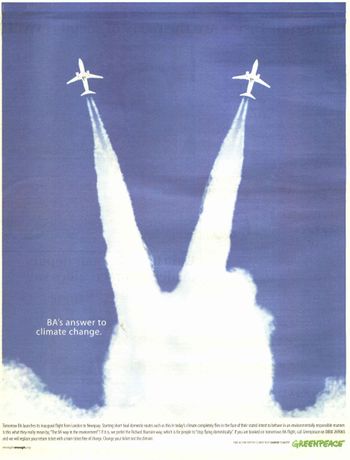
And this Greenpeace ad (thanks Rory).  I'm including this because it points to something interesting. I think we're only a few years away from casual air travel being as socially acceptable as wearing fur. (Which I think is a line stolen from John Grant.) This is a little like some of the early anti-fur work and it feels like it's starting to have a similar effect. Every social moment needs a leading edge and a trailing edge and this ad seems them working in tandem, Greenpeace at the lead, Virgin being the corporate follower. Or something.

I've got more to add, but I have to go to a meeting. At least I'm going on my bike....

...I'm back. Thanks Matt (see comments), perfect stuff. And just the reminder I needed to try and shoe-horn some extra things in:

I think I might open with this quote: "contemporary civil society can be led anywhere that looks attractive,         glamorous and seductive". It's from the Viridian Green manifesto and has been stuck on my wall since it first showed up on the Viridian Green mailing list.  And I think that's where our little branding world might be able to do our part for climate change. In making green-ness seem sexy, cool and interesting. Not worthy or necessary.

I want to fit this in there somewhere:
Makers_bill_of_rights

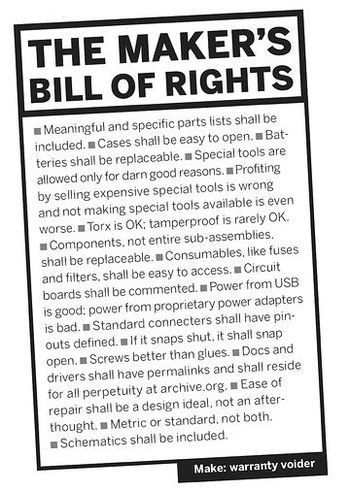
Because I think one of the ways that people are rethinking their relationship with brands, products and services is to do with what ownership really means. (Partly prompted by DRM concerns.) And I bet we'd be pushing against an open door if we tried to make long-life and repairability high status values for a product (to Ben's Porsche point - see comments). And the ability to fix stuff and tinker will clearly be high-status things in a post-conspicuous consumption Maslow heirachy. (Sorry, lapsed into bollocks there for a second.)

And, I'd like to talk about the responsibility of 'our industry' (whatever that is) to try and play its part in a chain of influence about how businesses conduct themselves. Advertising agencies are some of those most environmentally profligate organisations in the world (for their size), I sometimes think they're put on earth solely to have large quantities of polyboard driven around in the taxis. So we should examine our own consciences in these matters. Because if we don't do it, we'll be made to. As more and more clients adopt environmental pledges how long before carbon-neutrality becomes a pitch requirement? And how many agencies are ready to meet that. (A good start might be to read Marcus's piece on printing.)

And, given that I'm only supposed to be doing 5 minutes maybe I should stop there.

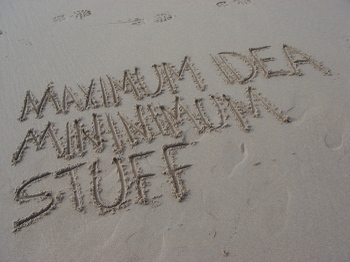
Matt's comments have really made me want to dive into a conversation about 'maximum idea, minimum stuff'. Or rather the notion that an idea can substitute for stuff, and that people's desire to consume could be satisfied without the creation of new stuff. I don't know what that looks like yet, but I suspect  getting there will involve some consilient thinking -  we'll need to collide  brains that currently live in boxes labeled Industrial Design, UI, Software, Brand and probably Some Other Things. I don't know.

I really am rambling now. Better start trying to cram all that into 5 powerpoint slides.


March 27, 2007 in unproduct | Permalink | Comments (15) | TrackBack (1)

more blogging blah

Campaignmarch23rd

Here's last week's Campaign thing. More blah blah blah about blogging. I need to find something else to write about really.

Blogs matter. They're easy to deride but they matter. Not because of the the technology or what people write or because millions of people are doing it, but because they show us what a world full of personally created media will be like. The blogosphere is dragging eyeballs and influence away from the mainstream so advertisers are going to have to learn how to deal with 'amateur media'. And it's not the same.

First thing to understand; if you want to get the most from a relationship with the blogosphere you've got to understand it. Obviously. This means reading blogs, and, ideally, writing one. You've grown up with magazines and telly, you know intuitively how they work. But you need a crash-course in blog grammar and writing one is the best way to get it. (If you're not reading lots of blogs, and you want to start, get yourself some kind of RSS reader, it's a lot easier, Google and Wikipedia will tell you what that means.) If you're not reading blogs but you're spending some money there, you might be wiser to invest your money with those nice men who email you about opportunities in Nigeria.

Second thing to recognise; there's not a lot of money in blogging. Very, very few people are getting rich out of it, and those that are tend to be in tiny niches. You might see this as opportunity (pick up lots of blog-readers for not much money) but it doesn't work like that, because most bloggers aren't doing it for money, they're doing it for fun, companionship, attention or any of thousands of reasons that people write or talk. So your regular space-for-cash transaction may not appeal to them. This can lead to a huge disparity between the value that you and your target blogger put on their content. You've probably looked at the audience, done  the maths and come up with a reasonable, sensible offer; probably a few hundred quid. They look at the effort, love and time they put in and will most likely see your offer as insultingly small. It's not that either of you is wrong, it's just that you're valuing their media in different ways.

And this is something we're all going to have to get used to, as more and more eyeballs are seduced by amateur media, in whatever form. Maybe you should start a new department - Customer Media Relationship Management - to develop and sustain all these new relationships, for though they might want less cash than the average magazine, they'll demand far more care and attention.

March 26, 2007 in campaign | Permalink | Comments (5) | TrackBack (1)

a little help

Plane

Can someone help me out? I'm trying to find an ad that I thought I saw the other week. It was Virgin having a go at British Airways for flying to Newquay. (Though I may have misremembered.) I've googled and technorati'd and I can't find it. I wanted to talk about it at the D&AD thing on Wednesday. Any help gratefully received. Thanks.

March 25, 2007 in ads | Permalink | Comments (3)

interesting update and expectation management

Interesting2007

As of the time of typing we've sold 144 tickets for Interesting 2007. The first 50 get the nice red badges above for being so supportive. The next lot will get blue ones for being early too. I'm really delighted about the response, both the ticket sales and the offers of help and support I'm getting, you're a splendid lot.

But I'm also conscious that you've booked all these tickets without the least idea what's going to be happening at the event and that's worrying me slightly. Because, although it's been billed in some quarters as TED-lite, there's not going to be any former vice-presidents, billionaires or Noble Prize winners speaking. I'm talking to some really interesting people about speaking, but they're not really famous interesting people. Just so you know. I'm going to try and get the speaker/performer list up in the next week or so and if you want to wait until then to make your mind up until then, that seems perfectly reasonable. (And I believe eventbrite are very efficient at refunds if you were banking on a vice-president.)

The other thing that I'm excited by is the idea of 'rich reporting' the whole thing.  I think we've got people lined up to film it, record it and photograph it, and hopefully wifi will be sorted out soon so there'll be some blogging, twittering and IMing. And I'm hoping to find people who might report/record in other ways too. In my head I can imagine a trickle of content leading up to June 16th, then a steadily thickening stream on the day and beyond, words, pictures, audio, video, everything. Has anyone seen this done in an interesting way before? Anyone got good ideas on how to do it? I'm not really sure what I'm asking here but maybe someone has.

March 25, 2007 in interesting2007 | Permalink | Comments (4)

to the end

Cametotheend

I've just finished reading this. Very good. Not as brilliant as I thought it was going to be at the start but definitely worth reading. But I came very close to not blogging about it because someone at Penguin emailed me and told me about it. (Though, coincidentally I'd already bought a copy.) I like Penguin. And I can't fault them for writing to me about it, it's set in an advertising agency, it's likely to be of interest to me.

But I could feel that email causing the beginnings of that knee-jerk journalistic cynicism that I've always hated. (What do these people want? Why are they emailing me?) I never really understood that mindset, but now that I'm getting a small fraction of the PR bombardment that they get it makes much more sense. Someone emailed me the other day to ask if I'd review their chocolate easter egg on eggbaconchipsandbeans, I can see why they did wrote but, well, you know, I'm not going to do that.

On the other hand, those same cynical news organisations are sometimes completely credulous about the dumbest PR scam. Like this whole thing about McDonald's trying to get the OED definition of McJob changed. Obviously, McDonald's do not care about dictionary definitions. Obviously. But earlier this week I listened to a McDonald's executive talk for 5 minutes on the Today programme about how great it is to work there. Very clever.

This post is perfect illustration of my point about the difference between the way I blog and the way I feel I should write for Campaign. I have no point here. And no real ending. But, hey, you know.

March 23, 2007 in book | Permalink | Comments (14)

« Previous | Next »