
Trees reflected in your tea. Here.
Trees reflected in your tea. Here.
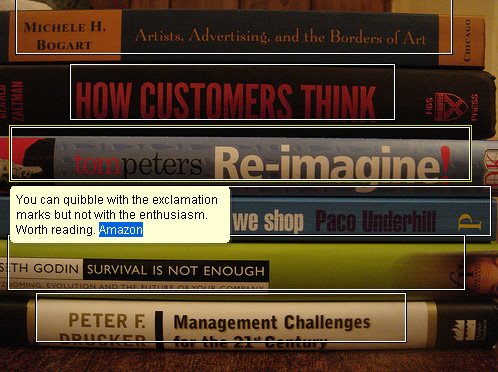
I've been accused of inventing a new form of advertising. God, you wouldn't want that on your tombstone would you? (Even if the accuser seems to think it's a good thing.)
What everyone seems to have missed is that the reason those books are up there is that I'm offering to lend them to people, for nothing. The Amazon link is really there as an extra service - more info etc. (Though obviously if someone wants to buy the book then I'm happy to make a little money through my affiliate number.) I guess this is a 'if you have a hammer everything looks like a nail' problem. If you're an advertising person, everything looks like an opportunity to do advertising. To me it doesn't look like advertising, it looks like an extra link to useful info. But even just typing that just makes me feel like some kind of evil spammer.
Jeez, I'll happily take everything down if it's going to result in the growth of some sort of nasty flickrspam. I hope that doesn't happen, and I hope it's not my fault.

I hope you've all read Everything Bad Is Good For You, but if you haven't here's a splendid summary of many of the ideas from Mr Steven Berlin Johnson. From Pop!tech 2005.


Patrick has been true to his word and posted a copy of Stephen King's 1974 JWT Planning Guide at the Staufenberger Repository, along with a 1972 Jeremy Bullmore speech to Kraft. Reading them just reminds me how all us planning bloggers (and planners generally) are simply re-learning the lessons that the greats like Mr King learned all those years ago. if I'd ever had any planning training this is the planning training I'd like to have had.
I hope no-one at JWT objects to these being up there, I'm sure they won't, and it's good for them and everyone that this stuff is available to all, demonstrating their place in the history of planning. And anyway it's too late now. They're out, probably won't be long before you can get them as BitTorrent files.
Right, now who's got a copy of Jim's Planning Toolkit?
Tip o' the hat to Spell With Flickr
Campaign asked me to do one of those group interview/opinion things a while ago. You know, they ask a few industry big-heads the same questions and make a piece out of it.
Obviously they had to edit it down a bit so I thought I might as well stick my answers up here for you all to mock.
The Future of Media - Questions
Can content replace the 30-second TV ad? (By content we mean ad funded programming, brand-owned TV channels, product placement etc)
That’s a bit like asking whether chocolate can replace ice-cream. They have some things in common, but that’s not really the point.
We’re entering a world where people will only watch what they want to watch. So they may well watch short bursts of communication (maybe 30 seconds) or ad funded programming or whatever, but only if it’s better, more interesting or more compelling than all their non-ad-funded options.
And it’ll probably help if your brand has a history of providing exactly that kind of thing, and experience in doing it. So we’re excited by this future.
Will people still be reading newspapers in 20 years? (How must newspapers adapt to survive?)
Yes, in that people will still be reading news printed on paper. Paper is incredibly convenient and humans are evolutionarily adapted to be interested in news. So news plus paper makes sense.
Whether the existing newspaper brands will survive is a different question. I think they have to realize that innovation means more than ‘getting slightly smaller’ and that they need to move from being newspaper brands to being news brands. People like The Guardian are getting that. I’m not sure about many of the others.
Will we ever watch ads on our mobile phones? (If not, what will we watch? How will advertisers use mobiles to target consumers?)
People are already watching ads on mobile phones. We’re offering ads on mobile phones. Isn’t everyone?
But the idea of targeting consumers with mobiles is wrong-headed. We make content available to consumers via mobiles – if they find our brand and communications compelling enough then they’ll seek them out and ideally, pass them on. We can’t target consumers any more, they have to target us. And in those circumstances the most relevant, most interesting, most useful communications win. Not the ones with the biggest ‘targeting budget’.
What effect will time-shift TV have on advertising? (Will changes in technology mean ads become more targeted? Will consumers search out ads/info via their TVs like they do on the internet?)
Time-shift TV will kill bad advertising. Just like it’ll kill bad programmes.
People will only want to watch what they want to watch.
And they’ll only seek out what they want to find. So if your ads are funnier, cleverer, more moving, more involving, or more useful than all their other options they’ll watch them. If not, you’re toast. The channel’s not important, the story-telling, the connection and the content is important.
Who will be the dominant media owners in 20 years?
Regular people will be the dominant media owners in 20 years time. They’ll construct their media viewing from thousands of different sources.
Some of them will be existing media brands – the BBC, Google, Rocketboom, Univision.
Some of them will be emerging media brands - already, today, 30 or 40 of the most visited 100 blogs in the world are Chinese.
Some will be brands who we don’t think of as media brands right now - I suspect Nike will be one.
But most of the time people will be constructing their own media channels from stuff sent to them by other regular people. The idea of ‘dominant media brands’ is going away.
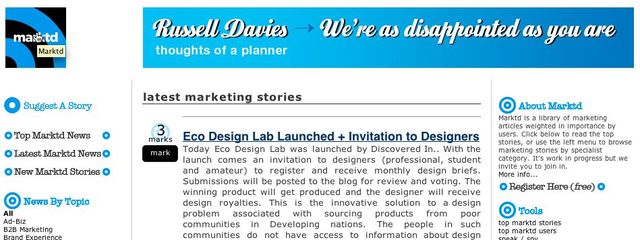
Marktd is a great idea. It's like Digg for marketing stories. Piers built it to fill in for PSFK while he goes on holiday. Very smart. He offered a few people a chance to stick some banners up there and I have no clue how to do that so Stefan very kindly built me a couple, overnight. What a nice man. You can see them occasionally on the site.
I've agonised for several seconds about whether anything recent on here is worth submitting and then decided not to. I'm too English.
As promised earlier, podcast number four. More old records, a behind the scenes look at the spawning of a great piece of creative and some top comedy (from someone else, not me.)
Thanks for the Odeo questions, I'll answer them next time.

For some reason, I'm in an neophile mood at the moment. I'm wanting to try new things.
So here's one. I've got a podcast waiting in the wings, I just need to think mix it properly, but I'm worrying about the next one because I'm running out of amusing vinyl to play. So I was thinking of soliciting your questions so I don't have to come up with a topic on my own. And I noticed that Odeo are doing a splendid thing which is a bit like instant voicemail. If you click on the button above, you'll get taken to a page where (assuming you've got a mic on your computer) you can record a message that'll get emailed to me. (I can already imagine the abuse you're thinking of hurling down that thing.)
If you fancy it, click away and send some questions, and I'll try and integrate the audio, and some answers, into the next podcast.
I was complaining to someone the other day, about how the version of my Honda paper in the APG book was so truncated because of the way it needed to be edited, and the lack of colour availability. You lose some of the jokes and most of the pictures. And then it occured to me that I could just put it up here. So here it is. (It's a 10MB pdf, sorry about that, lots of pictures.)
And if you liked this, you can read the one that Stu wrote two years later by going here, clicking on download and scrolling down to 'Honda APG Paper Sept 2005'. (Where I've just realised my thing has been available for download for ages. Ah well.)