Russell Davies

As disappointed as you are
About | Feed | Archive | Findings | This blog by email

it takes a model village

voyage

aloft

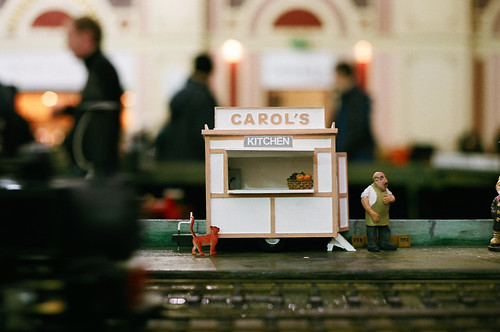
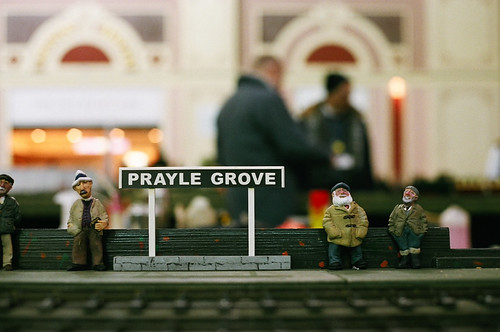
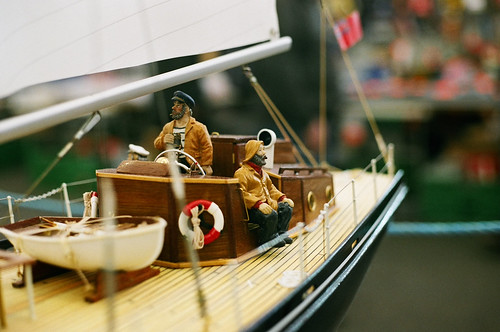
We went to the Model Engineering Show at Alexandra Palace at the weekend. I found myself drawn to the little figures that sometimes populate the models. They're often the least regarded bit of the model, pre-bought, not scratch built, not always exactly to scale, often not at the same fidelity as the engineering they're there to decorate. A bit like 3D render ghosts.

at sea

We were talking at the show, about the way modeling acts as a way of preserving an engineering culture - capturing in minature particular conjunctions of techniques and materials. And about how there'd probably be no equivalent for the age of network technologies. The internet won't get modeled in miniature.  

carol's

Then, yesterday there was a programme on BBC4 about model railways. Apart from some gratingly emphatic gender politics (model railways are for DADS and SONS) there was a little more analysis than the usual nostalgia-fest and someone pointed out that model railways only captured the physical stuff, didn't model the social relationships. And I thought Hornby Network Modelling!  

prayle grove

I don't know what that means. Obviously. But I'd like to work it out. Like Lyddle End 2050, but for networks. Or Network Realism, but with glue. Or something.

Anyway.

January 25, 2013 | Permalink | TrackBack (0)

ten words

Book 51. Don't Think of an Elephant by George Lakoff. Probably no startling revelations in here for any of you lot.

I liked the idea of a ten-word philosophy though, such as this summary of Republicanism:

"Strong Defense, Free Markets, Lower Taxes, Smaller Government, Family Values."

January 24, 2013 | Permalink | TrackBack (0)

more criticism

I've already covered books 49 and 50 here. Ha! Day off.

January 23, 2013 | Permalink | TrackBack (0)

all you needed

Kindle Book 48. A Moveable Feast by Ernest Hemmingway. One highlight, my favourite sentence ever:

"The blue-backed notebooks, the two pencils and the pencil sharpener (a pocket knife was too wasteful), the marble-topped tables, the smell of café crèmes, the smell of early morning sweeping out and mopping and luck were all you needed."

January 22, 2013 | Permalink | TrackBack (0)

assuming that failure is documented

Kindle Book 47. A bit of a departure this, it's Debates In The Digital Humanities by Matthew Gold.

To be honest I'm not really sure what I made of this. I didn't finish it but i did read a lot. There's a lot to read. There were lots of moments where I felt the thrill of recognition across a disciplinary/cultural boundary. Like looking at an alien species and noticing that they also smile when they're happy. That made me feel like there were interesting things to pursue. But, lots of the time it just seemed alien. Maybe if i were 20 years younger this would be a world to explore.

Fragments follow:

"Whatever else it might be, then, the digital humanities today is about a scholarship (and a pedagogy) that is publicly visible in ways to which we are generally unaccustomed, scholarship and pedagogy that are bound up with infrastructure in ways that are deeper and more explicit than we are generally accustomed to, a scholarship and pedagogy that are collaborative and depend on networks of people and that live an active, 24-7 life online. Isn’t that something you want in your English department?"

"After much tension between media makers and media scholars, an increasing number of programs are bringing the two modes together in a rigorously theorized praxis, recognizing that the boundaries between the critical and the creative are arbitrary. In fact, the best scholarship is always creative, and the best production is always critically aware. The digital humanities seems another space within the academy where the divide between making and interpreting might be bridged in productive ways."

"Whereas the traditional humanities are text based and nontechnical and value solitary, specialized work resulting in a book, the digital humanities are collaborative and technical, value design, and are built upon shared information resources (“Digital Scholarship in the University Tenure and Promotion Process”)."

"Ayers and Thomas initially included the word “experiment”—Two American Communities on the Eve of the Civil War: An Experiment in Form and Analysis (Ayers and Thomas)—in the title of their article for The American Historical Review, which tests how historians can “create or present new forms of scholarship and narrative” (Thomas, 415). However, reviewers rejected the article’s use of hypertext, since it “frustrated readers’ expectations for a scholarly article laid out in a certain way (Ayers, “The Academic Culture and the IT Culture”). When Ayers and Thomas’s article was finally published in the journal, it adopted a “much-simplified form” and took a new title that deemphasized its experimental approach"

"Failure is accepted as a useful result in the digital humanities, since it indicates that the experiment was likely high risk and means that we collectively learn from failure rather than reproducing it (assuming that the failure is documented)."

"“If an electronic scholarly project can’t fail and doesn’t produce new ignorance, then it isn’t worth a damn” (“Documenting the Reinvention of Text”)."

"Sometimes new tools are built to answer preexisting questions. Sometimes, as in the case of Hauksbee’s electrical machine, new questions and answers are the byproduct of the creation of new tools."



January 21, 2013 | Permalink | TrackBack (0)

anna in common

I'm sure it'll surprise you all to learn that I'm not really that much into high fashion. But, I have to say, these three films trailed below are probably the best documentaries I've ever watched.


The trailers concentrate on the fashion stuff but that's not really they're about. They're about people. And epecially, people working and people at work. And they're brilliant.


It's not actually all fast and cutty like that. It's actually rather intimate. It might well make you cry. And it'll point out how massively powerful you can be if you can just look at someone in a meeting without saying something for longer than they can stand to look back at you.


Oh, and there are some moments in this. Moments of tenderness and tension. Fantastic.

January 20, 2013 | Permalink | TrackBack (0)

views

17:05

One of the good things about the new job.

January 19, 2013 | Permalink | TrackBack (0)

the influencing machine

Kindle Book 46. The Influencing Machine by Mike Jay.

I bumped into this via William Gibson's twitter stream. Not sure how I'd have found it otherwise. And it is a magnificent book so I'm very grateful. It is, I suppose, a history, the history of a Bedlam inmate who claimed to see elaborate conspiracies everywhere, caused by a hideous technological invention, the Air Loom. The interesting twist is that, it would seem, he had actually seen elaborate conspiracies everywhere. It's a brilliant read. Read it.

I'm not sure my highlights are useful, they're just fragments, but here they are, they might give you a flavour.

"influencing machine’: a hallucinatory device that sends messages and controls minds. For everyone who has since had messages beamed at them through their fillings, or their TV sets, or via high-tech surveillance, MI5, Masonic lodges or UFOs, James Tilly Matthews is Patient Zero"

"He always carried a sponge, with which he would erase any chalked public signs he found incorrect either grammatically or morally"

"‘delusions of reference’"

"‘cacodemonomania’, or demonic possession"

"The Omni Imperious Palace"

January 18, 2013 | Permalink | TrackBack (0)

you have to choose

Kindle Book 45. How Soon is Now?: The Madmen and Mavericks who made Independent Music 1975-2005 by Richard King. 

Ah. This book. Brilliant. Brilliant and depressing because it was a history book full of history I lived through. That made me feel old. Lots of excellent stories behind lots of the music I love. And lots that I hated and now I know I was right.

There is also a thread of interesting thinking about the nature of independence, especially commercial independence - how useful it is, how hard it is, how rare and special. It made me want to start a record company.

"Each generation, to put it another way, rescues a new area from what its predecessors arrogantly and snobbishly dismissed as ‘the lunatic fringe.’"

"that’s what independence is, it’s about building structures outside of the mainstream, structures that can help you infiltrate the mainstream."

"From his first day at Blenheim Crescent, Dave Harper had noticed an atmosphere at Rough Trade, that of a company caught between its ideological motives and the reality of near bankruptcy." 

"‘It’s a really hard thing to do. You have to choose: you can be on some kind of really small indie, or you can be on Polydor. One of them’s going to sell you tons of records and the other one’s going to be your mate, but it’s a really, really hard line to walk, one that’s almost impossible to get right."

January 17, 2013 | Permalink | TrackBack (0)

about sameness

Kindle Book 44. Liars and Outliers: Enabling the Trust that Society Needs to Thrive by Bruce Schneier.

I'll confess, I didn't finish this. I was very overexcited at the beginning, I thought it'd have all sorts of useful answers for our work on identity, reputation and trust. It undoubtedly does. But it did seem to get a bit repetitive. Good and helpful though.

“Whatever matters to human beings, trust is the atmosphere in which it thrives.”

"Branding is yet another way to make reputation scale, similar to group membership. In many cases, we interact with organizations as groups rather than as individuals. That is, the corporate reputation of McDonald's is more important to our decision about whether or not to trust it than the individual reputation of any of the stores or the individual employees."

"Branding isn't necessarily about quality; it's about sameness. Chain restaurants don't necessarily promise the best food, they promise consistency in all of their restaurants. So when you sit down at McDonald's or a Cheesecake Factory, you know what you're going to get and how much you're going to pay for it. Their reputation reduces uncertainty."

"A final way to make reputation scale is to systemize it, so that instead of having to trust a person or company, we can trust the system. A professional police force and judiciary means that you don't have to trust individual policemen, you can trust the criminal justice system. A credit bureau means that lenders don't have to decide whether or not to trust individual borrowers, they can trust the credit rating system. A credit card relieves merchants from having to figure out whether a particular customer is able to pay later; the system does that work for them. Dunbar's number tells us there is a limit to the number of individuals we can know well enough to decide whether or not to trust; a single trust decision about a system can serve as a proxy for millions of individual trust decisions. We have a lot of experience with this kind of thing online: ratings of sellers on eBay, reviews of restaurants on sites like Yelp, reviews of contractors on sites like Angie's List, reviews of doctors, accountants, travel agencies…pretty much everything you can think of. Social networking sites systemize reputation, showing us whom we might want to trust because we have friends in common. This is an enormous development in societal pressure, one that has allowed society to scale globally. It used to be that companies could ignore the complaints of a smallish portion of their customers, because their advertising outweighed the word-of-mouth reputational harm. But on the Internet, this isn't necessarily true. A small complaint that goes viral can have an enormous effect on a company's reputation. On the other hand, while these reputational systems have been an enormous success, they have brought with them a new type of trust failure. Because potential defectors can now attack the reputational systems, they have to be secured."

January 16, 2013 | Permalink | TrackBack (0)

« Previous | Next »