Russell Davies

As disappointed as you are
About | Feed | Archive | Findings | This blog by email

"A complex system that works is invariably found to have evolved from a simple system that worked"

Kindle Book 43. Open Government: Collaboration, Transparency, and Participation in Practice by by Daniel Lathrop, Laurel Ruma. 

I read this mostly because of the Tim O'Reilly Gov 2.0 essay, which is very good. And contains all sorts of useful ideas for the work at GDS. 

"In one of the early classics of software engineering, Systemantics, John Gall wrote: “A complex system that works is invariably found to have evolved from a simple system that worked. The inverse proposition also appears to be true. A complex system designed from scratch never works and cannot be made to work. You have to start over beginning with a working simple system.”

"Designing simple systems is one of the great challenges of Government 2.0. It means the end of grand, feature-filled programs, and their replacement by minimal services extensible by others."

"Each of those pieces that make up the e-commerce platform are actually separate services. Whether it’s Sales Rank, or Listmania, or Recommendations, all of those are separate services. If you hit one of Amazon’s pages, it goes out to between 250 and 300 services to build that page. It’s not just an architectural model, it’s also organizational. Each service has a team associated with it that takes the reliability of that service and is responsible for the innovation of that service…. [W]e found that a lot of those teams were spending their time on the same kind of things. In essence, they were all spending time on managing infrastructure, and that was a byproduct of the organization that we had chosen, which was very decentralized. So…we decided to go to a shared-services platform and that became the infrastructure services platform that we now know in the outside world as AWS [Amazon Web Services]."

"Open source software projects like Linux and open systems like the Internet work not because there’s a central board of approval making sure that all the pieces fit together but because the original designers of the system laid down clear rules for cooperation and interoperability"

"Being a platform provider means government stripped down to the essentials. A platform provider builds essential infrastructure, creates core applications that demonstrate the power of the platform and inspire outside developers to push the platform even further, and enforces “rules of the road” that ensure that applications work well together."

"When Microsoft introduced Microsoft Windows, it didn’t just introduce the platform; it introduced two applications, Microsoft Word and Microsoft Excel, that showed off the ease of use that came with graphical user interfaces. When Apple introduced the iPhone, it didn’t even introduce the platform until its second year. First, it built a device with remarkable new features and a suite of applications that showed off their power."


 

January 15, 2013 | Permalink | TrackBack (0)

failure waste

Kindle book 42. Systems Thinking in the Public Sector by John Seddon. 'Failure waste' has entered the GDS vocabulary from here. It was interesting to read so much about Ohno since I spent so much of my advertising life working with Japanese car clients and heard a lot about Kaizen and related ideas. I hadn't realised how important these ideas were beyond the car business.

It's also a great book to be reading when you're dealing with a failure in service - normally, for me with a delivery company. It makes you think through what's going on, consider how it might be improved. This is a useful philosphical exercise in that it distracts you from futile fury.

"The causes of failure demand can only lie in the way the service is designed, so the next step for the systems thinker is to study the flow of work: how everything works end-to-end from the claimant’s point of view."

"As Toyota’s Ohno taught, the more work is sorted, batched, handed over and queued, the more errors creep in. And there is rework: every time a file is opened it has to be read."

(I think this is true of 'creative work' too. The more a task is batched and sorted between user, briefer and maker the more diluted and error prone it gets.)

"Turning off the causes of failure demand is one of the most powerful economic levers available to managers; it has an immediate impact on capacity."

"In this new world managers begin to appreciate the fundamental truth that strategy lies in operations: designing against demand will lead to new and better services, in short a new and better strategy."

"A system must have an aim. Without an aim, there is no system. W. Edwards Deming."

"This prompts me to mention Ohno’s thoughts about ‘best practice’. He thought it a dangerous and misleading idea. ‘Best’ implies static, something ‘good’ that should be copied. He said that whenever you hear the word ‘best’, think ‘better’, because anything can be improved. Second, everything you need to know in order to make improvements will be found in your own system. If you go looking elsewhere, you will be looking in the wrong place."

(I used to get asked to do a lot of talks about best practise. The assumption being that I could just pass on the secrets learned at the great places I'd worked. There weren't any secrets to best practise though.) 

"Instead of compliance we need innovation, and to foster innovation we need freedom. People need to feel free to act in the best interest of their stakeholders or, in Moore’s terms, to do what is best in terms of their particular circumstances. To achieve that, we have to make public-sector managers responsible. They have to be able to choose what to do, free from the obligation of compliance. The way to foster innovation is by changing the locus of control from the regime, which compels compliance, to the public-sector manager, who is the person who actually needs to change."

"Inspection of performance should be concerned with asking only one question of public-sector managers: ‘What measures are you using to help you understand and improve the work?’"

"Moreover, systems thinking is concerned with increasing capacity. It is as Deming taught: better quality leads to lower prices, a greater market share, growth and, thus, to more jobs. Those who seek cost reductions will fail, yet, paradoxically, cost reductions are a by-product of systems design."


January 14, 2013 | Permalink | TrackBack (0)

old soho

the hobbit - still there

January 13, 2013 | Permalink | TrackBack (0)

you can never go back

Tony's, Northcote Road

It's been ten years since I started Egg Bacon Chips and Beans and A Good Place For A Cup Of Tea And A Think. (Well, almost.) So I thought I'd go back and see what's happened to some of the places I found.

The adventure starts here: EBCB Revisited

January 12, 2013 | Permalink | TrackBack (0)

introducing little toaster

23:52

This has got to be next, surely:

Arsenal toast

January 11, 2013 | Permalink | TrackBack (0)

back the good night lamp

Good Night Lamp on Kickstarter from Good Night Lamp on Vimeo.

Back the Good Night Lamp on Kickstarter. Back it and prove that the Internet of Things can be more personal, special and human than a bunch of internet fridges. Back it and help some of the nicest, smartest people I know build something magic. Just back it.

January 10, 2013 | Permalink | TrackBack (0)

it's not complicated; it's just hard

Sometimes a phrase scrapes against me and I just know it's going to leave a mark forever. This is one, it's already a thing I say, pretty soon I'll think I invented it:

"It’s just change management. It’s not complicated; it’s just hard."

It's from The Atlantic's magnficient piece about the engineers and engineering behind the Obama campaign.

It reminded me of this video about Jerry Seinfeld writing a joke.

The main thing - it takes a lot more work than you might imagine.

And of this piece (and almost every piece) about Teller, of Penn and Teller.

"Sometimes magic is just someone spending more time on something than anyone else might reasonably expect”

Lots of things are like that. They're not complicated. They don't require brilliant, innovative strategies, they're just hard. They require more work and more effort and than anyone might reasonably expect. The best managers create organisational room for that to happen.

January 09, 2013 | Permalink | TrackBack (0)

motivating knights and pawns

Kindle book 41 was the first thing I read explicitly for work at GDS.

Every now and then Mike chucks a book at me. They've never been things it would occur to me to read otherwise, public policy etc is just not a world I know much about. But they've all been good so far. Normally I go and download it on the kindle anyway; so I can take notes.

This was Motivation, Agency and Public Policy: Of Knights and Knaves, Pawns and Queens by Julian Le Grand. It was a fascinating introduction to a new world of thinking. Got me thinking about why people do things. Not consumers, but public servants. People inside organisations, not outside them. Helped me look beyond the civil service cliches.

I didn't highlight a lot, partly because I was just ploughing through. I should go an reread it. A year on, I bet it'd be useful again.

"Behaviour is the product of an interaction between motivation and constraints"

"As Michael Power (1999: ch. 5) has argued, in circumstances where they are regularly audited professionals feel (rightly) that they are no longer trusted; they feel resentful at the auditing requirements imposed on them by the inspection agencies; they become less committed to the service and more inclined to pursue their self-interest."

"Efforts to understand and persuade are both a cause and a consequence of respect for others; hence, since respect for others is morally desirable, so are understanding and persuasion, and so is the mechanism that brings them about: market exchange. "

January 08, 2013 | Permalink | TrackBack (0)

the last great web problem

There were lots of good reasons to go and work for GDS - the assembled talent, the top leadership, the regular hours, the paraphenalia - and probably, above all that it represents the last great web problem.

(We know how to do lots of things on the web - publishing, retail, sharing, cats - but no-one's yet worked out how to do public services really well. I missed the big dotcom moments, I missed the BBC moment, I missed social networking, this felt like the last chance to work on a really big web poblem.)

But part of the reason was, also, some how, atmospheric. There was just something in the air about British designers solving big problems.

The Kenneth Grange exhbition had just been on at the Design Museum. We had a family cycle ride there.

a family bridle

It was inspiring, Grange's work showed you what good, ambitious British design could be like. That you could do interesting stuff at scale.

That summer was also the anniversary of the Festival of Britain. You don't need to hear more about that.

museum of 51

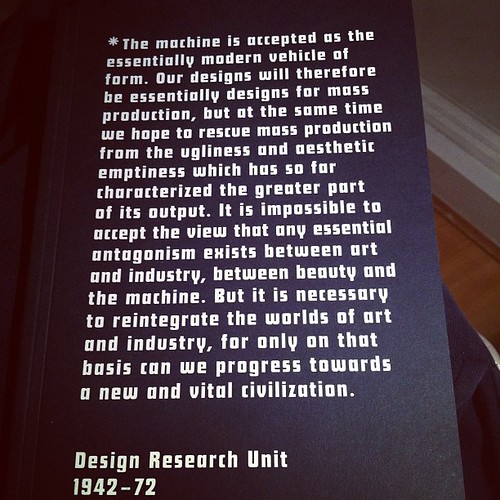
And, I came across this book. A history of the Design Research Unit:

DRU

It seemed relevant and appealing for a few reasons.

The preface says this about the DRU:

Formed in London in 1942, the Design Research Unit was the first consultancy in Britain to bring together expertise in architecture, graphics and industrial design. They pioneered a model for multidiscinplinary practice with an approach that was shaped by inter-war developments in artistic discourse and post-war trends in industry and communication; in particular the accelerated demand for corporate design...

...Initially under the charge of the writer Herbert Read and operating from offices shared with Mass Observation, the Design Research Unit was founded by advertising executive and patron of contemporary art Marcus Brumwell with designers Misha Black and Milner Gray. Following Read's essay, Art and Industry and the literature of International Constructivism the group outlined an intent to combine creative intelligence with technical research into materials and markets, seeking to bring 'artists and designers into productive relation with scientists and technologists.'

DRU was a nexus of all sorts of interesting stuff.

Herbert Read (anarchist, poet, and critic of literature and art) was closely associated with Unit One.

(Come to think of it, his description of how artist groups like Unit One might operate might be a good brief for the immediate future of RIG: "Practical things they can do in common: they can have a central office, an information bureau where the enquirer can find out about the nature of the works done by members of the group, their whereabouts and prices...They can hold joint exhibitions and share expenses connected with such exhibitions.")

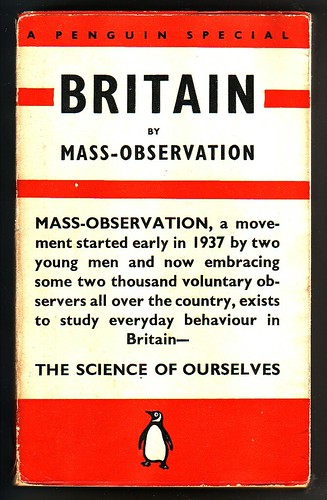
mass-observation

They shared offices with Mass Observation and a connection via the sponsorship of Marcus Brumwell and the Advertising Services Guild ("a group of medium-scale companies that counteracted a diminishing wartime market by pooling contacts and skills")

Richard and Su Rogers were briefly part of DRU (Su Rogers was Brumwell's daugther and they designed a lovely extension for their Marylebone offices. It looked like this:

17:49

It looks like this now, less good:

10:02

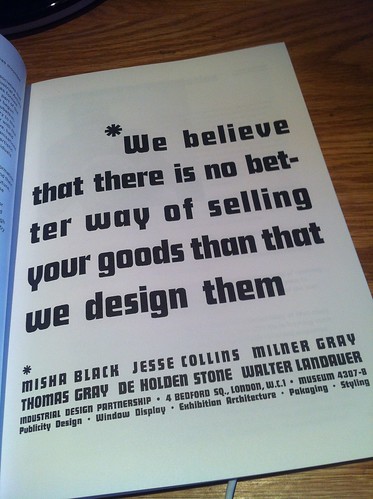
They anticipated all sorts of contemporary design/marketing chat:

13:02

And, of course, the DRU designers made much of the world I grew up in, and made it better: Watneys pubs, ICI, City of Westminster street signs, the British Rail identity.  

(And, personally, I'm getting fascinated by Brumwell, an adguy at the centre of so much interesting thinking, to be so connected to, and to recognise the value of so much art, design and architecture, and to have worked in advertising when it was more about useful explanation than empty branding. I'm going to look into him more.)

Anyway. To get back to my point. The GDS opportunity came along when all this stuff was in the air; DRU, the Festival of Britain, Kenneth Grange, Mass Observation. And I think they're useful and valid inspiration. I know it's easy to get trapped in nostalgia for those times and let's not forget that BR were terrible, despite having good corporate ID but, personally, I find all that more inspiring than the usual West Coast shininess. They seized a particular moment - post-war reconstruction - and did great things in new ways.

If we can do a fraction of that I'd be very happy.

January 07, 2013 | Permalink | TrackBack (0)

see what comes along

Kindle book 40 was Angelmaker by Nick Harkaway. Another splendid read.

On the stricture of tea:

"At the workbench, tea in hand (the approved commencement of a difficult task, the stricture of patience to be borne strongly in mind, lest one be hasty and make an irretrievable error early in the proceedings) he contemplates the fragments before him."

On not watching:

"Watching is a mug’s game. You watch for something, you think you know what it will look like. If it doesn’t look like that, it can walk right past you. The human brain, son, is a miracle of rare device, but it dreams and fabulates and it can be induced to deceive the eye. Remember the Monte? Yes? Well, this is like that. You watch too hard for one thing, you miss the other. So when you’re lookout, Joe, don’t watch for coppers. Just wait and see who comes along. You’ll know trouble when it turns up. That’s science, that is."


January 06, 2013 | Permalink | TrackBack (0)

« Previous | Next »