Russell Davies

As disappointed as you are
About | Feed | Archive | Findings | This blog by email

such tidy nonsense

Kindle book 39. Thinking The Twentieth Century by Tony Judt, Timothy Snyder.

Lots of this went over my head. I skipped quite a bit. But the bits I could follow were extraordinarily good. I wish I'd read stuff like this when I was actually studying history. Maybe I'd have got more out of it.

"the paradox of distributed responsibility: bureaucracy dilutes and obscures individual moral responsibility, rendering it invisible and thus producing Eichmann and, with Eichmann, Auschwitz."

"Since neither present nor future information—whether about economics or anything else—is ever vouchsafed us in perfect form, planning is inherently delusory, and the more all-embracing the plan, the more delusory its claims (much the same can be, but rarely is, said of the notion of perfect or efficient markets)"

"What really mattered to intellectuals was a milieu: people whom you knew—or people who were like the people you knew—and the things that happened to them"

"It is actually much harder to write well about someone you admire: dismissing Althusser, ridiculing Martin Amis, diminishing Lucien Goldmann—child’s work. But while it is easy enough to assert that Camus was a great writer, Kołakowski a brilliant philosopher, Primo Levi our greatest Holocaust memoirist and so on, if you wish to explain precisely why these men matter so much, and what influence they have exerted, then you have to think a little harder."

"If you asked my colleagues: what is the purpose of history, or what is the nature of history, or what is history about, you would get a pretty blank stare. The difference between good historians and bad historians is that the good ones can manage without an answer to such questions, and the bad ones cannot"

"It seems that what history has going for it, and one of the reasons that it survives, even as literary criticism falls into crisis and political science becomes unintelligible, is precisely that its readers agree that it should be well written"

"That not only should we write well because that means that people buy our books and not only should we write well because that is what history is, but also because there aren’t that many crafts anymore that have a responsibility to the language. Whatever sort of responsible craftsmanship remains, we’re right in the middle of it"

"The job of the historian is to take such tidy nonsense and make a mess of it."

"You and I are not the people who put the furniture in the room—we are just the folks who label it. Our job is to say to someone: this is a large couch with a wooden frame—it is not a plastic table. If you think that it’s a plastic table, not only will you be making a category error, and not only will you hurt yourself every time you bump into it, you will use it in the wrong ways. You will live badly in this room, but you don’t have to live quite this badly in this room. That is to say, I profoundly believe that the historian is not here to rewrite the past. When we re-label the past, we do it not because we have a new idea of how to think about the category “furniture”; we do it because we think we have come to an improved appreciation of what kind of furniture we are dealing with. A piece of furniture marked “large oak table” may not always have been labeled thus. There must have been times when it seemed to people to be something else: the oak, for example, may have been so obviously part of it because everything was made of oak that no one would speak of it. But right now, the oak counts more because—e. g.—it’s an unusual material. So what we are dealing with is a large oak table, and it’s our job to bring out the emphasis."

"There are lots and lots of paths, real and potential, marked and unmarked, through this forest. The past is full of stuff. But if you don’t have a path through it, you stare at the ground, you search for footing, you can’t appreciate the trees"

"Intellectual activity is a little bit like seduction. If you go straight for your goal, you almost certainly won’t succeed. If you want to be someone who contributes to world historical debates, you almost certainly won’t succeed if you start off by contributing to world historical debates. The most important thing to do is to be talking about the things that have, as we might put it, world historical resonance but at the level at which you can be influential."

"The characteristic intellectual of the television age has to be able to simplify. So the intellectual of the 1980s and after is someone able and willing to abbreviate, simplify and target his observations: as a consequence, we have come to identify intellectuals with commentators upon contemporary affairs."

"The alternative is to be a “media intellectual.” This means targeting your interests and remarks to the steadily shrinking attention span of television debates, blogs, tweets and the like. And—except those rare occasions when a major moral issue arises or there is a crisis—the intellectual has to choose. He can retreat to the world of the thoughtful essay and influence a selected minority; or he can speak to what he hopes is a mass audience but in attenuated and reduced ways."

"The time has come to write about more than just the things one understands; it is just as important if not more so to write about the things one cares about."




January 05, 2013 | Permalink | TrackBack (0)

good / falling slowly

On January 4th 2012 I wrote this in my secret online diary:

"First day at the Government Digital Service. Was good. I think it's going to be rather interesting."

Obviously I'd started the day by meeting Ben at Diana's:

waiting for @benterrett

According to foursquare we lunched at Cafe Kozzy:

ebcb - cafe kozzy

(It was not this lunch though, this was from later in the month)

That evening I finished this and stuck it up on Soundcloud. It wasn't especially a reaction to GDS, entirely coincidental, but I'm still rather pleased with it. If you want to skip straight to the magic head for about 1.40.

Falling Slowly by russelldavies

January 04, 2013 | Permalink | TrackBack (0)

detail, cataloging, distinguishing one thing from another

Kindle book 38. Distrust That Particular Flavor by William Gibson. Full of meaty goodness.

"In writing speeches, curiously, one sometimes finds out what one thinks, at that moment, about something."

"The Walkman changed the way we understand cities."

"(This perpetual toggling between nothing being new, under the sun, and everything having very recently changed, absolutely, is perhaps the central driving tension of my work.)"

"Working in language expressed as a system of marks on a surface, I can induce extremely complex experiences, but only in an audience elaborately educated to experience this."

"But Sinclair’s faux Lovecraftian subtexts, like Moore’s blood-drenched conspiracies in From Hell, finally lose traction in the way that all conspiracy theories do: The description of an underlying, literally occulted order is invariably less complex than the surface reality it supposedly informs. Conspiracy theories and the occult comfort us because they present models of the world that more easily make sense than the world itself, and, regardless of how dark or threatening, are inherently less frightening."

"Understanding otaku-hood, I think, is one of the keys to understanding the culture of the Web. There is something profoundly postnational about it, extra-geographic. We are all curators, in the postmodern world, whether we want to be or not."

"The Japanese are great appreciators of what they call “secret brands,” and in this too they share something with the British. There is a similar fascination with detail, with cataloging, with distinguishing one thing from another. Both cultures are singularly adroit at reconceptualizing foreign product, at absorbing it and making it their own."

"Another reason, and this one is more mysterious, has to do with an ongoing democratization of connoisseurship, in which curatorial privilege is available at every level of society."

"The idea of the Collectible is everywhere today, and sometimes strikes me as some desperate instinctive reconfiguring of the postindustrial flow, some basic mammalian response to the bewildering flood of sheer stuff we produce."

"Any Swatch or Casio keeps better time, and high-end contemporary Swiss watches are priced like small cars. But mechanical watches partake of what my friend John Clute calls the Tamagotchi Gesture. They’re pointless in a peculiarly needful way; they’re comforting precisely because they require tending"

"Our hardware is likely to turn into something like us a lot faster than we are likely to turn into something like our hardware. Our hardware is evolving at the speed of light, while we are still the product, for the most part, of unskilled labor."

"If the content is sufficiently engrossing, however, you don’t need wraparound deep-immersion goggles to shut out the world. You grow your own. You are there."

"The physical union of human and machine, long dreaded and long anticipated, has been an accomplished fact for decades, though we tend not to see it."


January 04, 2013 | Permalink | TrackBack (0)

distinct

letterpress

These are bad pictures I took while trying to get the hang of my rangefinder again.

It just struck me that, disappoint the blurrines, you can clearly tell what game I'm playing on my phone. Full marks to Letterpress.

letterpress

January 04, 2013 | Permalink | TrackBack (0)

the deli of altruism

home of altruism

Kindle book 37. The Price of Altruism: George Price and the Search for the Origins of Kindness. 

I started reading this because I found out, I can't remember how, that George Price used to live in a flat above the deli on the corner of Great Titchfield Street and Little Titchfield Street that I walk past most days and pop in occasionally. Apparently there was a butcher there in his day. I wondered who he was, looked him up and found an absolutely fascinating character: have a read of his wikipedia entry.

January 03, 2013 | Permalink | TrackBack (0)

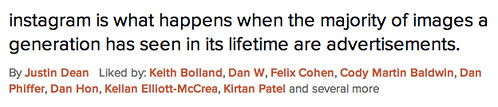
the majority of images

truthy

This tweet popped up in my Stellar feed last night. It's interesting and provocative. Provocative enough to make me wonder when the last time was when a generation got more non-advertising images than ad based ones. Best I can figure it was sometime in the middle ages - when most people got their images in church.

Obviously, this is a total reckon based on some wild assumptions (we're talking about 'the west', advertisments includes movie trailers and retail signage but not packaging, 'images' isn't just the real world, it implies some sort of reproduction.)

Working backwards - TV has always been ad-dominated (except for some occasional enlightened outposts of public broadcasting), radio doesn't have images, magazine and newspapers - always been full of ads, books - varies - sometimes ads, sometimes not. Cities have always been full of ads and signage - it's just we forget that because the old ones either disappear or look lovely when they're faded so we don't think of them as ads. The countryside - no ads, but no other images. Postcards - some ads, probably not the majority, cigarette cards - mostly ads, flyers/pamphlets - lots of ads. Have I missed anything? Probably.

That leaves - as potential sources of images - museums, art galleries and churches. I suspect, as mass phenomenon, they don't outweigh the impact of lots of ads.

So - for as long as there's been a lot of images around, for most people to see - the age of mechanical reproduction - most of the images have been ads.

There has never been a golden age when a generation of lucky people have been wondering around looking at lovely images uninterrupted by commercial intent.

If we're lucky that's something we could build. We could invent that. But this is why it's a hard thing to invent - it's never existed before.


January 03, 2013 | Permalink | TrackBack (0)

the emergent properties of fat and water

Book 36 on the Kindle. The Brain is Wider Than The Sky by Bryan Appleyard. I didn't get on with this as well as I was expecting. Didn't get very far into it. I liked these bits though - More Is Different seems an important thing to understand: Maybe I should give it another go. I'm increasingly finding my working life full of thinking about complex sysytems.

"The first and still the most influential contemporary expression of the basic truth of complexity was in an article published on 4 August 1972 in the journal Science. The author was Philip Warren Anderson, a physicist who, in 1977, won the Nobel Prize. His paper, ‘More Is Different: Broken Symmetry and the Nature of the Hierarchical Structure of Science’, was an attack on reductionism. Galilean science is based on a belief in reductionism, that, in the words of Steven Weinberg, another Nobel Prize-winning physicist, ‘the explanatory arrows always point downwards’. This means that we understand the world by breaking it down into its smallest constituents. In some sense, this computer is ‘really’ atoms, protons and quarks. Reductionism is the belief that if we understand these fundamental units of matter, then we can ultimately understand everything."

"In complex systems ‘more’ is defined as ‘emergent properties’. These are things the system can do that are not predictable from the constituents of that system, because they do not arise simply as a sum of all the properties of the parts of the system. A computer may be predictable from parts such as its memory, processor, hard disc and screen; it is emphatically not predictable from the qualities of silicon, aluminium or glass. But the best example is the most complex system of all, the human brain. Somehow, this particular organisation of fat and water generates the conscious human mind. Cars, wars, office blocks and poetry are all emergent properties of fat and water."

"Implicit in all this is the realisation that complexity is a desirable thing; it stabilises systems and makes them robust, able to survive shocks."

January 02, 2013 | Permalink | TrackBack (0)

on the lack of foxes in television debates

Book 35 on the Kindle. Another biggy. Thinking, Fast and Slow by Daniel Kahneman.

A good and useful book. The idea of the two modes of thought - systems 1 and 2 - seems rather helpful.

On working with a collaborator:

"We were sufficiently similar to understand each other easily, and sufficiently different to surprise each other."

Bias:

"People tend to assess the relative importance of issues by the ease with which they are retrieved from memory—and this is largely determined by the extent of coverage in the media."

Ten thousand hours all over the place:

"Expert intuition strikes us as magical, but it is not. Indeed, each of us performs feats of intuitive expertise many times each day. Most of us are pitch-perfect in detecting anger in the first word of a telephone call, recognize as we enter a room that we were the subject of the conversation, and quickly react to subtle signs that the driver of the car in the next lane is dangerous. Our everyday intuitive abilities are no less marvelous than the striking insights of an experienced firefighter or physician—only more common."

Wot gorilla?

"The gorilla study illustrates two important facts about our minds: we can be blind to the obvious, and we are also blind to our blindness."

But I was cognitively busy m'lud:

"People who are cognitively busy are also more likely to make selfish choices, use sexist language, and make superficial judgments in social situations."

On the advantages of the familiar and the repeated and the familiar:

"Words that you have seen before become easier to see again—you can identify them better than other words when they are shown very briefly or masked by noise."

"you experience greater cognitive ease in perceiving a word you have seen earlier, and it is this sense of ease that gives you the impression of familiarity."

"The famed psychologist Robert Zajonc dedicated much of his career to the study of the link between the repetition of an arbitrary stimulus and the mild affection that people eventually have for it. Zajonc called it the 'mere exposure' effect"

"Survival prospects are poor for an animal that is not suspicious of novelty. However, it is also adaptive for the initial caution to fade if the stimulus is actually safe. The mere exposure effect occurs, Zajonc claimed, because the repeated exposure of a stimulus is followed by nothing bad. Such a stimulus will eventually become a safety signal, and safety is good."

Well, is he?

"When asked, “Is Sam friendly?” different instances of Sam’s behavior will come to mind than would if you had been asked “Is Sam unfriendly?” A deliberate search for confirming evidence, known as positive test strategy, is also how System 2 tests a hypothesis."

A little knowledge is an easier thing:

"It is the consistency of the information that matters for a good story, not its completeness. Indeed, you will often find that knowing little makes it easier to fit everything you know into a coherent pattern"

Always asking myself these things:

"the main problems that an organism must solve to survive: How are things going? Is there a threat or a major opportunity? Is everything normal? Should I approach or avoid?"

On randomness:

"Random processes produce many sequences that convince people that the process is not random after all."

"“To the untrained eye,” Feller remarks, “randomness appears as regularity or tendency to cluster.”"

Skiing - definitely a bad death:

"He points out that experts often measure risks by the number of lives (or life-years) lost, while the public draws finer distinctions, for example between “good deaths” and “bad deaths,” or between random accidental fatalities and deaths that occur in the course of voluntary activities such as skiing. These legitimate distinctions are often ignored in statistics that merely count cases."

Interesting for policy people:

"Sunstein and a collaborator, the jurist Timur Kuran, invented a name for the mechanism through which biases flow into policy: the availability cascade. They comment that in the social context, “all heuristics are equal, but availability is more equal than the others.”

"They have in mind an expanded notion of the heuristic, in which availability provides a heuristic for judgments other than frequency. In particular, the importance of an idea is often judged by the fluency (and emotional charge) with which that idea comes to mind."

Ooh, I know a bunch of availability entrepeneurs:

"An availability cascade is a self-sustaining chain of events, which may start from media reports of a relatively minor event and lead up to public panic and large-scale government action. On some occasions, a media story about a risk catches the attention of a segment of the public, which becomes aroused and worried. This emotional reaction becomes a story in itself, prompting additional coverage in the media, which in turn produces greater concern and involvement. The cycle is sometimes sped along deliberately by “availability entrepreneurs,” individuals or organizations who work to ensure a continuous flow of worrying news"

On luck and stories:

"Indeed, the statistician David Freedman used to say that if the topic of regression comes up in a criminal or civil trial, the side that must explain regression to the jury will lose the case"

"The explanatory stories that people find compelling are simple; are concrete rather than abstract; assign a larger role to talent, stupidity, and intentions than to luck; and focus on a few striking events that happened rather than on the countless events that failed to happen."

"Good stories provide a simple and coherent account of people’s actions and intentions. You are always ready to interpret behavior as a manifestation of general propensities and personality traits—causes that you can readily match to effects."

Crazy gamblers and outcome bias:

"Although hindsight and the outcome bias generally foster risk aversion, they also bring undeserved rewards to irresponsible risk seekers, such as a general or an entrepreneur who took a crazy gamble and won."

"Everything makes sense in hindsight, a fact that financial pundits exploit every evening as they offer convincing accounts of the day’s events. And we cannot suppress the powerful intuition that what makes sense in hindsight today was predictable yesterday"

Why you see so many hedgehogs on the telly:

"Hedgehogs “know one big thing” and have a theory about the world; they account for particular events within a coherent framework, bristle with impatience toward those who don’t see things their way, and are confident in their forecasts. They are also especially reluctant to admit error. For hedgehogs, a failed prediction is almost always “off only on timing” or “very nearly right.” They are opinionated and clear, which is exactly what television producers love to see on programs. Two hedgehogs on different sides of an issue, each attacking the idiotic ideas of the adversary, make for a good show. Foxes, by contrast, are complex thinkers. They don’t believe that one big thing drives the march of history (for example, they are unlikely to accept the view that Ronald Reagan single-handedly ended the cold war by standing tall against the Soviet Union). Instead the foxes recognize that reality emerges from the interactions of many different agents and forces, including blind luck, often producing large and unpredictable outcomes. It was the foxes who scored best in Tetlock’s study, although their performance was still very poor. They are less likely than hedgehogs to be invited to participate in television debates."

Private thinking first:

"I was following a procedure that we already planned to incorporate into our curriculum: the proper way to elicit information from a group is not by starting with a public discussion but by confidentially collecting each person’s judgment"

Useful theories:

"Richer and more realistic assumptions do not suffice to make a theory successful. Scientists use theories as a bag of working tools, and they will not take on the burden of a heavier bag unless the new tools are very useful. Prospect theory was accepted by many scholars not because it is “true” but because the concepts that it added to utility theory, notably the reference point and loss aversion, were worth the trouble;"

The power of the negative comment:

"The psychologist Paul Rozin, an expert on disgust, observed that a single cockroach will completely wreck the appeal of a bowl of cherries, but a cherry will do nothing at all for a bowl of cockroaches. As he points out, the negative trumps the positive in many ways, and loss aversion is one of many manifestations of a broad negativity dominance."

Stop miswanting goods:

"Daniel Gilbert and Timothy Wilson introduced the word miswanting to describe bad choices that arise from errors of affective forecasting. This word deserves to be in everyday language. The focusing illusion (which Gilbert and Wilson call focalism) is a rich source of miswanting. In particular, it makes us prone to exaggerate the effect of significant purchases or changed circumstances on our future well-being. Compare two commitments that will change some aspects of your life: buying a comfortable new car and joining a group that meets weekly, perhaps a poker or book club. Both experiences will be novel and exciting at the start. The crucial difference is that you will eventually pay little attention to the car as you drive it, but you will always attend to the social interaction to which you committed yourself."

"The focusing illusion creates a bias in favor of goods and experiences that are initially exciting, even if they will eventually lose their appeal. Time is neglected, causing experiences that will retain their attention value in the long term to be appreciated less than they deserve to be."

January 01, 2013 | Permalink | TrackBack (0)

operations room

kindle book 34. The Gone-Away World by Nick Harkaway. I loved this. These are specially loved:

"You heard it first as a kind of aggressive quiet. The whoosh and snarl of the desert all around us was still going on, but somehow it was subsumed by this deep, bass silence. Then you could feel it as a coldness in your knees and ankles, an unsteady, heart-attack feeling of weakness and vibration. A bit later it was audible, a thrumming gnognognogg which echoed in your lungs and let you know you were a prey animal today."

"the sounds you hear are the sounds of real people working hard on things they can hold, eat and use."

"Boardrooms are rooms to show how important you are. This is an operations room. It is a place where you do important things."

"You don't make strategy so that there's one path to victory; you make it so that as many paths as possible lead to something which isn't loss."

December 18, 2012 | Permalink | TrackBack (0)

forces of brightness for me

Kindle book 33. Reamde by Neal Stephenson. You're not that surprised I read that are you?

This is true:

"People who had job titles and business cards could say easily where they worked and what they did for a living, but those who worked for themselves, doing things of a complicated nature, learned over time that it was not worth the trouble of supplying an explanation if its only purpose was to make small talk. Better to just go directly to airline travel."

The power of MacGuffins and, maybe, iPhones:

“You will have noticed that many if not most works of fantasy literature revolve around physical objects, usually ancient, imbued with numinous power. The Rings in the works of Tolkien being the best-known example.” Richard, hiding his face behind his pint for a moment, made a plausible guess as to the meaning of the word “numinous” and nodded agreement. “There is nearly always a chthonic link. The object-imbued-with-numinous-power tends to be of mineral origin: gold, perhaps mined from a special vein, or a jewel of extraordinary rarity, or a sword forged from a shooting star. I am merely describing,” D-squared added, with a flick of the fingers, “pulp. But the vast popularity of, say, a Devin Skraelin, attests to the power of these motifs to seize the reader’s attention, down at the level of the reptilian brain, even as the cerebrum is getting sick.”

"“The point is,” said Don Donald, “that it works. Put a magic gem in a story and it grabs the reader. This can be done shamelessly, or with more or less artfulness, according to the tastes and talents of the author. I should say that Tolkien got it right by layering atop it a story about good and evil. The numinous mineral object is now also a technology; it has been imbued with power by a sentient will who possesses some sort of arcane wizardry. It can only be unmade by exposing it to a certain geological process that, being geological, is prior to, and takes precedence over, any work of culture.”

This is the bit that's lasted longest. This simple, eternal way of dividing culture:

"Forces of Brightness. Earthtone Coalition"

First world opportunties, eastern solutions:

"Engineering! Another luxury of nationalities with huge populations and intact landmasses."

"Hungary, severed from half of the population and most of the natural resources that it had once claimed, had now to practice a sort of economic acupuncture, striving to know the magic nodes in the global energy flow where a pinprick could alter the workings of a major organ. Mathematics was one of the few disciplines where it was possible to exert that degree of leverage, and so the Hungarians had become phenomenally good at teaching it to their children."

Know-it-allness is important.

"One way to be strong was to be knowledgeable. In so many areas, it was not possible to be knowledgeable without getting a Ph.D. and doing a postdoc. Guns and hunting provided an out for men who wanted to be know-it-alls but who couldn’t afford to spend the first three decades of their lives getting up to speed on quantum mechanics or oncology."

Ha!:

"This was part of Corporation 9592’s strategy; they had hired psychologists, invested millions in a project to sabotage movies—yes, the entire medium of cinema—to get their customers/players/addicts into a state of mind where they simply could not focus on a two-hour-long chunk of filmed entertainment without alarm bells going off in their medullas telling them that they needed to log on to T’Rain and see what they were missing."

Meetings not necessary:

"This was probably rooted in a belief that had been inculcated to him from the get-go: that there was an objective reality, which all people worth talking to could observe and understand, and that there was no point in arguing about anything that could be so observed and so understood. As long as you made a point of hanging out exclusively with people who had the wit to see and to understand that objective reality, you didn’t have to waste a lot of time talking. When a thunderstorm was headed your way across the prairie, you took the washing down from the line and closed the windows. It wasn’t necessary to have a meeting about it"


December 18, 2012 | Permalink | TrackBack (0)

« Previous | Next »