Russell Davies

As disappointed as you are
About | Feed | Archive | Findings | This blog by email

mike and brian

Kindle book 32.The Innovator's Cookbook: Essentials for Inventing What Is Next by Steven Johnson.

Two little bits. Something good about Mike:

"And Michael Jordan, perhaps the most creative basketball player ever, had a “love of the game” clause inserted into his contract; he insisted that he be free to play pickup basketball games anytime he wished."

And what Eno does:

"First of all, the very fact of having somebody who isn’t in the band and who is suggesting new ways of working is in itself very powerful. Because that person is not part of the political/ diplomatic situation within the band itself."

December 18, 2012 | Permalink | TrackBack (0)

a year ago

I don't know if this is healthy or not, but I spent quite a lot of Sunday evening reconstructing last week a year ago via various social media and 'this is what you were doing a year ago' services like Timehop, OhLife, Flickr and that.

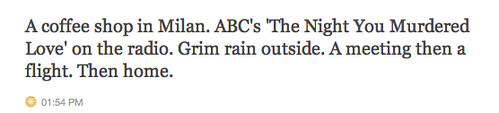
Aside from the heightened drama of personal circumstances we did Radio Roundabout, GDS offered me a job, I quit R/GA and I went on one of the most miserable and pointless business trips of my life.

It was a big week. Scary in some ways. But it's worked out very well.

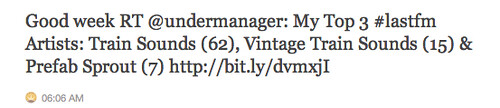
Fragments from that week:

a year ago

glitchy

a year ago

a year ago

milan

a year ago

london

a year ago

a year ago

a year ago

a year ago

December 18, 2012 | Permalink | TrackBack (0)

writing wrong

oh good

Sometimes the copy and the code don't quite chime.

December 16, 2012 | Permalink | TrackBack (0)

ghost mail

Finally, a proper book. Book 31 was Follow Me Down by Kio Stark. I'm lucky enough to know Kio a bit and I had to apologise to her that I only highlighted two words in the whole book. It was mostly because I was too gripped by actually reading the thing to worry about what I might keep on my kindle. It's a fantastic book.

On the other hand, the two words do, sort of, sum it up:

'Ghost mail"

December 16, 2012 | Permalink | TrackBack (0)

annoying gods

Book 30 was Supergods by Grant Morrison. It was like his comics, sometimes brilliant and often self-indulgent and annoying. I didn't highlight the annoying bits:

"With a keen sense of ironic symmetry, the comics arrived as ballast alongside the US service personnel whose missiles threatened my very existence. As early R&B and rock ’n’ roll records sailed into Liverpool to inspire the Mersey generation of musicians, so American comics hit in the west of Scotland, courtesy of the military-industrial complex, to inflame the imaginations and change the lives of kids like me."

"We live in the stories we tell ourselves. In a secular, scientific rational culture lacking in any convincing spiritual leadership, superhero stories speak loudly and boldly to our greatest fears, deepest longings, and highest aspirations. They’re not afraid to be hopeful, not embarrassed to be optimistic, and utterly fearless in the dark."

"(It was O’Neil who came up with my favorite description of comic-book dialogue and captions: “headlines written by a poet.”)"

"Then, as if handing me the keys to the jet pack, my dad bought me a typewriter and taped a message to the inside of its case: “Son—the world is waiting to hear from you."

"he favored long, horizontal panels that re-created how the cinema screen looks from the audience’s point of view. The artists who were able to adapt to this new trend were masters of scale and perspective, and they framed their shots like the directors of Hollywood spectaculars and science fiction blockbusters"

"Here in the twenty-first century we’re surrounded by proof that we tend to live our stories. As I brought this section to a close, one last synchronicity directed my attention to an article in New Scientist’s February 12, 2011, issue about the work of William Casebeer of the US Defense Advanced Research Projects Agency (DARPA), based in Arlington, Virginia. Casebeer, a neurobiologist, goes so far as to suggest that certain narratives are as addictive as cocaine, commenting on the effects a compelling yarn might have upon the minds of enemy soldiers or suicide bombers. He is convinced that we should be investigating the military potential of stories, by creating “counter-narrative strategies” engineered to undermine or oppose the religious or political storylines that inspire war, oppression, and greed."

December 16, 2012 | Permalink | TrackBack (0)

we're a service

Books 28 and 29 were Tinker Tailor Solider Spy and Our Kind Of Traitor by John Le Carre.

Hadn't read these for years. I guess it was prompted by the film. Tinker Tailor is full of gorgeous slices:

"Taking the marble he slowly rolled it round his hard, powdery palm and Roach knew at once that he was very skilful at all sorts of things; that he was the kind of man who lived on terms with tools and objects generally."

"a private Kim’s game to preserve his mind from the atrophy of retirement, just as on other days he learnt the names of the shops along his bus route to the British Museum; just as he knew how many stairs there were to each flight of his own house and which way each of the twelve doors opened"

"She’d been hanging around ever since, cooking nut rissoles and playing the flute"

"‘Sweat them, George. Tempt them, bully them, give them whatever they eat.’"

"he had the battered look of someone just arrived from a bad journey"

"‘George is like a swift,’ Ann had once told Haydon in his hearing. ‘He cuts down his body temperature till it’s the same as the environment. Then he doesn’t lose energy adjusting.’"

And I loved this from Our Kind of Traitor:

"We’re not hired to rock the boat. We’re here to help steer it. We’re a Service.’"


December 16, 2012 | Permalink | TrackBack (0)

34

Kindle book 27. Rule 34 by Charles Stross.

If you've just got interested in 3D printing you should read this, a gritty detective story in a grubby 3D-printed world.

"The good law-abiding folks—they’re welcome to run off Rawlplugs and coffee coasters and plastic Nessie tat for their weans. But the Polis don’t like unmonitored fabs. They could be making anything."

"when you mix memes with maker culture, you have something even weirder"

This is well-put:

"Meanwhile, the content-is-king mantra of the monetization mavens gridlocked the new media in an advertising-supported business model"

And this is a thing:

"A detective can never have too many pockets, your uncle Bert told you. He wasn’t wrong, but a quarter century later, the fashion industry still hasn’t caught on to the existence of female cops.)"

December 16, 2012 | Permalink | TrackBack (0)

predator rhythm

Book 26 on the Kindle. What Technology Wants by Kevin Kelly. I know this was good. Everyone said so, but I'm not sure I finished it. Felt like something you didn't have to read yourself, everyone else would read it for you.

These bits stuck out though:

"The Paleolithic rhythm actually reflects the “predator rhythm,” since the great hunters of the animal world, the lion and other large cats, exhibit the same style: hunting to exhaustion in a short burst and then lounging around for days afterward."

"Grandparents are the conduits of culture, and without them culture stagnates."


December 16, 2012 | Permalink | TrackBack (0)

Winston Churchill - druid

Kindle Book 25 - The Book of English Magic by Philip Carr-Gomm and Sir Richard Heygate. Mostly a quick leaf through rather than a read, but I liked these moments::

"Treadwell’s stocks plenty of second-hand books, which Virginia Woolf called ‘Wild Books, Homeless Books’, because, explains Christina, ‘they have already had a journey, so they have extra energy in them from where they have been before, and they’re looking for a home’"

"‘the Science and Art of causing Change to occur in conformity with Will’"

"By magic, Man shows that he is not content to be simply a pawn in the Great Game, but wants to play on his own account. Man the meddler becomes Man the Magician, and so learns the rules the hard way, for magic is concerned with Doing, while mysticism is concerned with Being’"

"In 1781, Henry Hurle founded the Ancient Order of Druids at the King’s Arms Tavern in London’s Poland Street."

"In 1908 the young Winston Churchill was initiated into the Order and, by 1933, incredibly, over one and a half million members called themselves Druids. The lodges produced engraved certificates, rings and even porcelain tea sets, which can still sometimes be found in antique shops or are dusted down as ancestral heirlooms"

December 16, 2012 | Permalink | TrackBack (0)

paraphernalia

Kindle book 24 was Paraphernalia: The Curious Live of Magical Things by Professor Steven Connor.

I liked this book a lot. These bits speak for themselves:

"When we speak of an object – from ob-, opposite or against, and –iacere, to throw – our word evokes something that is thrown or thrust up against us. The word ‘object’ seems to assert the existence of that which stands apart, and has no part of us."

"The meditations on objects I offer here will indeed often suggest that they can be seen as what in the fifteenth and sixteenth centuries in Europe would have been called ‘emblems’, allegories of human life, implying pocket homilies on love, time, hope, error, striving and death. As such, they give us work to do as well as being merely available for us to work on. And yet, their power comes entirely from us."

"A teacup asks to be picked up by the handle; a brandy glass invites one to cradle it, tender as a dove, from underneath; a shoe hints pointedly at a particular kind of toe-first, Cinderella insertion; a table spreads its flat expanse generously for banquet or billiards; a chair irresistibly proposes that one lower oneself into it backwards. Such objects seem to have us, or certain parts of us, imaged in them."

"Magical objects in this sense are always playthings, things that seem not to give some specific instruction as to their use, like the labels saying ‘eat me’ and ‘drink me’ on objects in Wonderland, but rather seem to say, ‘play with me: try to make out what I might be good for’. Magical things invite a kind of practical rêverie, a kind of floating but intent circling through or playing with possibilities, a following out of their implied reach. Magical objects are such stuff as dreams are made on. They afford reflection on their affordances."

"We play with such objects as we do with all playthings, for an entirely circular reason – namely, to find out how much play (in the sense of give, stretch or variability) they may be found to possess. Sometimes, the action of taking an object to its limits will result in its being tested to destruction. Eventually, the paper clip snaps. Perhaps all play has at its horizon the death of the plaything. When we put something to work, we use it for a particular purpose. In play, we seek not so much to use things as to use them up."

"What prevents us relapsing into a purely animal or mechanical existence are precisely those unnecessary things that are the tiny, persisting proof of our existence, by which I mean our defining unnecessariness, the fact that there is no particular need for us to have arisen at all."

"Sausages and saveloys were sometimes known in the nineteenth century as ‘bags of mystery’."

"its sheer all-in-one suits would be secured by zips and velcro (which would fasten diagonally, slashing diagonality being the infallible sign of futurity’s intolerance of fussy delay)"

"Buttons, like keys, are part of an economy of lost belongings, and glow glumly with the melancholy sense that the fate of things is not so much to fall apart as to come undone or get lost."

"The button became the image of the convertibility of scales, the possibility of setting in train or discontinuing a massive, complex and ramifying set of operations by a single elementary motion, one that is almost indistinguishable from pointing. The button was the proof of the new dominion of the miniature, the maximal condensed into the minimal. The button allows the concentration of will and purpose into a single form, a single, simple gesture, and the closing of the gap between intention and action."

"The reading space of the newspaper is much more diversified, animated by the order and quality of its reading, than the uniform space of a book page. The eye is not enjoined to move steadily through the newspaper’s text, but skips, scoots, circles and skids fly-wise around the page. As Nicholson Baker has put it, newspapers ‘have a visual exorbitance, a horizon-usurping presence’"


December 16, 2012 | Permalink | TrackBack (0)

« Previous | Next »