Russell Davies

As disappointed as you are
About | Feed | Archive | Findings | This blog by email

homely

The fourth book on my Kindle: At Home by Bill Bryson. I seem to remember finding this slightly annoying but, looking back, I've highlighted quite a lot. Mostly of the kind of facts I wish I could remember to repeat to people while having one of those fact-based exchanges people have in pubs.

"The 1851 census also showed that more people in Britain now lived in cities than in the countryside – the first time that this had happened anywhere in the world"

1851! This is nothing new to us. We're used to it. Copy us.

"The duke was so cheap that he refused to dot his i’s when he wrote, to save on ink."

I can't remember which Duke. It doesn't matter.

"*Although he is hardly read now, Walpole was immensely popular in his day for his histories and romances. He was a particularly adept coiner of words. The Oxford English Dictionary credits him with no fewer than 233 coinages. Many, like ‘gloomth’, ‘greenth’, ‘fluctuable’ and ‘betweenity’, didn’t take, but a great many others did. Among the terms he invented or otherwise brought into English are ‘airsickness’, ‘anteroom’, ‘bask’, ‘beefy’, ‘boulevard’, ‘café’, ‘cause célèbre’, ‘caricature’, ‘fairy tale’, ‘falsetto’, ‘frisson’, ‘impresario’, ‘malaria’, ‘mudbath’, ‘nuance’, ‘serendipity’, ‘sombre’, ‘souvenir’ and, as mentioned a few pages back, ‘comfortable’ in its modern sense."

Bring back gloomth!

"Two years before his unhappy adventure with ‘many worms creeping’, Samuel Pepys recorded in his diary a rather more prosaic milestone in his life. On 25 September 1660, he tried a new hot beverage for the first time, recording in his diary: ‘And afterwards I did send for a cup of tee (a China drink), of which I never had drank before.’ Whether he liked it or not Pepys didn’t say, which is a shame as it is the first mention we have in English of anyone’s drinking a cup of tea."

I remembered this one.

"For years he refused to accept that the future of motion pictures lay in projecting images on screens because he hated the thought that they could become visible to someone who had slipped into the viewing chamber without buying a ticket. For a long time he held out for the idea of keeping them securely inside hand-cranked peepshow boxes."

The movie person hasn't changed much.

"A big part of the appeal of Brown’s approach was that it was cheap in the long run. Manicured grounds with their parterres and topiary and miles of clipped hedges needed a lot of maintenance. Brown’s landscapes looked after themselves by and large. He was also emphatically practical. Where others built temples, pagodas and shrines, Brown put up buildings that looked like extravagant follies but actually were dairies or kennels or housing for estate workers."

Capability Brown, presumably. Design resillience there.

 

November 21, 2012 | Permalink | TrackBack (0)

vintage baker

The third book on Kindle. Looking around for something to take on a long journey, as I remember. And I turned to a favourite author - Nicholson Baker - and a bit of a compilation, called Vintage Baker. I don't really know why I highlighted these bits. But it's good to see them again.

Just on it's own. This bit. Lovely.

"Shoes are the first adult machines we are given to master."

Then, a long sequence about the notion that it would be nice, sometimes, for good things to be undiscovered for a bit, not instantly swept up by trendhunters and best ofs.

"At times it’s fun to be part of a society so intent on institutionalizing its response to novelty. Our toes are curled right around the leading edge of the surfboard. Nothing far out will catch us off guard. We will monitor left field continually, and no hint of activity from that quarter will elude our scrutiny. But there are ill effects, nervous tics, symptoms of exhaustion, that arise in an audience when it oversolicits the heteroclite. Newness ought to suffer a period of frost—it should even have to submit, for its own good, to entrenched and outraged resistance. Neglect gives a winsome oddity more time to perform important tests on itself; widespread narrowmindedness shelters surprise.

No one will blame a publisher who has discovered an out-of-print minor masterpiece and feels it his duty to enrich and uplift the human spirit by publishing it in paperback, with a beautiful, spare, up-to-the-minute cover design. That is his job. But sometimes we can’t help wishing he would wait, and just buy one old copy for himself from an antiquarian dealer, preserving for at least a few more years the delight of private, proprietary knowledge, the ecstasy of arriving at something underappreciated at the end of a briareous ramification of footnotes, since the hope of such secrets is one of the things that keep us reading. Rough timetables, “appreciation schedules,” may be of some guidance. That pad dotted on both sides with suction cups, to which you can vertically affix a wet bar of soap while you are in the shower? It should remain unmentioned by any magazine’s “New and Noteworthy” column for six months. Each of us should have a fair chance of finding it, hanging unheralded from a hook in the hardware store, on our own.

A good poem, as Horace suggested, ought to have a nine-year news blackout. And a major leisure item—a new sort of inflatable raft, for example—deserves at least five summers of quiet superiority before it gets a Best Buy rating from Consumer Reports and leans against the wall in the sporting-goods department at the high-volume discounters. After all, this successful raft—with its revolutionary osmotic inflatervalve—displaces several other very good makes of raft, which once so proudly rode the crest; and when we look through the still-hopeful catalogs of these inferior raft-crafters, and sense their anguish, deepening monthly, as they watch their sales go into steep decline, then they begin to take on rarity— the rarity of the underdog, one of the most seductive kinds— and we discover ourselves feeling, too soon, that we must root for the second-rate product. (Haven’t you felt a peculiar sort of worry about the chair in your living room that no one sits in? Haven’t you sometimes felt sleeve-tugs of compassion and guilt over an article of clothing that you dislike and therefore scarcely wear? Haven’t you at least once secretly sat down in the hardly-sat-in chair, wearing that ugly shirt, in order to rectify these inequities?) A little lengthening of the time it takes for new merit to out, for rare proficiencies to make their sudden bundle, would allow our sympathy for the underdog and our excitement in superiority to coincide; too rapid a transmittal of the knowledge of relative greatness, on the other hand, eliminates that beautiful period when these emotions overlap."

And there's this bit, about the various processes you can set in train, just by ordering stuff and paying for it.

"As I walked out of the office-supply store, I became aware of the power of all these individual, simultaneously pending transactions: all over the city, and at selected sites in other states, events were being set in motion on my behalf, services were being performed, simply because I had requested them and in some cases paid or agreed to pay later for them. (The letter to my grandparents didn’t exactly fit, but contributed to the feeling even so.)
Molten rubber was soon to be poured into backward metal letters that spelled my name and address; blind people were making clarinetists’ finger motions over the holes of a half-caned chair, gauging distances and degrees of tautness; somewhere in the Midwest in rooms full of Tandem computers and Codex statistical multiplexers the magnetic record of certain debts in my name was being overwritten with a new magnetic record that corresponded to a figure diminished to the penny by the amount that I had written out in hasty felt-tip pen on my checks (I made the traditional long wavy mark after “and 00/100” on the dollar line, just as my parents had, and their parents had before them); the dry cleaner’s would close soon, and in a sack somewhere in the darkened store, tied in a bundle to keep it separate from all other bundles, behind the faded posters in the window saying “For That Newly Tailored Look,” my dirty clothing would rest for the night; I trusted them to take temporary possession of it, and they trusted me to return to their store and pay them for making it look like new.
All of this and more I could get the world to do for me, and at the same time all of it was going on, I could walk down the street, unburdened with the niceties of the individual tasks, living my life! I felt like an efficient short-order cook, having eight or nine different egg orders working at once, dropping the toast, rolling the sausages, setting up the plates, flicking the switch that illuminated a waitress’s number."


November 20, 2012 | Permalink | TrackBack (0)

book two

Following on from yesterday, the second book I read on my Kindle was The Art of Game Design by Jesse Schell.

The bit I highlighted in that: 

"When a list of things is numbered, the numbers somehow give a certain dignity to the things in the list"

1. It's true. 2. It's worth remembering. 

November 19, 2012 | Permalink | TrackBack (0)

Grow up. Behave. Prepare

I increasingly feel like this is the only place on the internet I really own. The place I'm sure of. Twitter, Instagram etc feel like places that could be snatched away at somebody's whim. Which would, sort of, be fine but, sort of, be not. I'm backing them up like I'm backing this up. But the files without the social context would be a little thin.

Anyway. I was just looking at my Kindle Highlights the other day and realising they're similalry precarious. So I might put some of them here. In a 'blog all dog-eared pages' kind of way.

Here's the first. The first book I ever read on Kindle (on my phone). January 2010. Iain M. Banks and Consider Phlebas. I highlighted precisely one thing, this:

Consider Phelbas

I wonder what that says about me?

November 18, 2012 | Permalink | TrackBack (0)

feature creep

feedback tube

The next obvious step is clearly to add an easy, non-getting-your-phone-out-and-tapping-at-it channel to respond to the coffee offer. Fortunately Belkin also make a WeMo motion sensor and they've integrated their devices with If This Then That. Which was clever of them.

Which means all Anne has to do, if she fancies a coffee, is wave her hand over that little carboard tube and I get a text message demanding caffination.

(The tube has the motion sensor in it, it was added to prevent false positives. Obviously when this sort of thing is in Target or Habitat they'll get Zaha Hadid to do a better job of the hardware than cardboard and duct tape. But you get the idea.)

The next step is a negotation over whether the motion sensor should be right next to the bed, so no getting up is required. Tricky.

November 14, 2012 | Permalink | TrackBack (0)

the internet of middle-class things

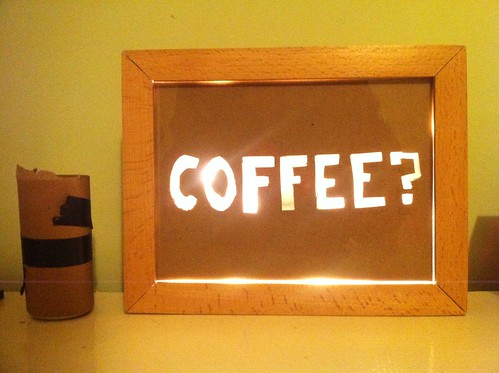
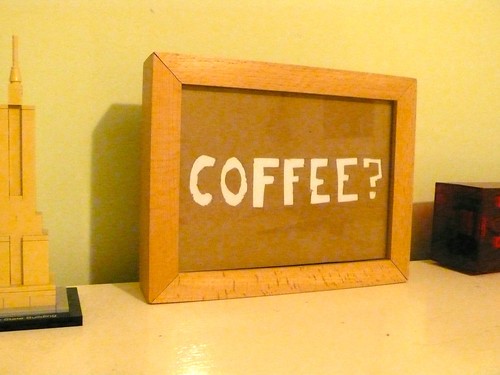
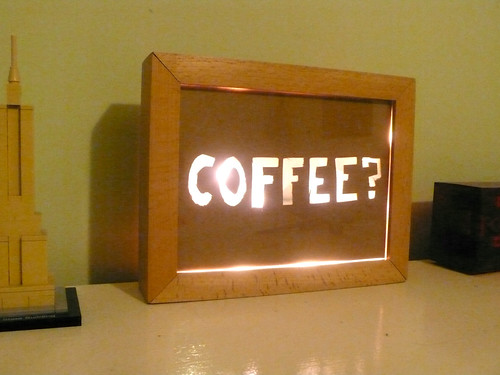
I made this last night.

Off

Use case:

I often get up early at the weekends and pop into town for coffee, while everyone else in the house is asleep. On the way back I wonder if Anne would like me to fetch her a coffee. She might still be asleep, though, so I can't call or text her to ask, because that would wake her up.

Solution:

On

When I press a button on my phone the sign lights up. So, if she's awake she'll see it and text me and say yes. If still asleep she can slumber undisturbed.

Technology:

No cleverness on my part. Just a Belkin WeMo, a Habitat picture frame and a small string of Christmas lights. A massively overexpensive solution for such a trivial problem.

But that is not the point.

The point is that - once the bridging/programming/installing problem is solved, hopefully by something like the BERG cloud  - people are going to want this kind of stuff. It's the decorative, furniturey, not exactly useful, certainly not to do with work stuff that people buy in the nicer sort of garden centres. If I was a better designer, or cutter-out of paper it might start to be like Matt's Mujicomp.

Look, for instance, at the latest designs of the Good Night Lamp and tell me they won't be popular. This is going to be a thing.

November 13, 2012 | Permalink | TrackBack (0)

good couple of days

today

Today we launched something huge, important and serious in a responsibly sober way.

Minis with Hands

Yesterday we launched something cute, frivolous and tiny, in a noisily silly way.

I'm very grateful to have such talented, thoughftul, hardworking groups of people in my life. And such a brilliant balance of important and silly.

October 17, 2012 | Permalink | TrackBack (0)

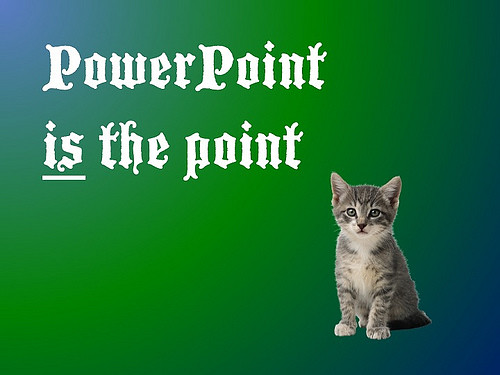
the management philosophy embedded in powerpoint


If you work for the government there's a lot that's interesting about this talk. Though, typically, I've probably got the wrong end of the stick because the line that really stuck with me was:

"When you adopt a tool you also adopt the management philosophy embedded in that tool" 

And what I instantly thought about was Powerpoint.

(When I say Powerpoint, I mean Generic Presentation Software. Right now, at work, I use PowerPoint, Keynote and Google Docs, they all have good points and bad points, it's just easier to call them Powerpoint.)

Arriving at GDS made me realise how much of my professional life has been spent in Powerpoint. It's my default tool for writing and thinking, most of the organisations I've been in are the same.

That's less true of the Civil Service though, where the default tool seems to be Word, or something similar - something, anyway, for making documents. This is possibly as it should be, documents are about detail and detail is important when you're running a country and drafting laws.

I wouldn't want statutes written in 36-point Times New Roman on a graduated blue background. But, it might also be worth examining the merits of Powerpoint, because - when done well - Powerpoint can be a great tool for making 'Agile Strategy'.

powerpoint

The assumption embedded in Powerpoint is - it's going to be talked about, because it's going to be presented, and a presentation has people in the room. Powerpoint causes conversation. Wheras Word is there to be read. It's private, in your head. Word is private, Powerpoint is social.

Word encourages addition. The way people work on documents is to add things to them, make them longer. But Powerpoint tends to limit that - it's normally measured in time ("you have 20 minutes") - so it makes you prioritise and decide what you really want to say.

If Word is about detail, then Powerpoint is about essence. The main points, the key things, the story.

Powerpoint is quick, you can get to that essence in minutes or hours. You can present, revise, represent, get approval and move on at speed.

And Powerpoint is visual. It can be printed out and stuck on the walls - like the stickynotes and whiteboards of Agile. It's instantly and easily shareable.

(That reminds me, I need to write more about walls.)

You get the idea.

Now there are probably other, less useful, management assumptions baked into Powerpoint - stuff to do with power relations for instance - and it could certainly be approved, but those of us who've learned to be good at Powerpoint are very lucky. It's a good tool for a fast, flexible, agile world. It's going to be handy.

(And for everyone who think of this kind of thing when they think about Powerpoint, or this, THAT'S NOT WHAT I MEAN. I mean Powerpoint done well. Which, these days, it often is. MOVE ON.)

October 14, 2012 | Permalink | TrackBack (0)

criticism

I've recently stormed through Some Remarks by Neal Stephenson and The Way The World Works by Nicholson Baker. Both brilliant. Both really good on technology and the cultures that technologies encourage.

Here, for instance, are some fragments from Stephenson on the difference between geeking out and vegging out. 

"To geek out on something means to immerse yourself in its details to an extent that is distinctly abnormal—and to have a good time doing it. To veg out, by contrast, means to enter a passive state and allow sounds and images to wash over you without troubling yourself too much about what it all means."

"Scientists and technologists have the same uneasy status in our society as the Jedi in the Galactic Republic. They are scorned by the cultural left and the cultural right, and young people avoid science and math classes in hordes. The tedious particulars of keeping ourselves alive, comfortable and free are being taken offline to countries where people are happy to sweat the details, as long as we have some foreign exchange left to send their way."

"Nothing is more seductive than to think that we, like the Jedi, could be masters of the most advanced technologies while living simple lives: to have a geek standard of living and spend our copious leisure time vegging out."

"But many people, after they have vegged out long enough to recharge their batteries, derive fun and profound satisfaction from geeking out on whatever topic is of particular interest to them. Choose any person in the world at random, no matter how non-geeky they might seem, and talk to them long enough, and in most cases you will eventually hit on some topic about which they are exorbitantly knowledgeable."

"But we’re all geeks in different subject areas, and so the only thing that links us all together is what we watch on the tube when our geek energies have been spent and we feel the need to veg out—the lowest common denominator stuff."

(Probably some parallels here with Matt's thinking about attention.)

And here's Nicholson Baker on Wikipedia.

"And when people did help they were given a flattering name. They weren’t called “Wikipedia’s little helpers,” they were called “editors.” It was like a giant community leaf-raking project in which everyone was called a groundskeeper."

"It worked and grew because it tapped into the heretofore unmarshaled energies of the uncredentialed. The thesis procrastinators, the history buffs, the passionate fans of the alternate universes of Garth Nix, Robotech, Half-Life, P. G. Wodehouse, Battlestar Galactica, Buffy the Vampire Slayer, Charles Dickens, or Ultraman—all those people who hoped that their years of collecting comics or reading novels or staring at TV screens hadn’t been a waste of time—would pour the fruits of their brains into Wikipedia, because Wikipedia added up to something."

"You looked up Diogenes, and bang, you got something wondrously finished-sounding from the 1911 Britannica. That became Diogenes’ point of departure. And then all kinds of changes happened to the Greek philosopher, over many months and hundreds of revisions—odd theories, prose about the habits of dogs, rewordings, corrections of corrections."

"And yet amid the modern aggregate, some curvy prose from the 1911 Britannica still survives verbatim: Both in ancient and in modern times, his personality has appealed strongly to sculptors and to painters. The fragments from original sources persist like those stony bits of classical buildings incorporated in a medieval wall."

"A piece of antivandalism software, VoABot II, reverted that edit, with a little sigh, less than a minute after it was made."

"Without the kooks and the insulters and the spray-can taggers, Wikipedia would just be the most useful encyclopedia ever made. Instead it’s a fast-paced game of paintball."

"You recall the central Wikipedian directive: “Be Bold.”

And here's another bit of Baker, a lovely description of Google's arrival amidst the cluttered portals that the original directories and search engines had become:

"Then Google arrived in 1998, sponged clean, impossibly fast. Google was like a sunlit white Formica countertop with a single vine-ripened tomato on it."

That reminded me, instantly, of some of the best little moments of Clive James on TV.

I've always thought that would be the best job in writing right now. To do for the internet what Clive James did for telly. I'd love to do it myself but I'm not funny or clever enough, and I wouldn't be willing to be critical enough. Someone should though. Someone.


October 13, 2012 | Permalink | TrackBack (0)

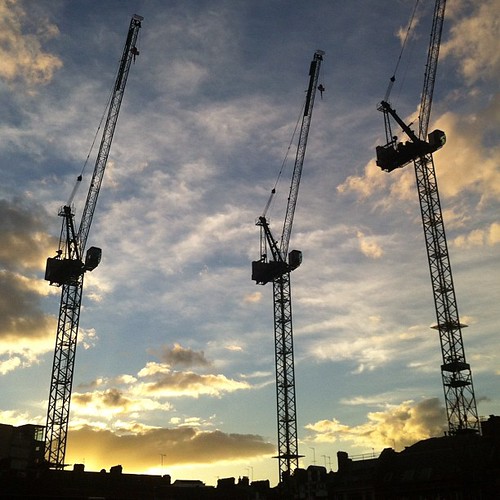
autumn cranes

Untitled

Not Basho:

The crane's legs
have gotten shorter
in the spring rain

September 24, 2012 | Permalink | TrackBack (0)

« Previous | Next »