Russell Davies

As disappointed as you are
About | Feed | Archive | Findings | This blog by email

what is BRIG?

BRIG-Panorama

A correspondent writes to ask what BRIG is - since I referred to it the other day. Well, BRIG is what we've come to call the offices/studio we share with BERG, Ruby Pseudo and assorted friends including Chris, Phil, James, James and Leila. (We're also lucky enough to have Tinker upstairs, and Matt.)

And, I have to say, it's the most completely inspiring and enjoyable environment I could imagine. These are brilliant and nice people. All doing interesting and unusual things. Certainly, sometimes the power fails, we have quite a lot of ants and I don't like being responsible for the toilets. But one of the things we really wanted to do, way back, was rent a space and invite a variety of imaginative and pleasant people to share it. I think doing that makes good things happen. We're not all making things together yet. We chat a bit around the kettle but there's not as much mingling as I'd hoped. You can't force that though, it'll come. Perhaps.

Anyway. That's what BRIG is.

August 26, 2010 | Permalink | TrackBack (0)

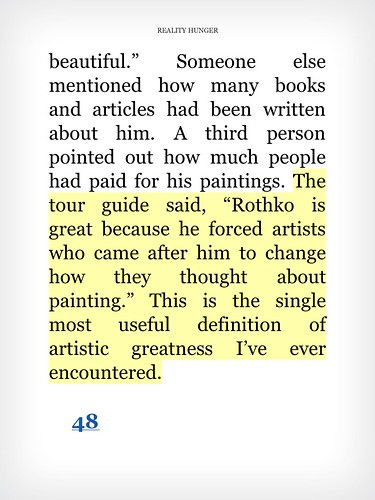
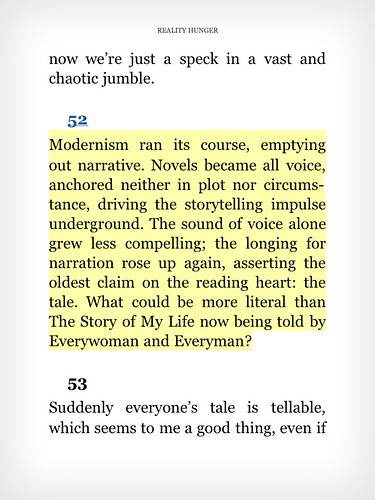
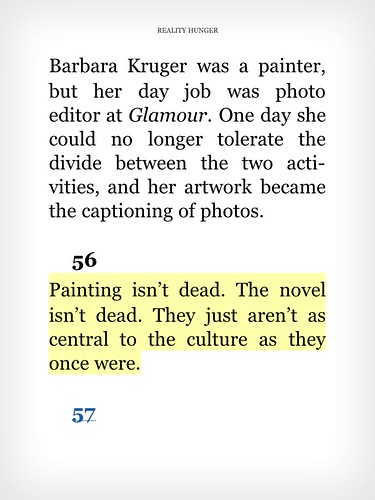
reality snacks

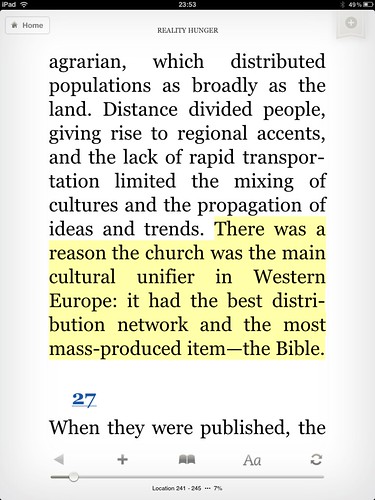
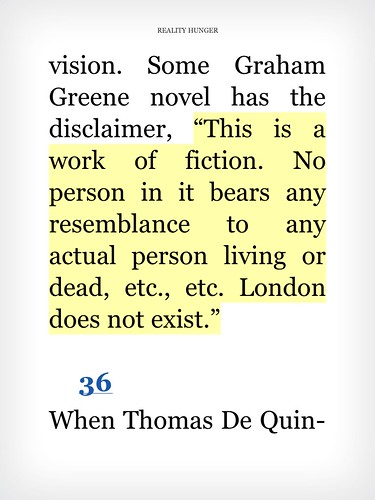
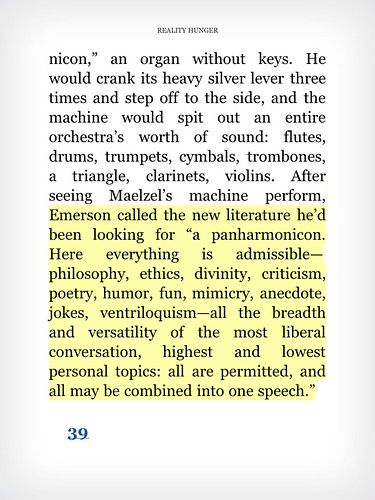
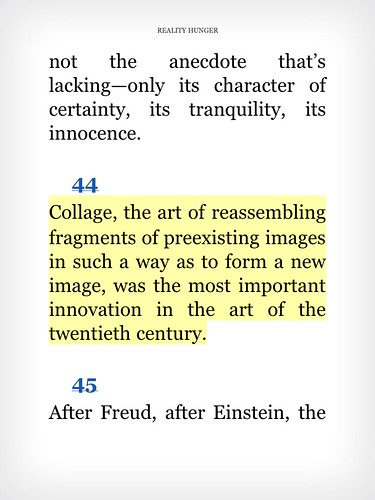
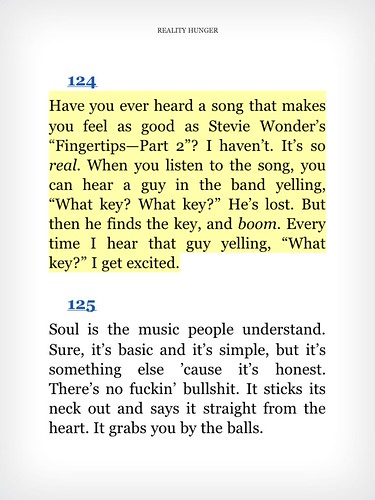
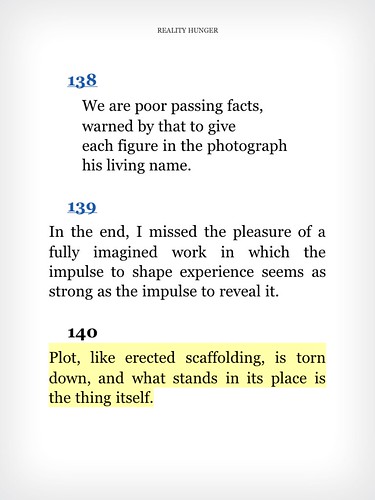
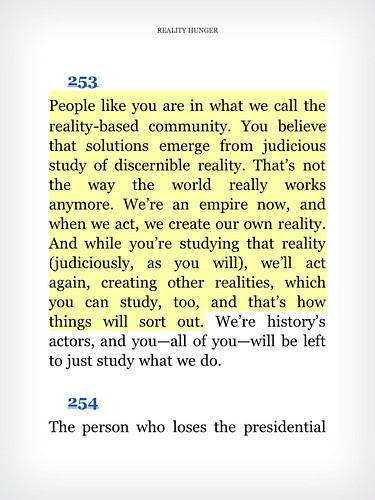
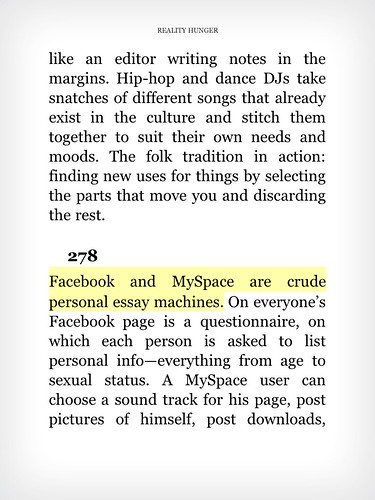
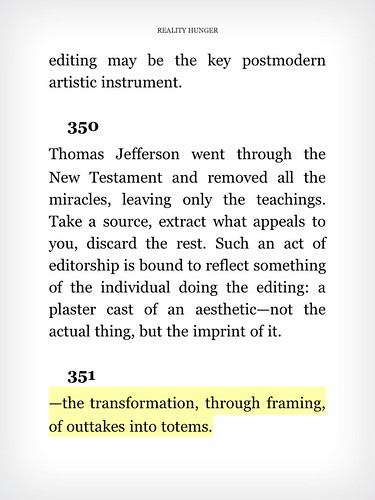
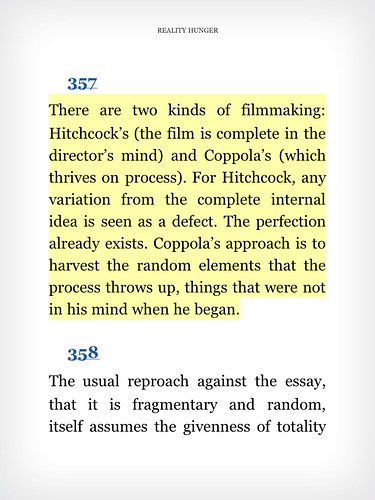
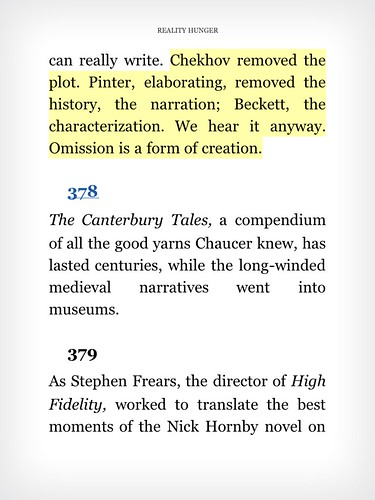
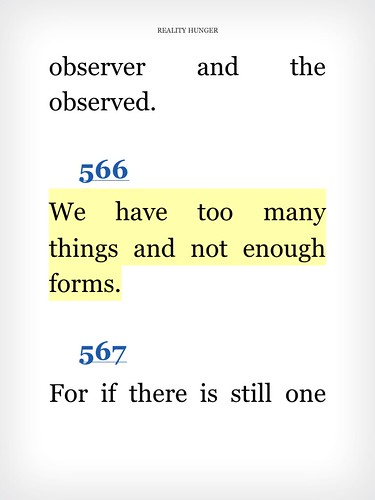
Materials: iPad, Kindle App, Reality Hunger by David Shields

reality hunger

reality hunger

reality hunger

reality hunger

reality hunger

reality hunger

reality hunger

reality hunger

reality hunger

reality hunger

reality hunger

reality hunger

reality hunger

reality hunger

reality hunger

reality hunger

reality hunger

reality hunger

reality hunger

August 25, 2010 | Permalink | TrackBack (0)

5 things

I'm late with mine. None of them startlingly original. All overlapping and connected. But here they are:

1. The Hundred Year Career

I've just written something about this for Wired. Don't think I thought of it as concisely as '100 Year Career' though. Lifetimes are being extended, retirement's being pushed back. Many of us will have working lives of 100 years +. How do you prepare for that? Or even think about it? I started thinking about it when I was wondering whether to take a new job. With a working life that could easily last another 40 years, probably longer than any of the industries I currently know anything about, what should I be doing next? My answer - learning - more learning about people and organisations. Because they, at least aren't going away. All those people thinking about jobs now, I'm tempted to say, do what you need to do now, because you've got plenty of time.

(Derived from an original conversation with M. Jones.)

2. The Buried Web

One of the best things about the London Cycle Hire scheme (among a lot of good things) is the way you interact with it. There are screens at all the cycle hire stations and you need to sign up on the web etc but, if you've got an account and you're a regular user you don't need to go near them. The normal way you interact with it is by putting a stick in a hole. You put your key/stick thing in the slot on the machine, the light goes green and you take your bike. No tapping, no typing, no swiping, no passwords. Put your stick in a hole.

I think a lot about that. About how to get the web in and out of physical stuff. Putting it in the world rather than layering it on top. Supported Reality not Augmented Reality.

(I guess technically, I may mean the internet here, not the web, but it didn't sound as good.)

3. The Internet of Products

The Internet of Things is a brilliantly useful and provocative idea. Got lots of people excited. Got me excited. But it's big and vague and woolly. It's hard to know what to do. Is it about networking? RFID? Barcodes? Is it, in fact, Barcode Battlers? It's especially too hard for commerce to grok. Business can't think about 'things'. So I've been trying to think about subsets that might be useful - and started thinking about an Internet Of Products. Meaning, for me; physical products with communication channels and commerce built in. Meaning products with programmable behaviours. Meaning products that never had demo-modes suddenly acquiring them. Meaning..to be honest, I don't know. That's why I'm thinking about it.

4. The Internet Marginal

Watching the Labour leadership campaign and the post-election analysis there's a pronounced return to thinking about constituencies. Labour are hiring community organisers, the lesson they seem to have taken from Obama's victory is that digital tools are there to enable local activism. Well, yes, sort of. That's true. And that's probably how you need to work to get elected by the party. But to get elected by the country I think you need to realise that most people think any form of local political activism indicates unhealthy obsession. And it doesn't recognise that lots of people don't live in their constituencies, they live on the internet. Alright, that's not a huge amount of people but it's at least the size and importance of one marginal constituency - and labour threw it away at the last election. With the Digital Economy Bil and assorted silliness they alienated a group of people who could have been theirs. It'd be good not to do that next time. I've been thinking about how Labour might win the internet. (The obvious answer being - put Tom Watson in charge.)

5.The What Next?

A lot of the people I see in the BRIG and around and about on the internet grew up with the web. They invented jobs to do on it and became very good at them. They built good bits of it. They understand it. But a lot of them did it, not because of something intrinsic about the technologies but because it was the new thing to understand, the new thing that other people didn't know about, it was arcane, unformed, novel. It needed inventing. Now, however, they're bored. They've done that. The web is baked. They're wondering what to do next. I'm loving watching that. I'm wondering too. Will there be another thing as big? Will the invisible high school fragment? Will they settle into middle-edge and do letterpress?

That's going to be interesting.

Anyway.

August 24, 2010 | Permalink | TrackBack (0)

measuring pebbles and companion objects

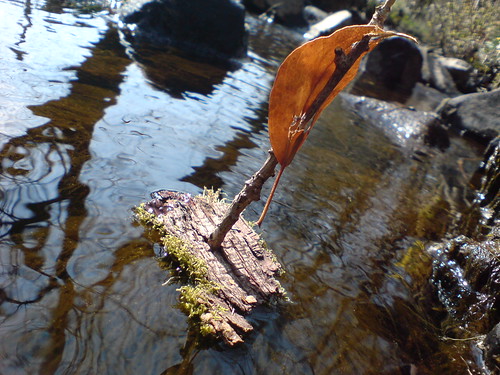
twig boat

Threads that seem connected:

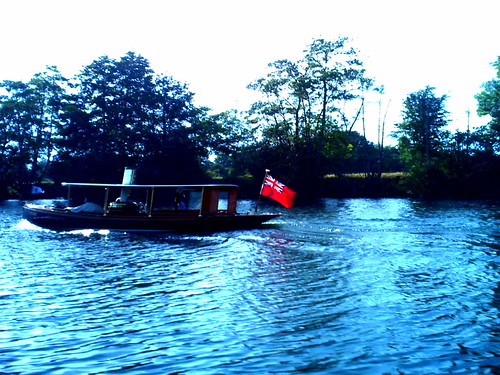
We were on a boat the other week and ended up wondering how you could make a cheap, pilotable underwater camera. The obvious answer seemed to be putting an iPhone in a plastic bag and attaching a propeller.

boat trip

Which had me thinking two things:

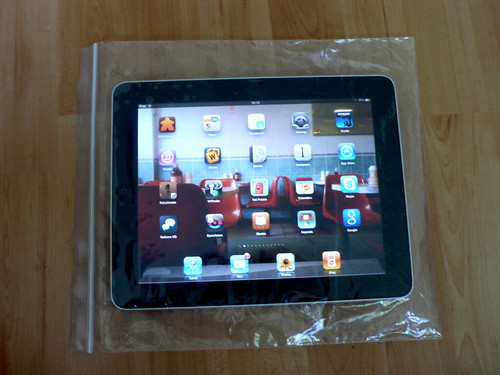
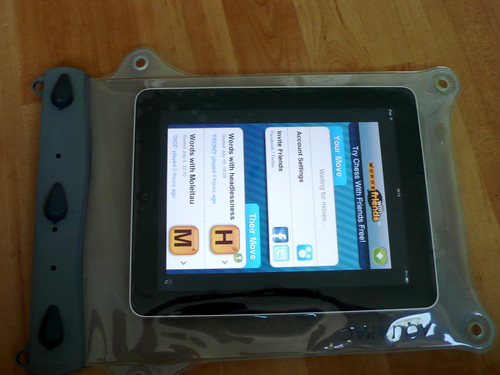
1. I bet we'll see more ruggedising for iPads soon. An ordinary freezer bag or an Aquapac thing make iPad he ideal bathtime reading companion.

waterproofing

waterproofing

2. Wouldn't it be good if there was a servo control app for the iPhone and iPad? Where you could tap in some on/offs, forward/backs and control a motor or motors via bluetooth or wifi or the headphone port. Then your iPhone or iPad could drive itself around. And Matt's Lego iPhone stand could drive up to him and tell him to get typing. (This is good, but I'm thinking about something like Big Trak, or perhaps a Drone that could carry its own controller.)

So someone would have to make a bundled app and companion device. I can imagine more of that soon.

In fact companion objects seems like a big old future category - related to measuring pebbles. Things that add physicality and fun to our mobile screens.

rolly

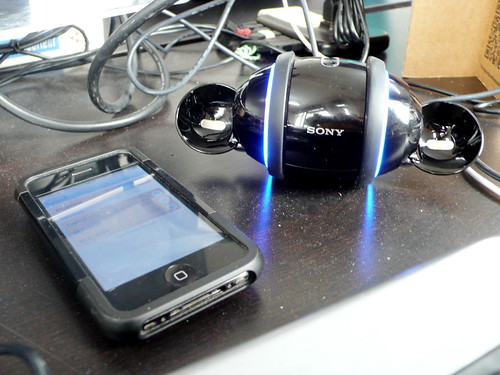
I bought a Sony Rolly the other day. They've been discontinued so they're very cheap now, if you can find one. And you can't be surprised that they didn't sell. They have no point. They were very expensive. They come with horrible Windows only software. They're like a research product that got released.

And yet, and yet, they're completely beguiling. It's this little hand-sized object that seems alive and magical. They've packed all these expressive robotics into a tiny CE-feeling package. It feels like a familiar that's been bewitched to just dance when it can really do all these other things - like a good hacker could really liberate it.

This same device could pair with your phone and sit on your desk; waving when you get text, waving with the other hand when you get a tweet, play your messages at you, roll over to you and beep when it's time for a cup of tea. It could take the brains and communicative ability of your phone and give it some friendly, pet-like behaviour.

Pocket robots, companion robots for smart devices. They've got to be worth thinking about. (And you always know you're onto something when BERG have already blogged about it.)

Anyway.

August 03, 2010 | Permalink | TrackBack (0)

vote vote vote

I judged this the other day. Was interesting. Now, should you want to, you can vote too. Not sure what's in it for you to do that. But, if I were you, I'd vote for this one. It seemed the best to me.

August 03, 2010 | Permalink | TrackBack (0)

this is facebook. this is the internet

Like everyone else I went through the Stages of Blogging. Trepidation at the first post, pride when something had arrived on the internet, happiness at finding other people reading, delight when it turned out to be a really interesting community, disillusionment at trolling and horrible comments and the realisation that blogging's just like everywhere else - there are bad people there. And, thinking back, I had the same experience with usenet and CompuServe forums.

And now, the whole country's having it. Facebook has got millions of people doing social internet stuff and they're going to go through the same stages of blogging. It started with privacy, it's Moat now, it'll be griefing and trolls and pranks and everything else soon.

And we'll fall a bit out of love, but we'll keep using it for what it's good at, and stop doing what worries us.

The added dimension now is that Facebook isn't confined to a technocratic elite. It's added swathes of people who've previously not had much public voice. And lots of them think Moatey is a legend.

Broadly, I think this is a good thing. It's good to know what people think, even if you don't approve. We should be disappointed and disgusted by this sort of thing, but, hopefully, soon, we'll stop being surprised.

July 15, 2010 | Permalink | TrackBack (0)

ideas whose technology has come

I keep thinking I must re-read Being Digital - because, without actually looking or doing any research I'm convinced Negroponte was right, just 20 years too soon. We, for instance, are slowly, and accidentally, building the Daily Me, It's a good idea, it's just that when everyone was excited about it it wasn't practically buildable. Now, when it's do-able, it's dismissed as futurist moonshine from the past.

I've been thinking the same about Pointcast. It was partly no good because of the bandwidth it hogged, partly because it was too advertisingy but mostly because no one had surplus screens. Screensavers are the wrong place for all this.

But we're about to enter an age of surplus pixels - screens sitting there, resting, not showing much, perhaps the odd slide show, screens that aren't the thing we're doing. In public spaces, in offices, in our homes. iPads and iPad-killers are going to be sitting around our living rooms, next to our desks, next our beds. And we'll soon want more on there than our picture libraries Ken Burnsing slowly away to themselves. But we're going to want less than most designers are inclined to design. We'll need a restful, slow, quiet sort of information/entertainment design. Stuff that's happy not to be looked at that much. That'll be interesting.

Anyway.

July 14, 2010 | Permalink | TrackBack (0)

clay shirky - blog all dog-eared interviews

It must be tricky being an author with a book to promote these days. You do all the rounds, grateful for every chance to plug your book but conscious that the people who read your interview in the WSJ are also likely to watch your interview on Newsnight and on MSN and your conversation with Borders or whatever. You're aiming at different audiences each time, but your True Fans will see you every time, alerted by the drip of RSS or the burp of twitter. And, obviously, you run the risk of repeating yourself.

Which was why I was really impressed with Clay Shirky's efforts this time around promoting Cognitive Surplus. He ended up talking in a lot of places, to a lot of people, and I ended up instapapering and reading a lot of these interviews. But I never got the sense of hearing too much of the same stuff, indeed he almost seemed to be saving up some nuggets for each occasion. I bookmarked new thoughts from many of those interviews.

I think that's a sign of a particular kind of writer/thinker - someone who's immersed in a field or area of thought and has taken time to put a sample of it in a book. It means by the time they get round to talking about it, new stuff has occurred to them, and they can genuinely reflect on the questions they've been given and come up with interesting answers. Versus the kind of writer who's just managed to get enough stuff together to fill the book and has only got that material to repeat.

This is the stuff I bookmarked from Mr Shirky's interviews. All of which just fell into my lap via RSS or twitter, so I'm sure if you go looking there'll be much more out there:

“What the fight seems to me now is around cultural expectations of ourselves,” he told me. “It’s actually about changing the culture we are part of in ways that take the new medium for granted"

The Souls Of The Machine

"All of a sudden in 2003-4, L.A. start-up culture got really interesting. It was the moment where 30-year-olds said, “Wait a minute. The people steering the ship only want to get it this much further and then they’re willing to see it sink. I’m bailing out now."

"Ecosystems don’t do things; people do things! To be in a room with people who care about what happens to the press and to offload to the ecosystem the idea that things will somehow be OK is to opt out of our cultural obligation to figure out what the “invisible college” model is right now, that is, to sign ourselves up for a more rigorous view of what the medium is capable of, beyond LOLcats."

"It is possible to think that the Internet will be a net positive for society while admitting that there are significant downsides—after all, it’s not a revolution if nobody loses."

"I think someone will make the imprint that bypasses the traditional distribution networks. Right now the big bottleneck is the head buyer at Barnes & Noble. That’s the seawall holding back the flood in publishing. Someone’s going to say, “I can do a business book or a vampire book or a romance novel, whatever, that might sell 60% of the units it would sell if I had full distribution and a multimillion dollar marketing campaign—but I can do it for 1% percent of the cost.” It has already happened a couple of times with specialty books. The moment of tip happens when enough things get joined up to create their own feedback loop, and the feedback loop in publishing changes when someone at Barnes & Noble says: “We can’t afford not to stock this particular book or series from an independent publisher.” It could be on Lulu, or iUniverse, whatever. And, I feel pretty confident saying it’s going to happen in the next five years."

Here Comes Clay Shirky

"Of course there’s a new Luddism! There’s always a new Luddism whenever there’s change. I mean, Luddism is specifically a demand that the people who benefited from the old system be consulted before any technology is allowed to disrupt it."

"And so one of the problems that old people like me suffer from is just we know too many solutions for problems that no longer exist. And it kind of freaks us out to realize that all the things we mastered don’t really add up to much value anymore."

"The baby boomers, when we were young, we had zero, zero patience for the idea that people who are in their fifties in the ’70s and ’80s should somehow be shielded from cultural changes because somehow the stuff that we were doing was upsetting them. So, now it’s our turn and we ought to just suck it up."

"What is quite obviously happening is that the number of things that are available for short attention are increasing. But, so is the ability to consume complicated, long-form information."

Interview with Clay Shirky

"Whenever media become more abundant, average quality falls quickly, while new institutional models for quality arise slowly."

"The response to distraction, then as now, was social structure. Reading is an unnatural act; we are no more evolved to read books than we are to use computers. Literate societies become literate by investing extraordinary resources, every year, training children to read. Now it’s our turn to figure out what response we need to shape our use of digital tools."

Does The Internet Make You Smarter?

"The final thing I'd say about optimism is this. If we took the loopiest, most moonbeam-addled Californian utopian internet bullshit, and held it up against the most cynical, realpolitik-inflected scepticism, the Californian bullshit would still be a better predictor of the future. Which is to say that, if in 1994 you'd wanted to understand what our lives would be like right now, you'd still be better off reading a single copy of Wired magazine published in that year than all of the sceptical literature published ever since."

"Would the world really be better off if we were to hide from ourselves the fact that teenagers waste a lot of time trying to either flirt with each other or to crack each other up? Like, to whom was this a mystery, prior to the launch of Facebook?"

"Look, we got erotic novels, first crack out of the box, once we had printing presses. It took a century and a half for the Royal Society to start publishing the first scientific journal in English. So even with the sacred printing press, the first things you get serve the basest human urges. But the presence of the erotic novels did not prevent us from pressing the printing presses into the service of the scientific revolution. And so I think every bit of time spent fretting about the fact that people have base desires which they will use this medium to satisfy is a waste of time – because that's been true of every medium ever launched."

"The whole, 'Is the internet a good thing or a bad thing'? We're done with that. It's just a thing. How to maximise its civic value, its public good – that's the really big challenge."

Guardian interview

"I have this theory. I call it the Russia-Poland Theory. Which is: one of the reasons Poland did better than Russia after the collapse of Communism is they’d only had one generation under the Communists, so there were still people who could remember that it had been different. Whereas, under Russia, no one alive remembered what life was like in 1916. When people go through two generations of stability, it’s easy enough to adopt an attitude that it has always been this way. So for somebody entering the book publishing business in, say, the year 2000, some 23-year-old just out of school, it has ALWAYS been this way. No one in the publishing industry has known anything but the postwar landscape. What you get when a situation like that happens is that one word comes to stand in for a business, a production method, a product, a cultural signifier—the whole range of it is all compacted into that single thing."

There are certain channels of conversation in this society that you can only get into if you have written a book. Terry Gross has never met anyone in her life who has not JUST published a book. Right?...

...I think because the cost of writing a book is very large. Someone has committed a lot of time to it. They’ve put a lot of their thinking into it. But also, a whole bunch of other people who have significant amounts of capital on the line have said, “This is worth publishing.” They’ve either said it in the context of the academic press, which says, “This will redound to our credit,” or they’ve said it in the context of the commercial press, which says, “Revenues will exceed expenses.” We use the phrase “self-published author” to mean “vaguely suspect.” Right? Or take painters. Anyone can be a painter, but the question is then, “Have you ever had a show; have you ever had a solo show?” People are always looking for these high-cost signals from other people that this is worthwhile."

"I’ve always adopted the Bill Burroughs mantra, which is, “If a thing is worth doing, it’s worth doing badly.” Which is to say that if there is any intrinsic value in writing or expressing yourself or taking a photo, it’s worth doing even if the results are mediocre."

"I think one of the ways of apprehending the world that’s actually showing up already in the academy is the so-called “one-box search,” where you don’t have to say, “This is the database I’m looking in.” One-box search privileges interdisciplinary work. Because if I search for a particular string or phrase, I am suddenly getting back results from psychology, sociology, economics, political science—all in the same search query. Disciplinary boundaries are just assaulted, rather than doubled down; if I have to know the database before I search it, then to become a good political scientist I have to know which journals are relevant."

"there are revolutions in which people’s principal skill is not being afraid of what they don’t understand. These people do well in revolutionary times. I jumped into this not because I was good at it, but because I didn’t have much to lose. That will give way—in fact, it even is giving way now. I started doing this in a day when you had to understand something about how the Internet works just to use it. Literally. There was no web, there was no graphic interface or anything like that. You had to understand something about the plumbing just to go to the bathroom. It’s like having to know how your car started to own a car. Those days are long gone. In fact, some of the interesting commentary on the iPad considers it as a new model for how little you have to know about your computer in order to get it to do what you want to do."

"There’s this long, long, lonely gap between the 8,000-word New Yorker article and the 80,000-word book. And there are a bunch of interesting things that are about 20,000 words long. In fact, it’s gotten to the point where, if you’re reviewing a nonfiction book, it’s commonplace, if you like it, to assure the readers of the review that this is not just a magazine article inflated to 80,000 words so that it can be sold on the shelves at the bookstore. Which, in a way, is saying there’s a bunch of stuff that actually would be better at 20,000 or 25,000 words than at 80,000 words."

Barnes & Noble interview



July 13, 2010 | Permalink | TrackBack (0)

one more and this is a thing

Waiting for Kevin, East Village, NYC.

Waiting for Dan, Soho, London.

July 11, 2010 | Permalink | TrackBack (0)

weeknotes - penthouse and pavement

world not in motion

friday

friday

friday

friday

friday

friday

friday

July 09, 2010 | Permalink | TrackBack (0)

« Previous | Next »