a wooden hat
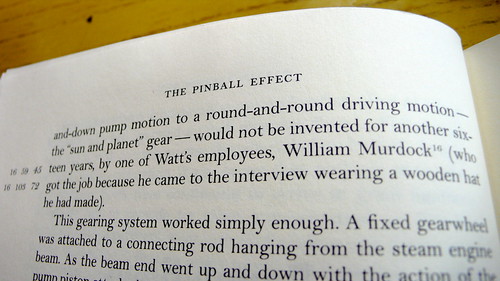
I was reading Connections by James Burke and came across this reference to William Murdock and his wooden hat. Obviously I've been trying to find out more but all I've uncovered so far is that it was oval and he made it himself on a lathe.
The description below adds flavour but nothing to the basic facts:
During the brief conversation that took place, the blate young Scotchman, like most country lads in the presence of strangers, had some difficulty in knowing what to do with his hands, and unconsciously kept twirling his hat with them. Boulton's attention was attracted to the twirling hat, which seemed to be of a peculiar make. It was not a felt hat, nor a cloth hat, nor a glazed hat: but it seemed to be painted, and composed of some unusual material. "That seems to be a curious sort of hat," said Boulton, looking at it more closely; "what is it made of?" "Timmer, sir," said Murdock, modestly. "Timmer? Do you mean to say that it is made of wood?" "'Deed it is, sir." "And pray how was it made?" "I made it mysel, sir, in a bit laithey of my own contrivin'." "Indeed!"
Boulton looked at the
young
man again. He had risen a hundred degrees in his estimation. William
was a
good-looking fellow--tall, strong, and handsome--with an open
intelligent
countenance. Besides, he had been able to turn a hat for himself
with a
lathe of his own construction. This, of itself, was a sufficient
proof that
he was a mechanic of no mean skill. "Well!" said Boulton, at last,
"I will
enquire at the works, and see if there is anything we can set you
to. Call
again, my man." "Thank you, sir," said Murdock, giving a final twirl
to his
hat.
Obviously, as soon as I know more I'll let you know.
According to some people who should know, there is no visual reference remaining of the hat in question.
what I meant to say at lift - part two - big red buttons and sliding into glass
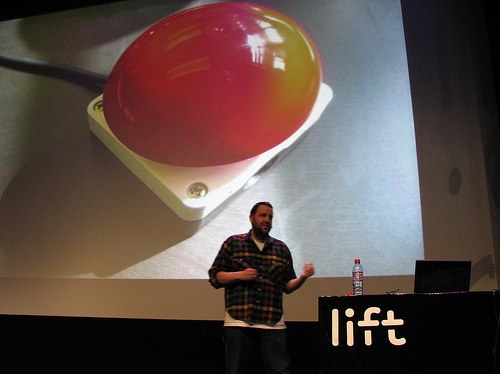
(Thanks to Tinker for the picture)
This is more of what I meant to say at Lift. (Part One is here). And it explains why I was messing around with this Big Red Button.
Clearly lots of the future is going to be about screens. Touch and screens. That's not a bad thing, that's full of enormously exciting possibilities. But if it's all we do we're going to be missing something; we're going to be missing most of our bodies and most of our senses. Even something like Project Natal - which is ostensibly about the body, feels, to me, more to do with disembodiment. It seems like an intermediate step on the way to total mind interface; where we just slide under the glass and live there forever. That seems to be what the designers are after.
Presentations and PowerPoint are an example. Conference organisers and software/hardware makers seem determined to promote a fantasy that the slides control themselves. They want the computer off the stage, hidden, they want the controller as small as possible. Again, they seem to be working towards an ideal state where the slides are advanced by an inflection in the speaker's mind.
This reinforces, and is reinforced by, a particular school of presentations/talks which imagines them as an exchange of minds facilitated by language, occasionally supported by imagery. Which, to me, always seems like such a waste, like taking a talking head off telly and going to see it live. This gets even worse when it's on a big conference stage like at Lift or dConstruct or somewhere. You're on this big, bare, dark, platform, normally lit like Derek Jacobi doing a soliloquy. There are a few great actors in the world who can fill a space like that with 40 minutes of compellingness just using the power of their voice and their words. I know I can't. And I've not seen many non-professionals who can.
We should be thinking of all the things we can to make ourselves more watchable. And, for me, one of those things, is to engage physically with our materials - our presentation, our slides. We should be performing PowerPoint not just showing it. You ought to be able to buy a PowerPoint Hero controller that gets you engaged the way a Guitar Hero controller does.
I've been thinking about this for a while, but being completely devoid of ideas for Lift, and having come to know Alex and the Tinker crew I thought I'd ask them if they could build an elementary version of this idea, so at least I'd have something new. Specifically I asked them for a Big Red Button that does nothing but advance the slides when you press it. Something mechanical with physical feedback and resistance. They kindly and expertly delivered exactly that.
And it works as I'd imagined. It makes you want to thump it. You lift your hand and bang it down. So if you're stuck in droning mind-meld mode for a moment you're soon jolted out of it by the movement and physicality. And your audience is reminded that they're watching a physical being not just an avatar.
It's a lovely thing, but I think it's just a beginning. Why do presentations have to be composed of serial images anyway? Maybe if we think beyond the slide advance button we can think of other interactions and other physical interaction ideas. What about a set of PowerPoint pedals, like guitar pedals, or a Keynote wand. Or something.
Anyway. Perhaps it's best I didn't try and say all that. I'm still not sure it makes sense.
cognitive surplus - blog all dog-eared pages
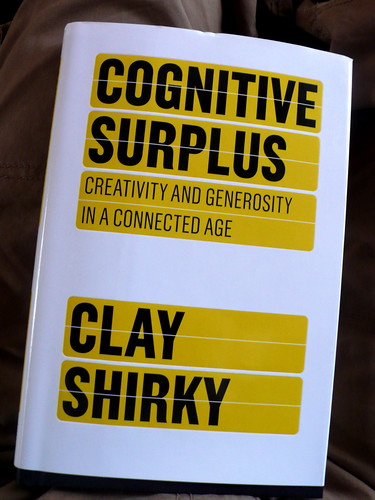
(As James points out, dog-earring is going through as rapid a transformation as everything else bookish these days. My latest technique with a physical book is to scan it into stickybits and then add photos as 'bits' every time I want to dog-ear something. That way you end up with a page with all the marked bits on it, including a record of where and when I was reading. (Though they aren't great pictures.) As back-up I'm also doing actual dog-earring and sticking pictures of some bits on flickr too. That's probably going too far. Pictures here will be a mixture of the two, the best ones I've got.)
I got the new Clay Shirky the other week, from an Amazon seller. It's been out in the US a little while and the fact that he's on Today this morning made me realise it's now available in the UK. It's very, very good. Just as readable and useful as Here Comes Everybody.
Here are the bits that stuck out for me:
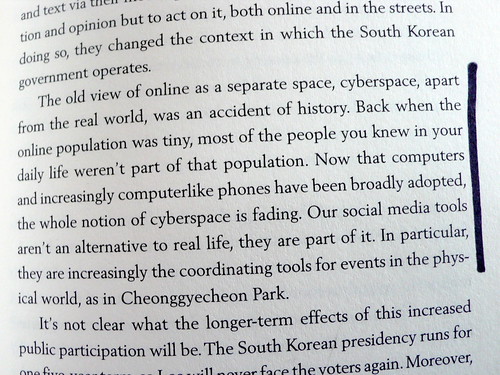
Reading this again, just now, it made me think of this - 'cyber' is one of those signifying words - demonstrating that you think that there's a set of technology that is different to or separate from life. And of what Douglas Adams pointed out about technology and age:
"1) everything that’s already in the world when you’re born is just normal;
2) anything that gets invented between then and before you turn thirty is incredibly exciting and creative and with any luck you can make a career out of it;
3) anything that gets invented after you’re thirty is against the natural order of things and the beginning of the end of civilisation as we know it until it’s been around for about ten years when it gradually turns out to be alright really."
(Though we should be careful not to conflate this observation, which feels true, with all that digital native nonsense, which obviously isn't)
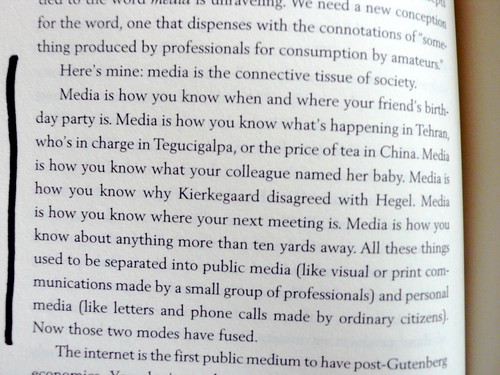
That helps me. Doesn't that help you? 'Media' is such a big, wide wet bath of a word that it's hard to get out of, it's hard to think about its edges. And this doesn't make it any smaller. But pointing out that fusion of public and personal media is helpful - and helps me understand all the things we get wrong when people who think they're operating in public media bang into people who assume they're using personal media. One lot see some clever targeted advertising, the other lot see someone steaming open their letters and inserting magazine ads.
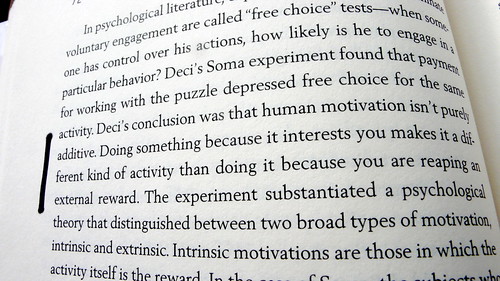
The Deci referred to is this one. The Soma experiment is described here.
I'm not going to talk about this too much, you have to read and think about the experiments and conclusions because, at first blush, they're so counter-intuitive. It's especially important to read if you're involved in trying to get people to do anything creative or problem-solving-y. I think most of us assume that there's a continuum of reward for tasks. Or that it's additive. If we'll do Task A for free because it interests us, we'll do more of Task A if we're also offered some money. Not necessarily true. And adding money to the mix profoundly changes our feelings about the task. So, in many ways, it's not the same task any more.
This helps me understand what happened to blogging when the prospects of financial reward crept in. It changed everything. And, presumably, unless people read and understand this, it's going to happen again when new creative tools are invented.
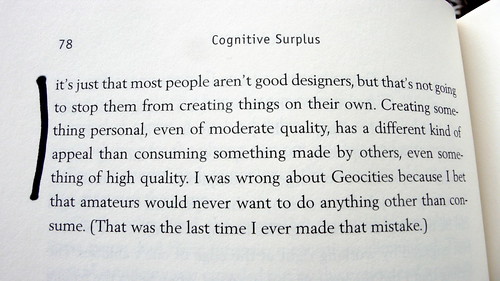
This is huge. And it's bigger than the internet. I suspect 'creating something personal, even of moderate quality' and letting people share it is going to be one of the business models of the century. And one of the social movements. Which will be even more interesting if we can squeeze the convenience and scale of the internet into other places.
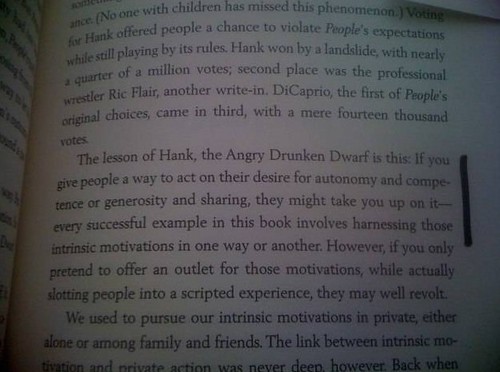
And that tells you what you need to do - satisfy a desire for autonomy, competence, generosity and sharing. Flickr does that. MyBarackObama did that. I think Newspaper Club does that. Imagine if Labour decided to redesign political activism around those satisfactions. That'd be interesting.
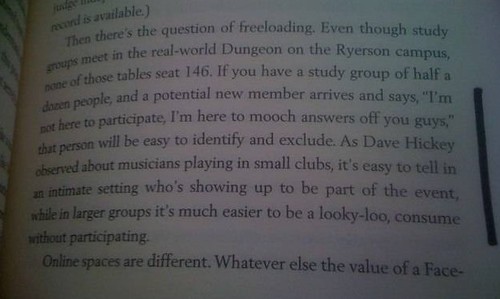
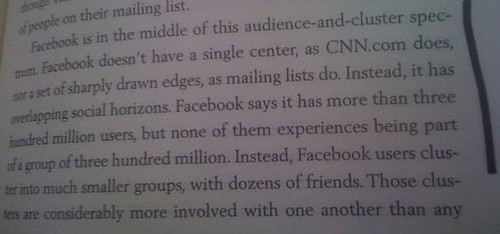
The most useful bit of Here Comes Everybody, for me, was Mr Shirky pointing out that any blog that gets beyond a certain audience size stops being personal and starts being broadcast. As he reminds us, More Is Different. The easiest way to misunderstand Twitter and Facebook is to take them as a single type of network. Because there are celebrities on Twitter, with hundreds of thousands of followers, people assume that's what it's for. That it's a broadcast, celebrity, mass audience tool. And while it is that, it's also a small, personal, intimate one. Private accounts, small networks.
I wonder, actually, whether this'll continue. Whether the public and the personal existing within the same channel/tool is sustainable or useful. I bet the next interesting thing will be tools for small networks.
cafes with friends
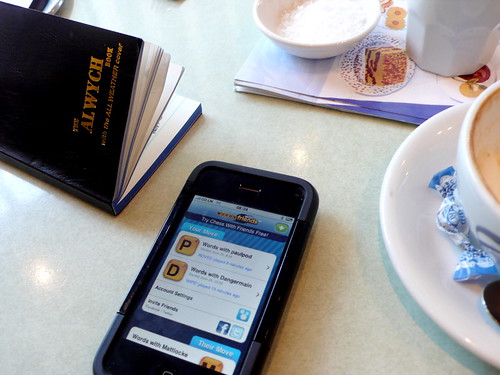
I'm something of a connoisseur of sitting in cafes. I do it a lot. Always have done. Just sitting, reading, writing notes, watching the world go by. And I couldn't imagine how that could be made better. It's simple, easy, good. But, you know what, Words With Friends, makes it better. It's like doing the crossword, but with a thin skein of social presence. No chat or banter like twitter, just a nice connection to some people you like.