My dConstruct talk has arrived on the podcast, and huffduff, so you might want to listen to it. (MP3)
I haven't been able to bring myself to do so, but I can't imagine it'll be very coherent without the accompanying pictures and videos so I thought I'd do a sort of write-up here. I've not written too much, just the bare bones, so the best experience might be to listen to the podcast and look at these pictures. (It'll be a bit like watching cricket on CeeFax.)
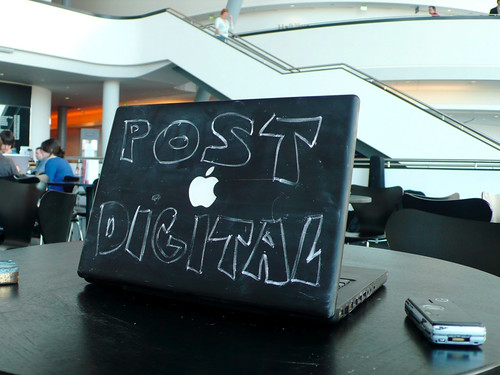
After the usual introductory hooplah we dived straight into some quick thoughts on 'post-digitalness'. Considering three aspects of that:
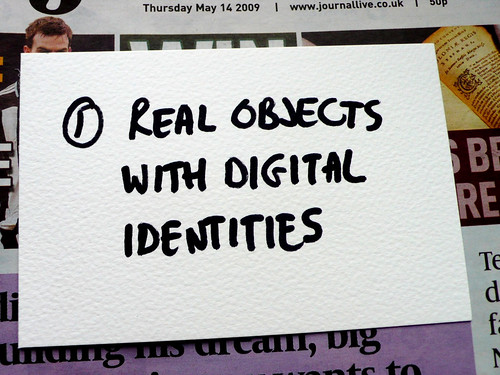
Ever since Bruce Sterling coined the word spime, this has seemed inevitable to me. And we are, in fact, seeing more and more physical things with some sort of presence in digital networks.
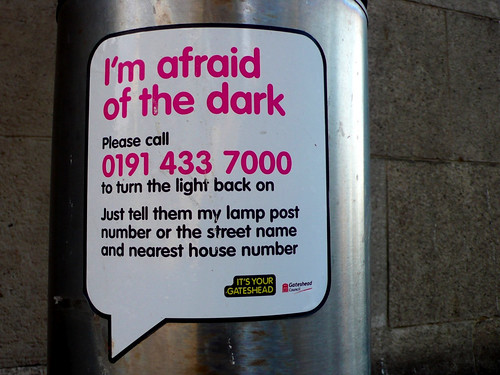
And one byproduct of this will be an increased amount of bubbly writing and things talking to us in the first person - in an effort to make all these informationalised objects friendly and not scary.
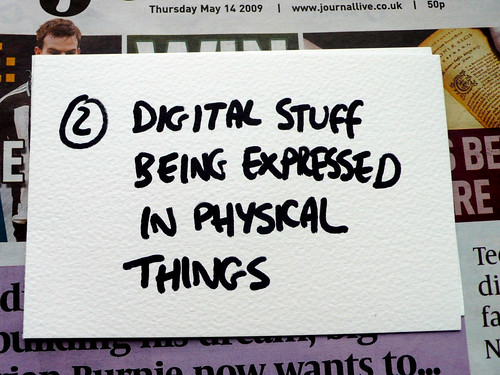
Bubblino is my favourite example of this. It's an arduino connected to a bubble-machine connected to the web; watching twitter for its own name. Adrian takes it to conferences and it's always hugely popular. And I think it's so successful because there's a really magical equivalence between the significance and value of twitter and the act of blowing bubbles. It's a splendidly well chosen conjunction.
Bubblino at Bookcamp from Adrian McEwen on Vimeo.
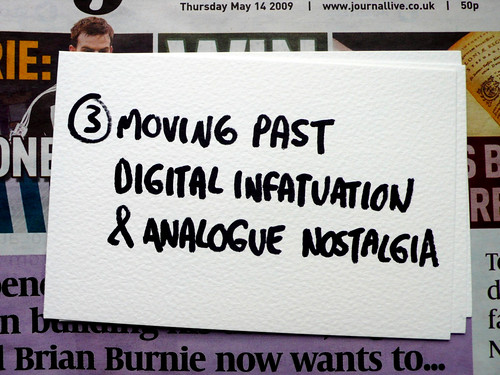
But this is probably the most interesting aspect - we're finally moving past the twin elephants in the room of technological conversation. Infatuation with everything shiny and digital, and that nostalgic, 'Lead Pencil Club' clinging to the past. We're finally getting to the point where we can decide which are the appropriate technologies to use based simply on their actual merits. And, we're starting to understand how to combine the analogue and digital in effective ways.
My favourite example is this: Things I Word Rather Read On Paper. Is it combines what the web does well; publishing, gathering, discovering and curating content (via instapaper) with what print does well; being readable, durable and portable.
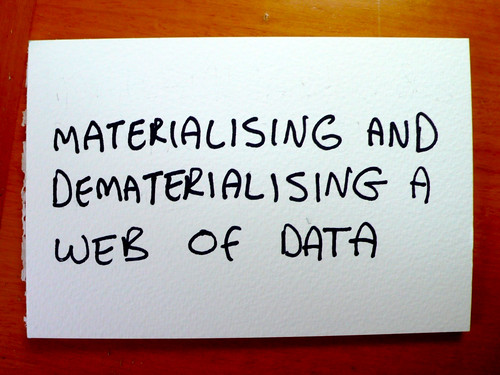
Which leads us to this rather portentous title, based, in the noble tradition of previous talks I've really enjoyed at dConstruct from Tom Coates and Matts Jones & Biddulph (MP3). All I've done is expand on their notion that the web it is moving beyond being a thing of sites and is becoming a thing of APIs and services. They've suggested that our data is escaping the boundaries of any particular website, I'm just suggesting that we are soon going to see it escaping the boundaries of the web itself - and of all those glowing rectangles.
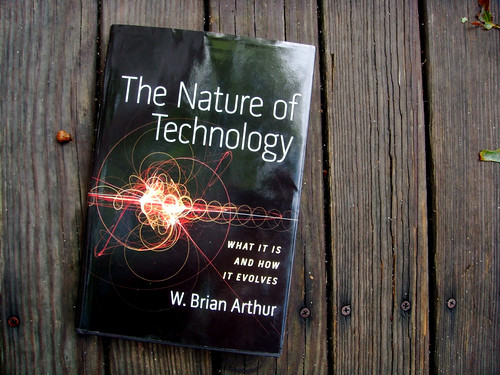
And this excellent book has given me some intellectual backing for exploring this further.
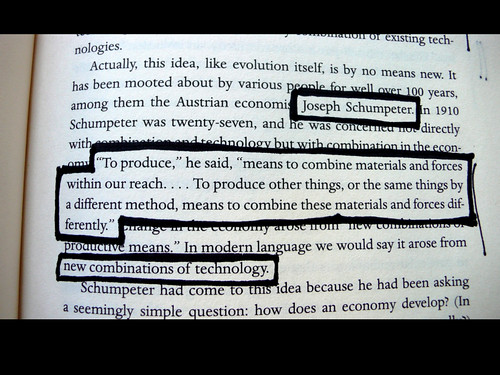
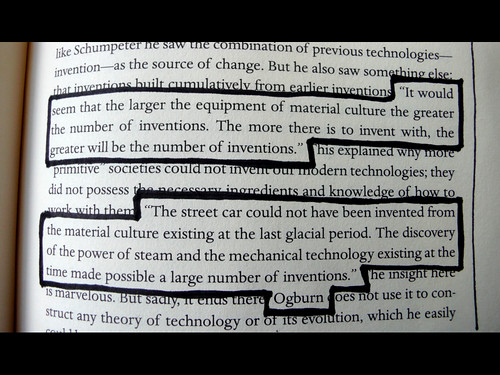
First point worth noting - all technologies grow out of previous technologies. The more technology there is around, the more there is to invent with.
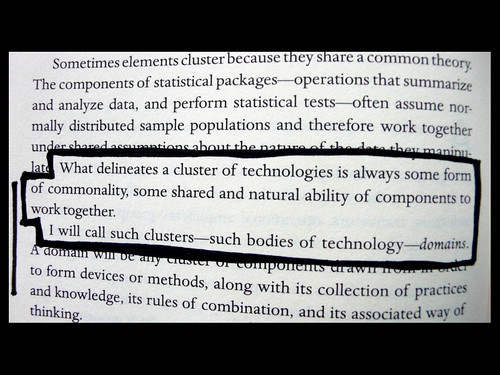
As technologies develop, certain elements come to be used together frequently and particular technologies cluster together in what Arthur calls domains. He talks about how a particular combination of pistons, turbines evolved into the aeroplane engine- and found a peak of development in the Rolls-Royce Merlin.
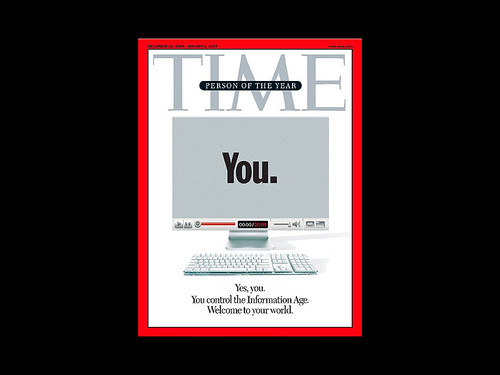
And many of us have been working in a particular technological domain too; that of the web and social media. One that's been extraordinary successful - economically and culturally. So successful that we were all Time's Person of the Year.
victory from russelldavies on Vimeo.
But all this success made me think of this little moment from the World At War - a French general talking about the construction of the Maginot Line, and about how clever and successful the French thought they were. And it made me wonder if we weren't in a similar place - starting to be a little too pleased with ourselves and our social media revolutions.
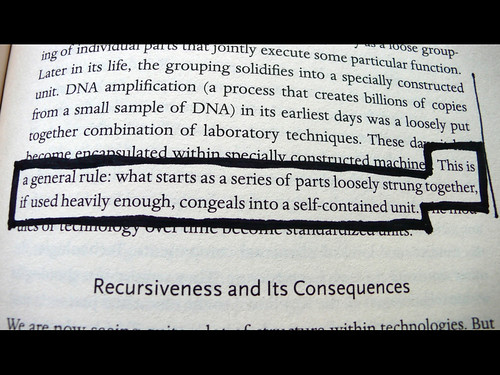
And Arthur talks about another phenomenon in the evolution of technology - how things that are used together often enough start to congeal into a single unit. We don't talk about the various components of the engine, we talk about the whole thing - as a single technology.
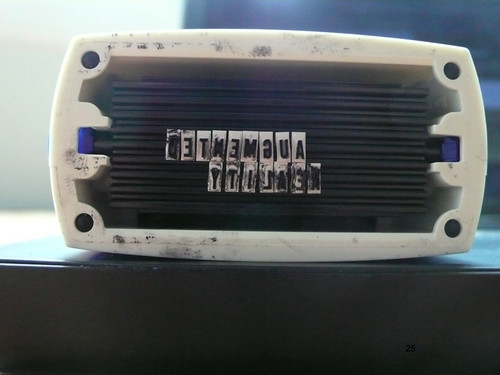
Which reminded me of the origins of the word 'cliche' - in the days of movable type it meant a set of letters/words that were used together so frequently that the printer didn't bother dismantling them. Which got me think about the cliches we're building, and about one in particular - the screen.
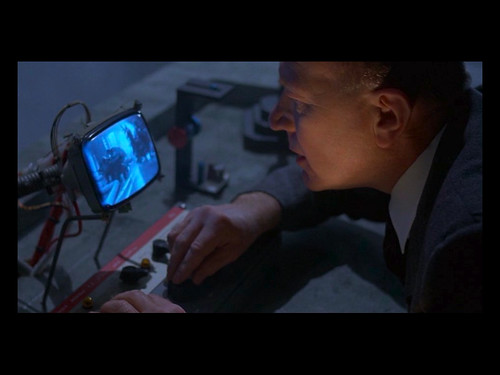
Because these glowing rectangles are appearing everywhere in our lives. Pouring out into the world.
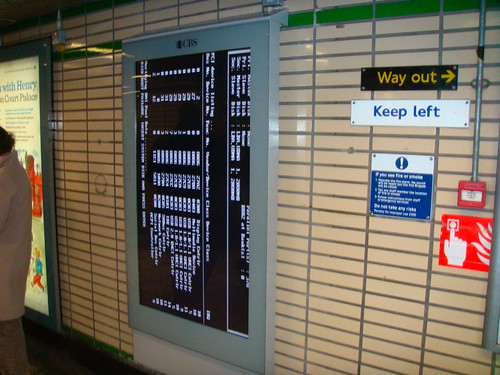
And they don't always work well. They don't fail gracefully.

We haven't really learned how to design or write for them yet.
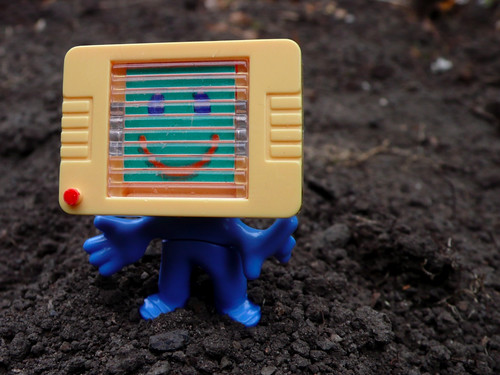
They're so common, you even get them in Kinder eggs. And they're only going to get cheaper and more ubiquitous. And I wonder if that's always a good thing.
Look, for instance, at this video - Drone Controllers Execute Hellfire Strike - it's hugely impressive and deeply chilling, and illustrates for me, the distancing effect screens can have, the way they can come between us and the world. Should we really be thinking about doing more of this, of putting more screens in the world, of deciding to walk round staring at everything through an augmented reality lens. Obviously it'll be great for some things - but should we not be considering some alternatives?
(If only because people don't seem that impressed with screens any more. You can do the cleverest, most expensive, most extraordinary bit of programming but put it on a screen and everyone'll think they've seen it before. And they probably have. In a movie.)
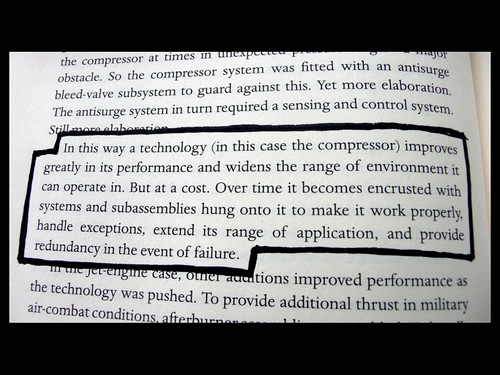
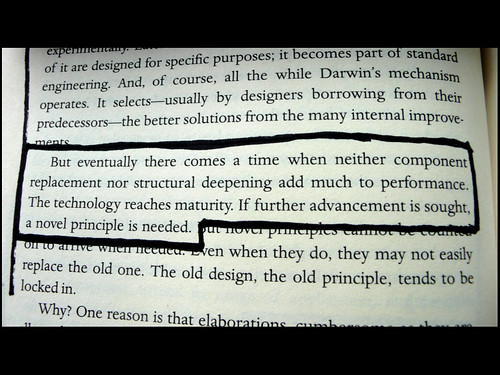
So, let's turn back to Arthur and see what he can tell us. For instance, doesn't this description of a mature technology feel just like the web right now? "encrusted with systems and subassemblies hung onto it to make it work properly, handle exceptions, extend its range of application, and provide redundancy in the event of failure."
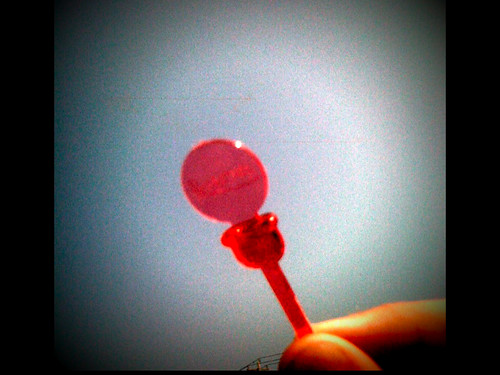
By way of illustration I showed the audience this. It's designed to go in the hole in a coffee cup lid.
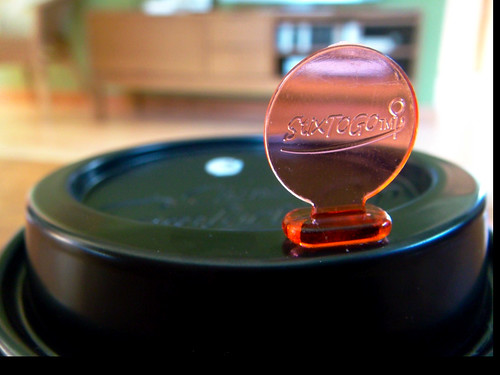
It seems like the ultimate example of a technological dead-end. It's useful, it does what it's supposed to, it solves a problem. But it reminds me of many of those applications built on top of twitter. We're solving the problems we created. Tinkering at the edge of things.
technology from russelldavies on Vimeo.
(And, of course, it's not the only way to solve the problem. There's a rich ecosystem of products and solutions around coffee cup lids.)
This is how a lot of web stuff feels to me right now. We're looking for ways to escape this way of thinking, but we're just encrusting the old model with new sub-assemblies.
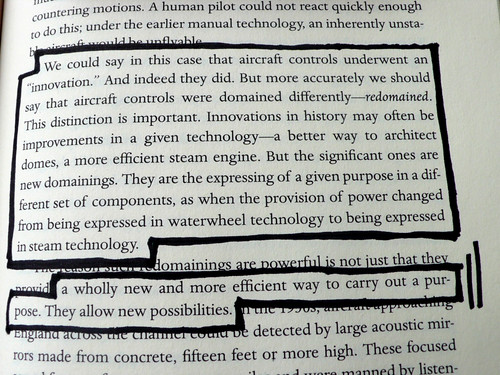
Arthur suggests that the answer is redomaining - introducing new components and new ideas from a completely different technological domain. This is how we get something genuinely new - not just by improving what we already have. This is one reason I suspect so many of us are looking at analogue technologies - we're trying to find a new domain we can combine with our existing digital expertise.
And the other reason is this:
brilliant from russelldavies on Vimeo.
There's something primal and irresistible about physical/analogue technologies. Compare and contrast the delight of this rocket engineer's 'brilliant' with the affectless 'excellent job' of the drone operators. Physical stuff reaches us in more fundamental ways than more stuff on screens.
(And a parenthetical thought occurred here)
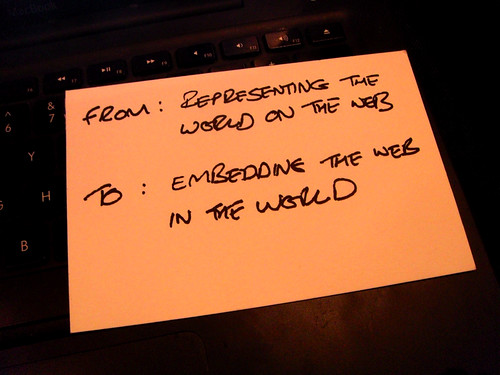
And, actually, that's probably a good place to stop. I then talked about how some of this stuff had found practical application in the creation of Newspaper Club, and the lessons we'd learned doing that. I'm sure I'll bore you all rigid with that at some point in the future, so maybe we should end with the summary of what I thought I was saying. This:
And, finally, huge thanks to everyone at dconstruct - clearleft, the other speakers and the crowd. It was a tremendous day out.