Russell Davies

As disappointed as you are
About | Feed | Archive | Findings | This blog by email

noho square allotments

2954237349_2a8ba67599

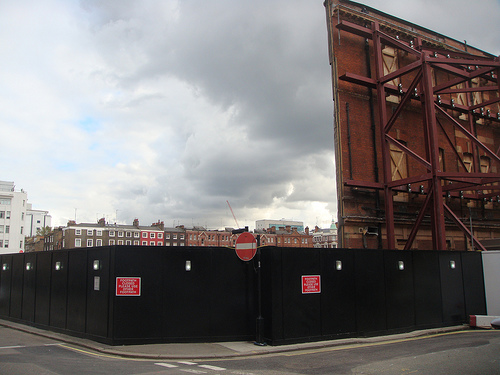
Well, my idea was obviously fanciful and impractical, but this one - for temporary grow-bag allotments on the site of the old Middlesex Hospital - is much obviously much better. And probably do-able. And exactly the sort of thing an enlightened developer would support or an enlightened brand would try and get behind. We've signed up, here's hoping.

2626308422_2f1648a073

June 01, 2009 in diary | Permalink | TrackBack (0)

interesting berlin

3527293883_4299884af5

It's happening everywhere. Interesting Berlin. June 12th.

May 13, 2009 | Permalink | TrackBack (0)

I like things to be numbered

1346427438_646aa120dc

Below is a 3 minute extract from Radio 4's show The Museum Of Curiosity. It's Chris Donald talking about a bridge plate. Packed into this three minutes is an explanation of so, so much that seems true and good to me, including the proto-spime nature of railway clocks.

MP3 here.


May 05, 2009 | Permalink | TrackBack (0)

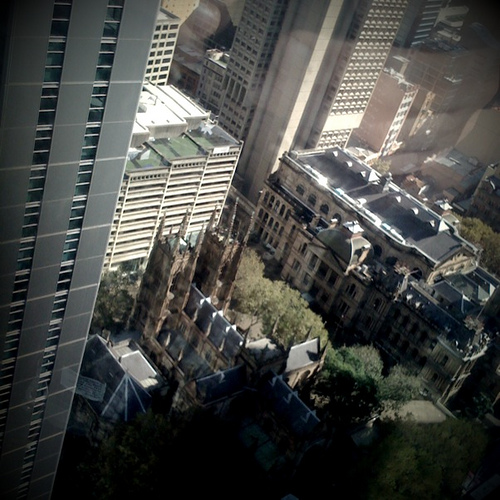
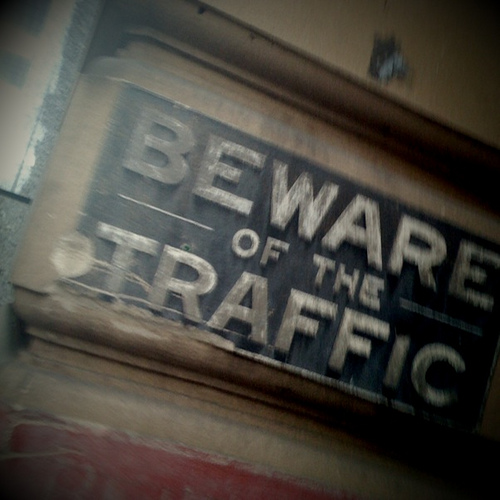
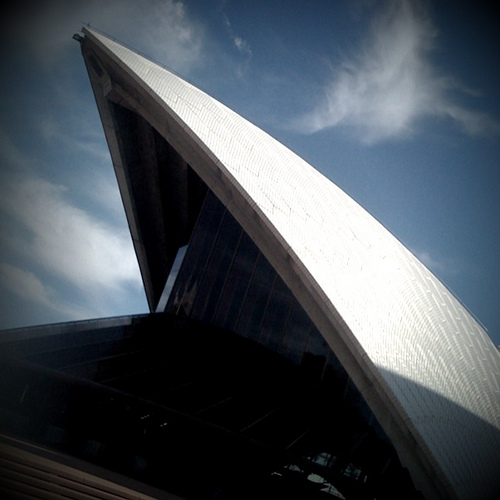
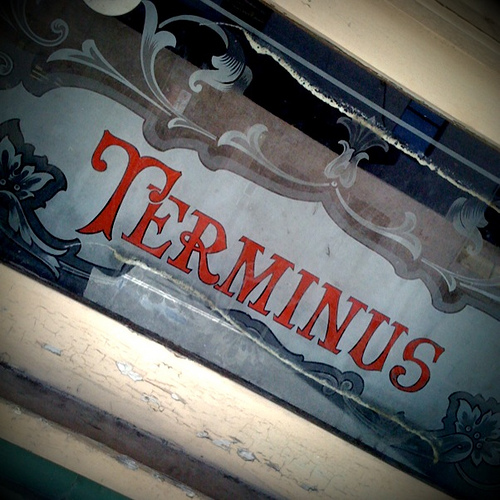
sydney

3472121833_4a98b9b07e

3478369479_accccc6128

3474970047_f3b5856450

3472928500_cc2b4b0ea1

3467308315_35580a316e

3469759339_8a65f35c37

3470564404_6b0075a0a9

3472124203_498689b715

3472930880_ecdaf0df8e

3474317932_56dac18a62

3475779254_1b272d8377

3479178184_8e90b0ac90

3479178548_ac17c01b14

3485806256_2c78d1d957

3486040456_0129c8917d

April 29, 2009 | Permalink | TrackBack (0)

BIG

L1090832

Dan very kindly took me to a talk by Bjarke Ingels last night. It was very good. I liked the architecture, but I'm not really qualified to talk about it. However, it was really interesting to hear about the interior of another sort of business - it seemed there were quite a few things that BIG do, that I've seen in other good creative businesses.(Including, unfortunately, lots of horrible flash on the website.)

1. They don't seem to be precious about ideas. They don't cherish them, regard them as valuable or hard to have. They have lots and lots of them and then prune, recombine and mutate. He talked about this as 'excess and selection'. You have an excess of ideas and then pick the ones that seem to fit the problem. (And you keep them all, because they might come in handy next time.)

2. The work environment is part of the process. Each project is documented on the walls of the office as it's being done. So anyone in the office can see what's going on, and contribute. It all seems to be a very open and collaborative practice.

3. There's a charismatic front-man. Mr Ingels himself is a great presenter, funny, smart, personable, and above all, convincing. He's great with powerpoint, managed to talk for more than an hour about architecture without any baffling jargon and is clearly someone you'd want to spend time with.

4.  They're happy to be opportunistic and pragmatic. Their didn't seem to be a lot of big theories, just a desire to get good stuff actually made. They're as adept at engineering the political/client reality to get something done as they are at making the building. If you need to put a huge picture of the client in the lobby to get the building made, then do that, and don't do it grudgingly, do it well, make it good, make it a postive.

5. They use video really well. They make a lot of films that make their projects understandable, and feel real. And use music well to add that convincing emotional depth.

April 28, 2009 | Permalink | TrackBack (0)

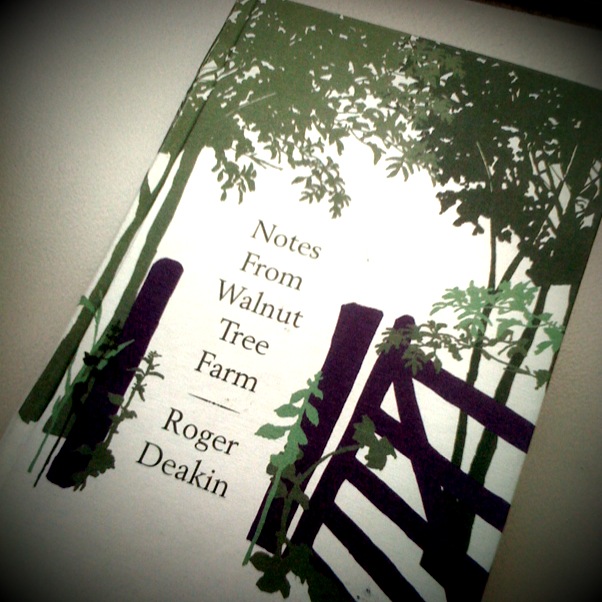
blog all dog-eared pages: notes from walnut tree farm

IMG_0648

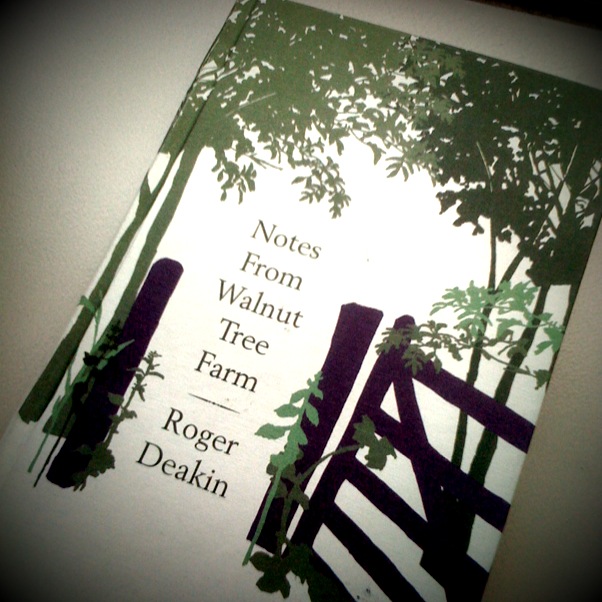
I don't normally go in for nature books. I don't know enough about nature, I don't have enough vocab to follow them. The conceptual bricks aren't there. But I bought Notes From Walnut Tree Farm because I discovered it had some references in it to Rogue Male, (my all time favourite book ever) and I've slightly fallen in love with it.

It's a set of jottings and notes by Roger Deakin organised, after his death, into a rough diary of the seasons. And it lends itself rather well to Mike's 'Blog All Dog-Eared Pages' format. (Incidentally, doesn't 'Blog All Dog-Eared Pages' seem like a rather exact precursor to what Steven Johnson is talking about here. Imagine how popular this would be if you didn't have to transcribe stuff by hand.)

Anyway. Here we go.

Page 21 - On corduroy (for Ben)

"We wore corduroy in those days: Barrell wore navy, Chapman wore black, I wore dark brown. I also went in for brown herringbone tweed jackets or overcoats. The jacket was very expensive, bought from Jaeger after working with Ken Russell, who wore the full works: brown herringbone trousers, jacket and matching cap. I couldn’t even afford the jacket, but bought one anyway.

I now realise that all these English country gentlemen outfits were designed to make you look as much like a ploughed field as possible."
526264020_c7446e5955

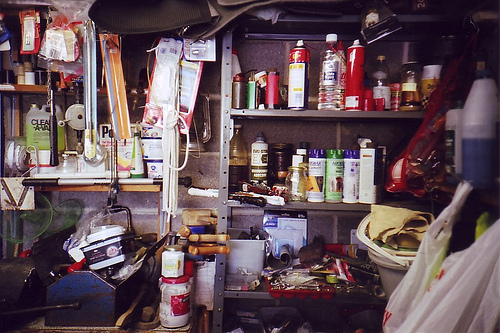
Page 22 - On tools and sheds

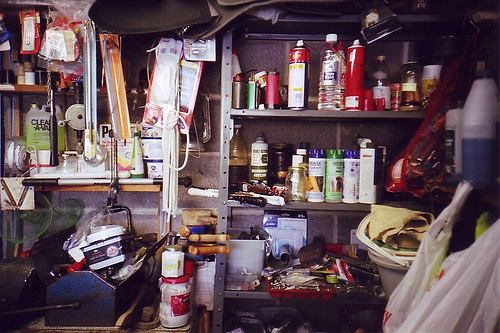
"There are many of us for whom the shed is a natural habitat. Mine is full of woodworking tools; a classic Myford ML8 lathe, band-saw, circular-saw and various drills, Skil-saws, planes. A whole wall of screwdrivers, chisels and gauges, and little drawers full of screws and fixings. Shelves of varnish, oils, stains and paints, and more drawers with drill bits, seeds, cramps, vices, an adze and several wedges for splitting wood. Handsaws, jigsaws."

There are many lovely passages in the book in praise of tools. There's also this, for instance, from page 296:

"The Whole Earth Catalogue, our bible as self-builders of our residences in the hippie-ish days of the 1970s, was subtitled ‘access to tools’. ‘With tools,’ ran the editorial preface, ‘you can do more or less anything.’

Buckminster Fuller weighed in at the front with an encouraging piece about geodesic domes, and a movement was launched all over the world. They showed the earth as a tiny planet on the front cover, as photographed from space.

Tools were what we needed, and tools were what went out and sought. I went to farm auctions and bought impossibly long wooden stack ladders nobody needed or wanted any more for a few pounds. I bought a giant old 1948 Fordson Major tractor with a six-cylinder Perkins diesel engine in perfect working order, and a full armoury of ploughs, harrows, cultivators and hay-cutters to go with it, for well under £600."

There's also a couple of little moments about the joys of driving, like this one on page 272:

"In a dark Norfolk lane driving at speed behind Adam Nicholson in his V.W, the brown toasted beech, oak and chestnut leaves swirling and tumbling in the slipstream of these cars as we whiz along beside the wide verges and hedges. This is how roads were meant to be. No mean farmers pinching bits of land."

I think this is what turns the book into more than just a paean to nature. It acknowledges, and likes some of, the technological, human-made world. It made me wonder how, when and if, the digital tools we work with today will end up integrated into a natural world view like this. Will a dusty old N96 feel as smooth, natural, and timeless as an old hammer in 50 years? Is it somehow inherently less 'natural' than a saw? Is it to do with materials? With screens? With needing a power supply? Lathe's need power and must have seemed un-natural and outlandish once. Now, not so much.

(Incidentally that reference to self-builders in the Whole Earth passage struck a chord with me too. It's the stuff that's being self-built that's so exciting at the moment. Not houses necessarily, but the most interesting digital and post-digital tools and toys.)
124795406_aeb576e7b7

Page 27 - On the architecture of trees

(He's describing a programme he's filming for Channel 4)

"I talk about the architecture of a tree, about its essential cone shape, with the branches cantilevered from the central tower of the trunk, tubular structures being the strongest. I stand beneath the branches and say there are thirty-five of them, and their combined weight must be several tons. I love the horizontality of oak. Of all trees, it has the strength to float its outstretched branches out at ninety degrees to the trunk. These horizontal branches exert enormous forces at the cantilevered joint, which must be immensely strong. That is why the joint pieces are so sought after by carpenters and shipwrights. They are the ‘knees’ of ships, binding the ribbed frame together, joining the horizontal keel to the upright stern and bow."

Like I say, I don't know much about nature and trees. But talking about a tree as an engineering issue connected with me somehow. I think that's something I'll pay attention to next time I see one.
2884722054_89d47f7a4b

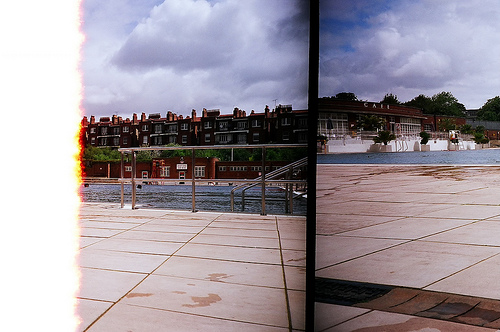
Page 73 - On lidos

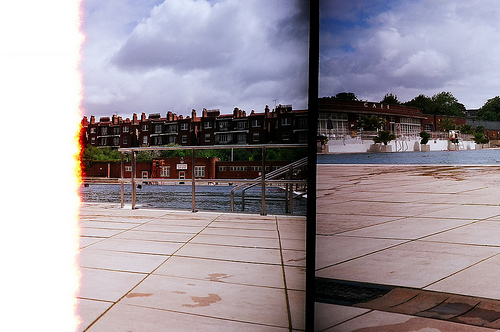
"Lidos are more fun than swimming pools. Lidos are to swimming pools what cathedrals are to churches. They are much more fun, they leave a lasting impression, and they cost a lot more to do up these days. ‘Fun’ is a word you immediately associate with lidos. Nobody can ever quite agree whether to say ‘Leedo’ or ‘Liedo’ (a place for lieing down in the sun). It is one of those words, like ‘toilet’  that we have borrowed from the Continentals, and tried unsuccessfully to Anglicise. ‘Toilet’ sounds much better as toilette in the original French. And ‘lido’ sounds much better in the original Italian."

Mr Deakin knew what he was talking about with lidos. His most famous book is probably Waterlog, a chronicle of swims up and down the country.

Page 106 - On silence

"Sometimes, when it gets too noisy in the country, I escape into the sheer throbbing silence of my flat in the city. I hear only the blackbird in the back gardens and, pressing my ear to the pillow at night, I hear the distant rumble of the tube trains on the Northern Line far beneath the house, heading out of Chalk Farm, uphill to Belsize Park, deep under Haverstock Hill."

You see, he's done it again. He's made the tube sound natural, like an enormous bear or a thunderstorm. Will this one day happen to an iPhone?

Page 142 - On visiting Dylan Thomas's old writing shed at Laugharne

"Thomas mostly wrote not in the boathouse but in its wooden garage. So, like garage music, his was garage poetry. I see straight away that it has the optimum dimensions for a writing shed; fourteen by nine, with a whitewashed boarded ceiling over a pair of pine cross-beams a foot above head height.

There are two windows in the shed, now brought up to a standard of repair far higher, I imagine, than in Thomas’s day, and a wooden floor with a single, diminutive scrap of a rug on it.

The place has been window-dressed to look as if the famed artisan has just popped out in mid-flow for a cup of tea, or more likely a beer or a pee. One imagines that DT must have been a much stained man; his fingers nicotine-stained, and perhaps his trousers eroded by dribbled pee in the frequent visits to the gents at Brown’s or the Three Mariners."
64584411_5d519c8169

Page 155 - On fire

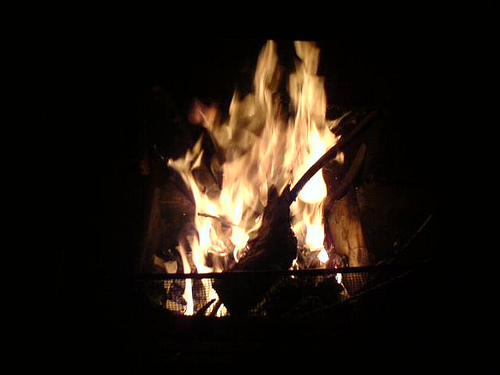
Mr Deakin was once an advertising copywriter and wrote a famous tagline for the Coal Board - Come Home To A Real Fire.

"I really do want people to come home to a real fire. A nation without the flames of a fire in its hearth, and birds singing outside the open window, has lost its soul. To have an ancient carboniferous forest brought to life at the centre of your home, its flames budding and shooting up like young trees, is a work of magic."
3245929606_1d7b5ac92c

Page 290 - On pockets

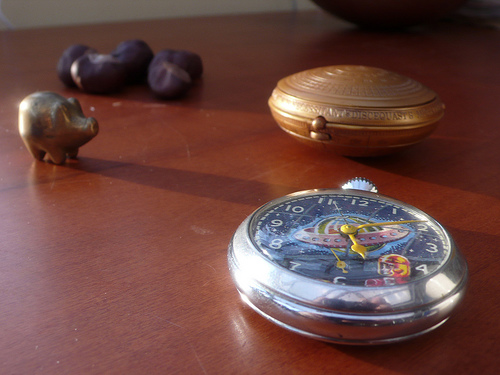
"Boys pick up odd things – a snail, a pebble, a leaf, a dead beetle, a chrysalis, a bit of sheep’s wool on a fence – and their pockets soon come to resemble birds’ nests. The contents of the pocket have no intrinsic money value but they do have great sentimental value to their owner. They become a microcosm of the local landscape, of the boy’s habitats and haunts."

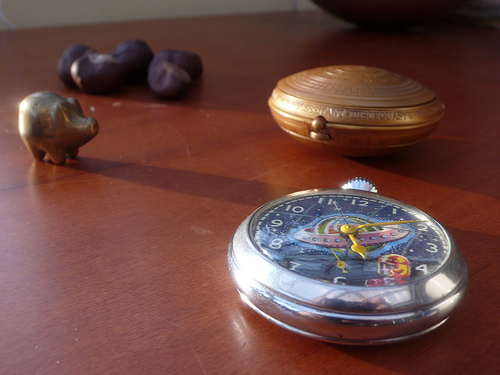
I've long thought that pockets deserved more study. Dan made a great start here, but there's a whole lot more to be thought about. It's what tends to end up in the pocket that's interesting. And so many modern devices don't have the pocket appeal of conkers and fob watches.

Anyway, there we are. Well worth a read. (The pictures are mine by the way, nothing to do with Mr Deakin, just things that seemed to fit.)
April 26, 2009 | Permalink | TrackBack (0)

spooky action at a distance


494850748_f5880bdc37_o

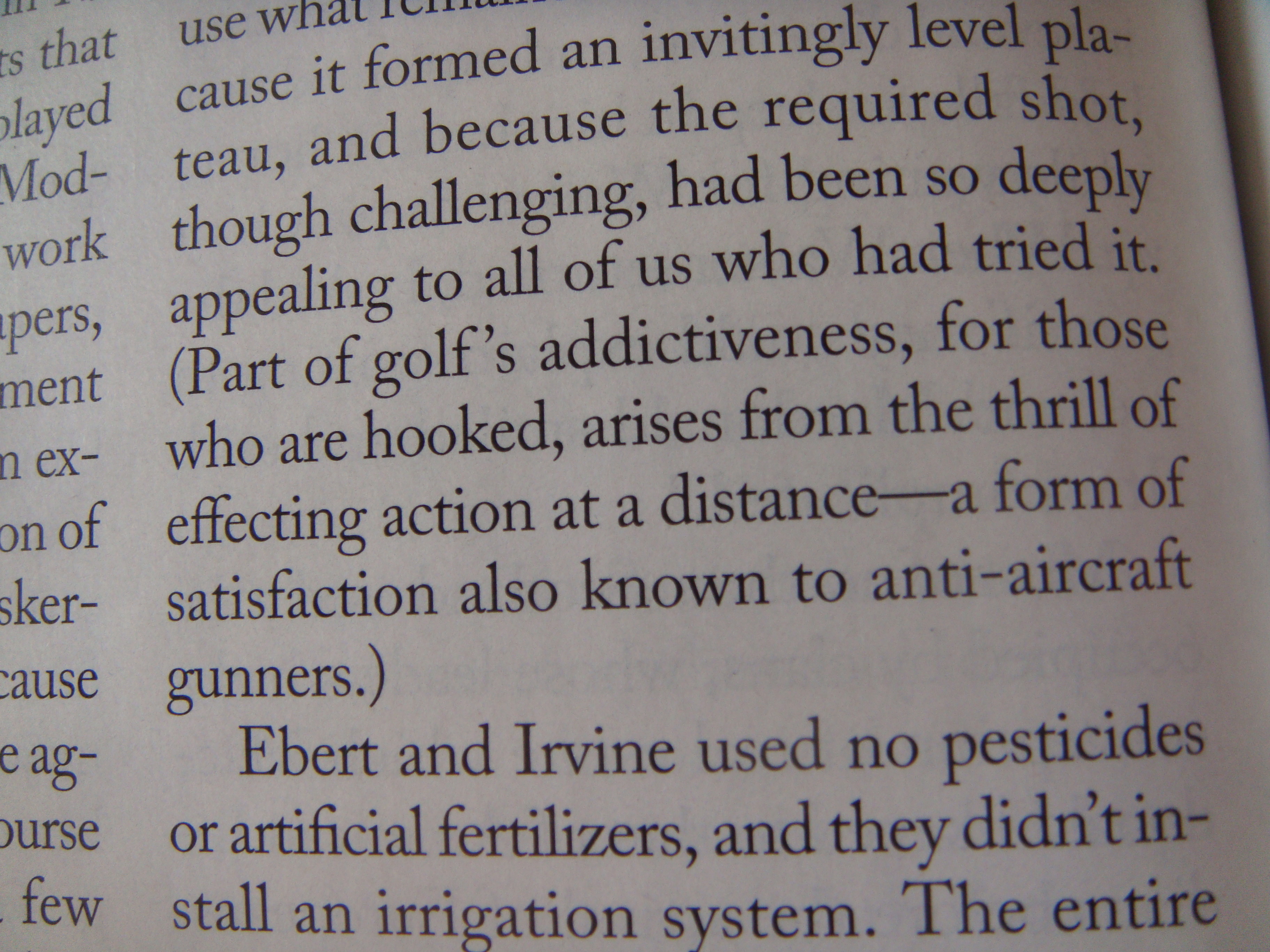
There was a tremendous article about a golf course on South Uist in last week's New Yorker. (Not online, unfortunately, but there's a related audio slideshow.) It included this little parenthetical thought: "Part of golf's addictiveness, for those who are hooked, arises from the thrill of effecting action at a distance - a form of satisfaction also known to anti-aircraft gunners."

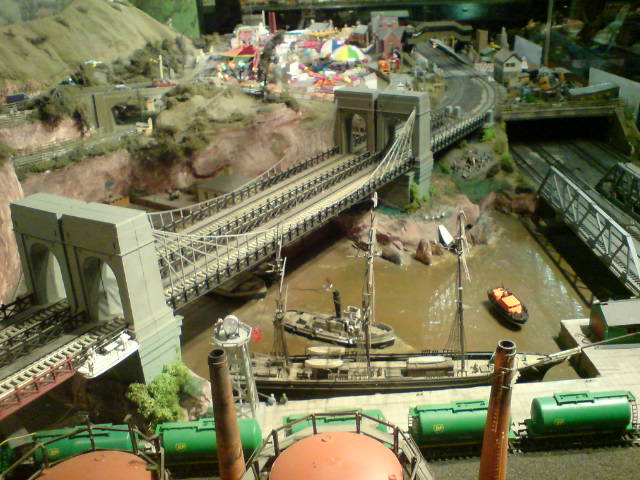
It reminded me of the fun we had a few years back at York Model Railway. It's an excellent lay-out, big, but it's made even better because there are buttons you can press which makes lights light up in windows of houses, or make windmills turn, really simple things like that. We go to lots of museumy places, with interactive exhibits, and most of them are much too complicated and involved. It's worth remembering how hard it is to beat something as simple, yet splendid, as 'the thrill of effecting action at a distance'.

April 25, 2009 | Permalink | TrackBack (0)

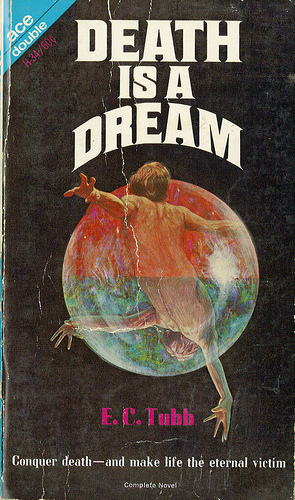
there's a difference between decline and death

Deathisadream

In 'the future' there won't be as many big newspapers businesses. That seems obvious. They're already closing down. The ad revenue isn't there to support all the newspapers we have. There are rival information sources. But there will still be lots of newspapers. That doesn't mean all newspapers will disappear. There's probably enough ad money for some to survive, maybe less money than now but still be lots of money. And newspapers will be funded in other ways; local authorities, community groups, charities, whatever. The newspaper form factor is too good to just disappear because some businesses are failing. There will be lots of newspaper businesses.

There won't be as many big TV businesses. As above. Ad revenue declining, lots of competition, harder to make money. But there will still be lots of TV. As above. There'll still be enough ad revenue to support lots of programmes, though they may not be organised and distributed exactly as they are now. Other funding models will arrive. If you want to be in television you'll still be able to. You just might get paid a bit less, have to be a bit better at your job and might end up a bit less famous.

There won't be as many big movie/advertising/publishing/music etc businesses. I guess you can see where I'm going here. But there will still be lots of movies/advertising/books/music etc. And I don't just mean that they'll all become cottage industries. Big, global, megacorps will survive. There just won't be quite as many, and they won't be quite as powerful. (Though I guess some might be more powerful because they'll have a bigger share of a smaller market.) So if you really want to be a music industry mogul you probably could be. It's just going to be harder. The marketing world will still want big agency networks, just not as many, and doing slightly different things. There'll still be publishing companies publishing books. Will they have the same cutlural dominance as in the 20th century? Possibly not, but neither will they have none.

All this is, of course, obvious. But I get fed up sometimes with people going on about the death of some industry or other. (Though, thinking about it, I suspect I might have done it myself) The issue they're all facing isn't death, it's decline in the size of the businesses involved, but that's often coupled with a growth in other things. TV's business troubles have led to a creative rennaisance. Newspapers are more widely read than ever, and probably more influential, while struggling to make as much money as they used to.

If you really want to debate the future of these things the thing to discuss is how significant that decline will be. Will Industry A shrink to the size of, say, Radio (which is still a massive and fascinating business) or to the size of Music On Vinyl (which isn't a massive business, but still represents a living for many people.)

April 17, 2009 | Permalink | TrackBack (0)

jottings

3438111476_376d42bb3a_o

I've been reading Roger Deakin's Notes From Walnut Tree Farm and I came across this bit:

"Much as I enjoy the process of writing and the exercise of my own skill and craft in getting it right, none the less I would often prefer to be a jotter. Jottings in their spontaneity and complete absence of any craft, are often so much truer to what I actually feel or think at a given moment."

Doing proper writing seems to have got me a bit stuck at the moment, trying to give blog things too much coherence and structure. That's no good. Need to do more jottings.

April 13, 2009 | Permalink | TrackBack (0)

sounds

Interesting soundscopy.pdf (1 page)

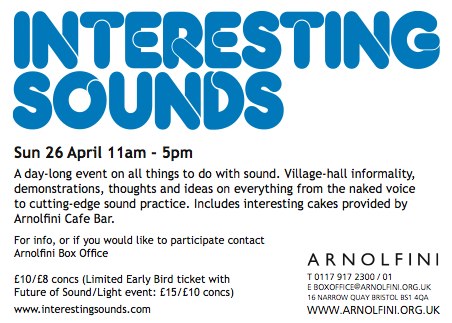
Like I say, I can't be there, but it's still going to happen. And there seem to be some really interesting people lined up for it. Very worth checking out.

April 12, 2009 in interestingsounds | Permalink | TrackBack (0)

« Previous | Next »