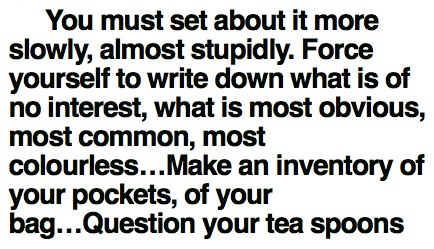
George Perec, quoted in Queuing for Beginners
George Perec, quoted in Queuing for Beginners
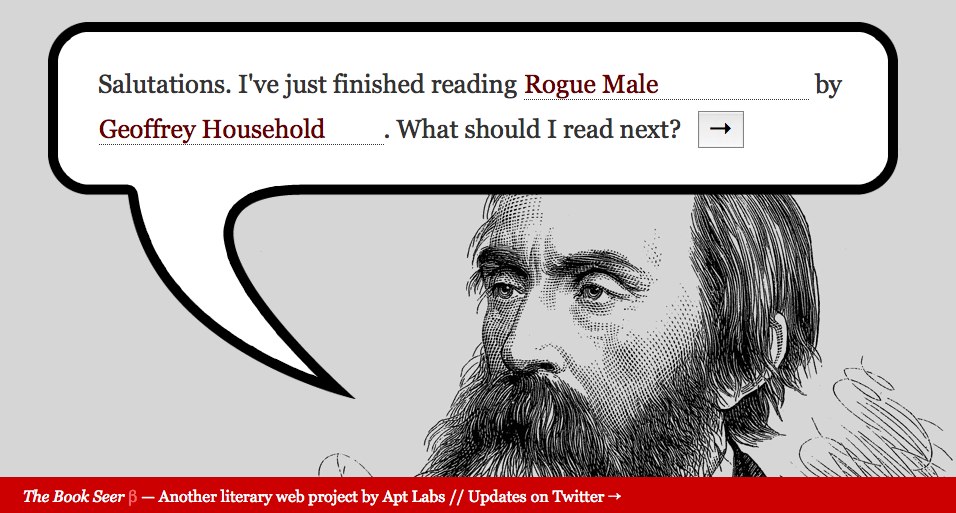 The Book Seer is a splendid project from James at Apt. It's simple and seductive on the surface and clever and thoughtful underneath. And it's got a man with a big beard. You should take a look. And you should also read his post about it, because it explains in lay-person's terms, with The Book Seer as example you can understand, why stuff like good data practise and linkability and APIs are important. Verily 'tis dead good, even unto the end.
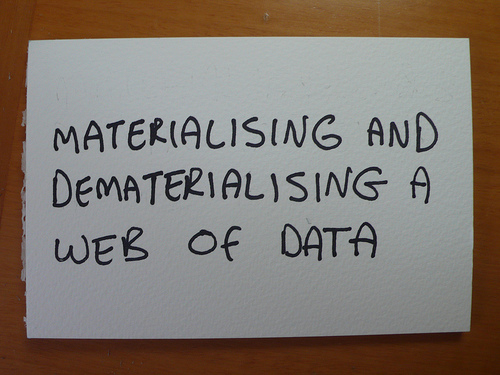
I'm rather honoured to be talking at dConstruct this year. I went in 2007 and glimpsed a whole new world I knew nothing about and now I've got to think of something to say in front of all those people. Erk.
So far, what I'm planning to talk about is above and in the blurb here (skip down past the embarrassing bio, I still never really know what to write for those things, Adam's is much cooler).
And once upon a time I could have quietly thought about this from now until September and turned up and said some stuff and that would have been fine. But in the accelerated discourse of the web I'm already almost out of date. Just yesterday, Matt said a lot of what I was thinking about and said it much intelligenterer, with lovely prototypes and diagrams. And examples, ideas and language will keep popping up between now and then, rendering any attempt at pre-thinking this stuff almost useless. (Which is probably just an elegant way of leaving everything until the last minute.) So, I thought I'd try and keep track of how the thing develops on here and via a draft version on slideshare (which I'll stick up shortly), so, if you're thinking of going to dConstruct you can afford to pop out for coffee during my bit.
And. Well. That's it.
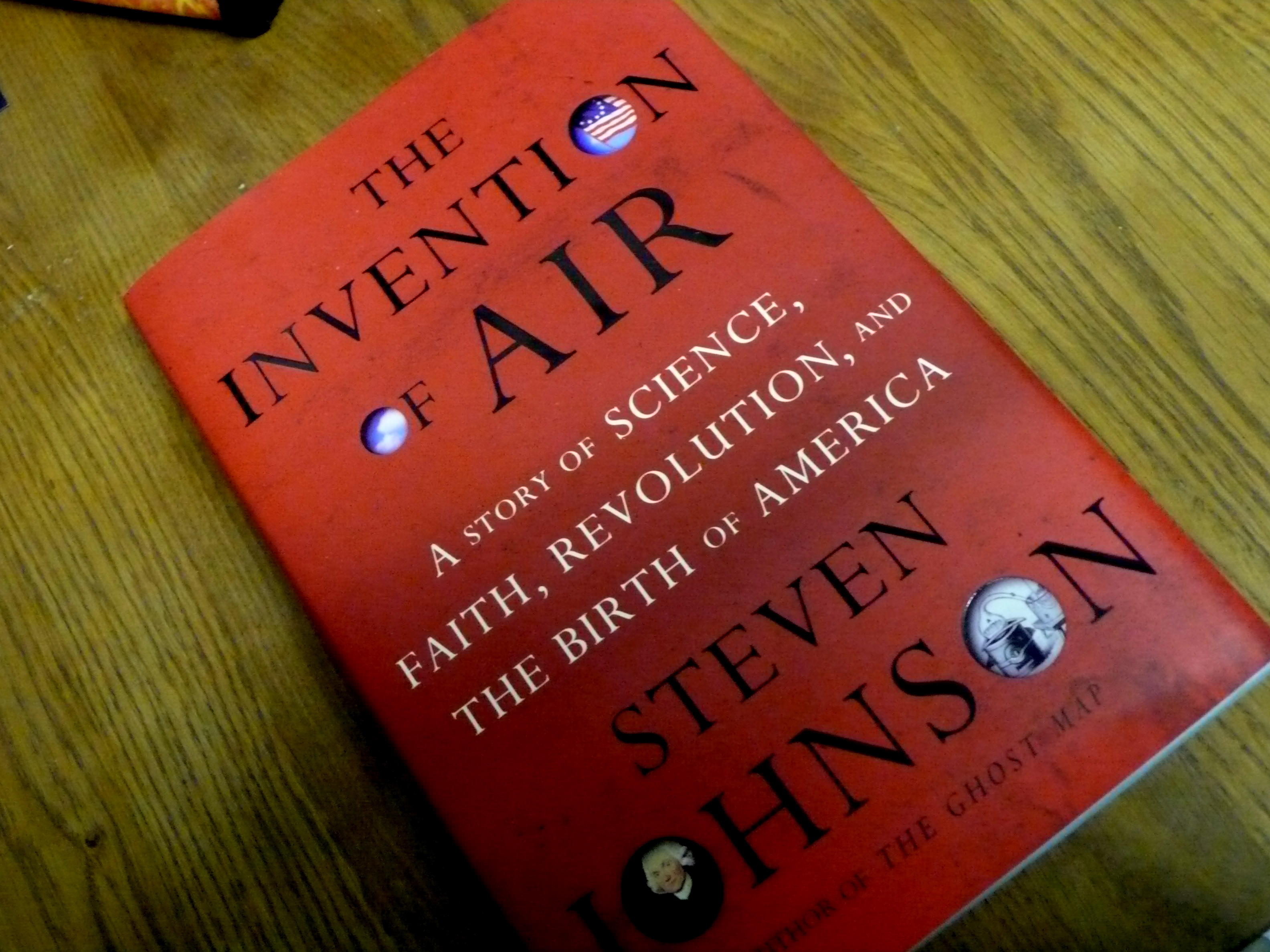
Reading Steven Johnson's piece in Time about twitter reminded me that I didn't do The Invention Of Air, and I certainly dog-eared a lot of pages. So here it is. It's a lovely book by the way; readable, wise, smart. It's got history in it but it's not just history. And it has narrative but it's a narrative that spans disciplines and ideas, it's like a focused version of James Burke's Connections, like diving into a Connections fractal or something. Anyway, highly recommended.
Here's a bit from the Author's Note at the beginning:
"One of the things that makes the story of Priestly and his peers so fascinating to us now is that they were active participants in revolutions of multiple fields: in politics, chemistry, physics, education, and religion….…My approach, instead, is to cross multiple scales and disciplines – just as Priestly and his fellow travelers did in their own careers. So this is a history book about the Enlightenment and the American Revolution that travels from the carbon cycle of the planet itself, to the chemistry of gunpowder, to the emergence of the coffeehouse in European culture, to the emotional dynamics of two friends compelled by history to betray each other. To answer the question of why some ideas change the world, you have to borrow tools from chemistry, social history, media theory, ecosystem science, geology. That connective sensibility runs against the grain of our specialized intellectual culture, but it would have been second nature to Priestly, Franklin, Jefferson, Adams, and their peers. Those are our roots. This book is an attempt to return to them."
The bit of the web I've been lucky enough to stumble into feels a bit like that. It feels like there's a connective sensibility there, people interested in, and doing, all sorts of stuff. I suspect that was true in advertising and marketing 20 or 30 years ago, it was a field that drew in generalists and people interested in everything. And it was true of 'digital' five or ten years ago. But then professionalism rears its head and people crave the respectability of 'specialized intellectual culture'. You get qualifications, institutes and awards and the connective sensibility fades away; the generalists move somewhere else. That seems, to me, to be happening now to 'social media'; codes are codifying, conventional wisdom is being agreed, the unwritten rules are being written down for the next generation, the people who'll work in social media but won't have invented it. And soon there'll be an Institute Of Practitioners in Twitter. Time to move on.
Page 7 - on optimism
"To embark on such a journey at the age of sixty-one took a particular mix of fearlessness and optimism. Priestly had both qualities in abundance. Nearly extended description of the man eventually winds its way to some comment about his relentlessly sunny outlook. He was almost pathologically incapable of believing the threats that arrayed themselves against him."
Optimism is such a powerful force, and one that digital culture appears especially tuned to resist. Every optimistic or positive noise on the web seems to come with in-built inverted commas. Yay. FTW. When you occasionally come across naked positivity it looks startling and naive. I think that's a shame.
Page 18 - on coffee and Welsh rabbits
From Boswell’s visit to the “Honest Whigs” at the London Coffee House in St Paul’s
“It consists of clergymen, physicians and some other professions…(including) Mr Price who writes on morals…we have wine and punch upon the table. Some of us smoke a pipe, conversation goes on pretty formally, sometimes sensibly and sometimes furiously: At nine there is a sideboard with Welsh rabbits and apple-puffs, porter and beer.”
That'd be a good evening.
Page 29 - on experimentation
"Priestly was never one for the grand hypothesis; he rarely designed experiments specifically to test a general theory….His approach was far more inventive, even chaotic. While the experiments themselves were artfully designed, his higher-level plan for working through a sequence of experiments was less rigorous, Priestly’s mode was to get interested n a problem – conductivity, fire, air – and throw the kitchen sink at it. (Literally so, in that many of his experiments were conducted in the kitchen sink.) The method was closer to that of natural selection that abstract reasoning: new ideas came out of new juxtapositions, randomness, diversity. Priestly would later credit the emerging technology of the period – air pumps and electrostatic machines – with helping him develop his distinctive approach: “By the help of these machines,” he wrote, “we are able to put an endless variety of things into an endless variety of situations, while nature herself is the agent that shows the result.”
That seems to find an echo in the current world of invention (a sort of pre-echo like Pink Floyd used so much). The people who learned their experimenting on the web, where it's cheap and quick, are moving that approach into DIYbiology and fabbing and all those areas where new machines and technologies let us 'put an endless variety of things into an endless variety of situations'. And perhaps that demonstrates why the overly strategic approach to problem solving is losing out to the kitchen sink at the moment. It's so easy to use natural selection to find your answer why would you bother with the pain and uncertainty of the lone genius in the ivory tower.
Page 65 - on Exciting The Attentions Of The Ingenious
"It was a sensibility that he shared with Franklin, who, in a letter to Collinson in 1753, ended a long summary of his electricity experiments with the lines:
These Thoughts, my dear Friend, are many of them crude and hasty, and if I were merely ambitious of aquiring some Reputation in Philosophy, I ought to keep them by me, ‘til corrected and improved by Time and farther Experience. But since even short Hints, and imperfect Experiments in any new Branch of Science, being communicated, have sometimes a good Effect, in exciting the attention of the Ingenious to the Subject, and so becoming the Occasion of more exact disquisitions (as I before observed) and more compleat Discoveries, you are at Liberty to communicate this Paper to whom you please; it being of more Importance that Knowledge should increase, than that your Friend should be thought an accurate Philosopher.
“Exciting the attentions of the ingenious” – this was Priestly’s mission in a nutshell. It defeated the whole point of the enterprise to write a book about a scientific advance, without sharing all the paths followed – and all the gear assembled – to reach that vista."
I cannot think about a better mission for this blog, or for Interesting, or for all my silly experiments than 'Exciting The Attentions of Ingenious'. Brilliant.
Page 117 - on leisure time
"The idea that hunches are crucial to scientific breakthrough is nothing new, of course. What’s interesting about Priestly is not that he had a hunch, but that rather he had the intelligence and the leisure time to let that hunch lurk in the background for thirty years, growing and evolving and connecting with each new milestone in Priestly’s career. We know that epiphanies are a myth of popular science, that ideas don’t just fall out of the sky, or leap out of our subconscious. But we don’t yet recognize how slow in developing most good ideas are, how the often need to remain dormant as intuitive hunches for decades before they flower…Most great ideas grow the way Priestly’s did, starting with some childhood obsession, struggling though an extended adolescence of random collisions and false starts, and finally blooming decades after they first took root."
We tend to think of money encouraging innovation because it functions as an incentive, and indeed one of the legacies of the coal-powered economic revolution of the eighteenth century is that it created a scientific-industrial marketplace where good ideas could be rewarded with immense fortunes. But accumulated wealth played almost the opposite role in most Enlightenment-era science; it allowed people like Joseph Priestly to pursue scientific breakthroughs without the promise of financial reward. And the lack of a monetary incentive made it easier for Priestly and the Honest Whigs to share their ideas as freely as they did.
One of the things that's slowly breaking down at the moment is the assumption that the market is the best and only way to fund things. People are looking for new ways to work, outside the firm and outside the academy, and, right now the legal and societal infrastructures aren't there. Rich patrons probably wouldn't be as popular now as they were in Priestly's day but the general increase in wealth allows for people to be their own patrons. Maybe that's a better way to think of 'amateur science' and DIY innovation. It's not amateurishly done, it's just privately funded. And of course, the lack of institutional involvement reduces the fierce need to publish all the time, to announce frequent announcements. It allows for both the slow and private gestation of ideas and for the sharing of work in progress.
Anyway. Those are just some things occurred to me. It's well worth reading.
Like everyone else I'm fascinated by Pixar and Apple and all those people. Astonishing creativity and ambition. But when I read stuff about them, or see video or whatever I never think - 'oh that's something I can learn from' or 'that's how I think about things'. They seem too impossibly good and unattainable. Too dedicated and focused and smart. I'm never going to be the Pixar of anything. But every time I see an interview with Kevin Smith I get incredibly inspired. It's not like I adore all his films, I've probably not seen all of them, there's parts of his aesthetic I don't like, but he always seems to talk so much sense. About creativity, making things, and the business and life of creativity and making things. I remember being so excited about a speech he did where he talked about just making movies with his friends and how that was a viable life/commercial choice. He says smart, interesting, common-sense stuff with a sort of practical idealism. Anyway, this metafilter post, links to the parts of a great interview with him. About movies, creative decisions, the good and bad of the internet, all sorts of stuff. It's v. good. And some of his films are really great too.
(The picture is not related in any way, I just like it.)
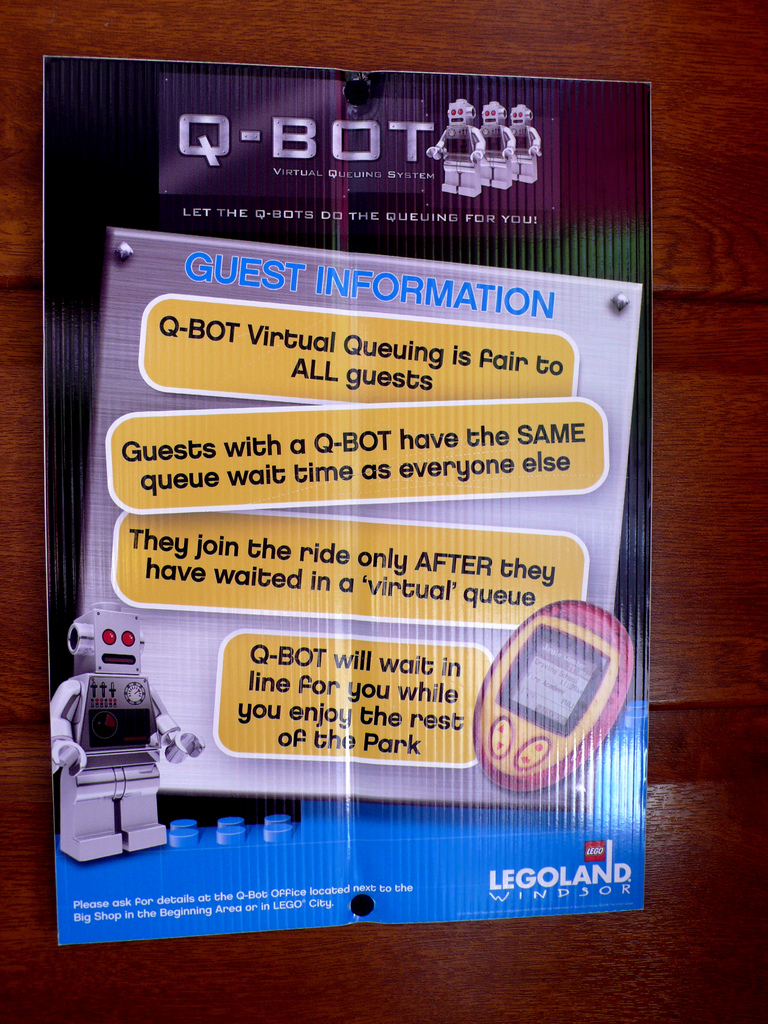
We went to Legoland yesterday. Very good. They had this virtual queuing system which worked rather well. £10 each for the day. I thought these posters were interesting though. There's obviously been some resentment among the non-Q-botters at the Q-botters jumping to the head of queue. This seems like the beginning of all sorts of issues. Is 'virtual queueing' the same as physical queueing? Actually, no. Or you wouldn't do it. And you wouldn't pay £10 for the privilege. It's not fair. We all understand how fairness works in actual physical interactions, the protocols are well established (especially if you're British). When this stuff gets disembodied it's going to get messy. Maybe there'll have to be holographic avatars actually waiting in line for us.

Splendid. It's organising itself. (With a lot of help from James. Thanks James.)
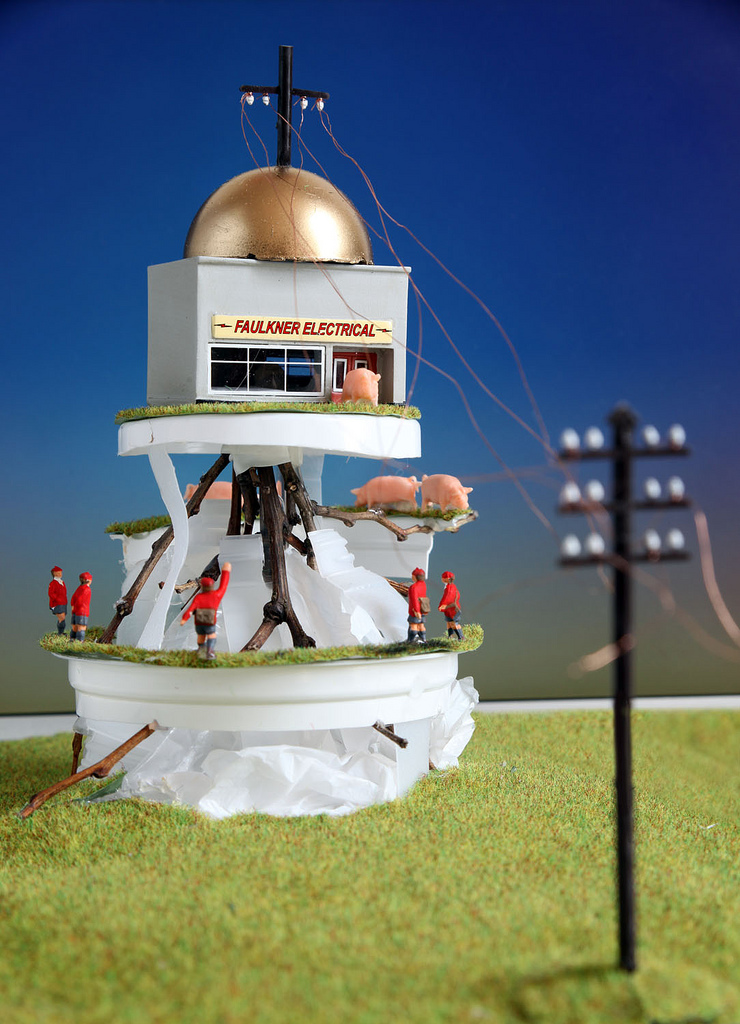
Well, the Lyddle End deadline's sailed by. I guess it had its desired effect in that many people have now finished, and the rest now feel much guiltier about not having done so. So we must turn our attentions to what to do next.
Originally I'd assumed we'd get them all together again and have a little show but I'm starting to worry about how small and fragile they all are. Some of them have got to travel quite a long way, and when they arrive they're still really, really small. I worry if they're going to be displayable properly. (Though there's been some interest in showing them from a few people, which is exciting.)
So I guess I'm wondering about a couple of things: can anyone think of a way things this small could be successfully displayed? Can we do something with mirrors/lenses?
But, perhaps more practically, I was wondering if there's some virtual world thing we can do to show them all off.
One of the things I like about the finished buildings is that they're not just objects, there are stories attached to many of them, music sometimes, and it'd be nice if we could feature that stuff as well. (like Tuur's here and in the picture above) I also like the different ways they've been photographed and the haphazard way they appear on flickr and tumblr. And the way that they illustrate different future views.
So I wondered if there was some sort of hybrid, cutandpaste virtural world we could build - which could just import the existing pictures and other content. In my head I'm imagining something somewhere between Ivor The Engine, Doom and Archigram. You know, you can walk around it, it's all collagey, not too much attention to proper perspective etc, but it still feels like a place. Does that make any sense?
Anyone got any ideas about how to do that? Or, more to the point, would someone actually do it? Any thoughts please drop me a line: lyddleend2050 at russelldavies.com.