Russell Davies

As disappointed as you are
About | Feed | Archive | Findings | This blog by email

how to be interesting

132393220_b3bf670440

While I was at the U of O I kept going on about how the core skill of any future creative business person will be 'being interesting'. People will employ and want to work with (and want to be with) interesting people.

And since I’d spent quite a lot of time telling them all the things they should stop doing I’d thought I’d try and teach something useful. Since I don't actually know anything useful I had to make something up. Which is below. It takes about 10 minutes to teach but it’ll take a lifetime for people to work out if it works or not, and by then I’ll be long gone. Ha!

I’ve based it on two assumptions:

The way to be interesting is to be interested. You’ve got to find what’s interesting in everything, you’ve got to be good at noticing things, you’ve got to be good at listening. If you find people (and things) interesting, they’ll find you interesting.

Interesting people are good at sharing. You can’t be interested in someone who won’t tell you anything. Being good at sharing is not the same as talking and talking and talking. It means you share your ideas, you let people play with them and you’re good at talking about them without having to talk about yourself.

The marvelous thing about tinterweb is that it’s got great tools for being interested and great tools for sharing. So I’ve used them a lot. It should, of course, be obvious that there are many other ways to be interesting. Some of them don't involve computers at all. These are just 10 things, and if you do them you’ll get more interesting. Or at the very least you’ll start practising the skills of being interesting.

It's sort of didactic, bossy even, but it's supposed to be instructional, rules you can follow. If you do them, and send me evidence that you’ve done them for three months, then I’ll send you a marvelous ‘I’m More Interesting Than I Was Three Months Ago’ certificate.

286385968_d86b976221

1. Take at least one picture everyday. Post it to flickr.

You should carry a camera with you. A phonecam will do. The act of carrying a camera, and always keeping an eye out for a picture to take changes the way you look at the world. It makes you notice more things. It keeps you tuned in.

Posting it to flickr (or other photosharing sites) means that you’re sharing it. It’s in public. This will make you think a little harder about what you shoot and it might draw you into conversation about your pictures.

2. Start a blog. Write at least one sentence every week.

This is pretty easy. If you just did this much I’d be disapppointed. You should write more sentences. Or you should write one true sentence. But I suspect that you won’t be able to limit yourself to just one sentence, I suspect you’ll get bitten and want to do more.

It’s easy to knock blogging as a kind of journalism of the banal but in some ways that’s its strength. Bloggers don’t go out and investigate things (mostly) they’re not in exciting or glamorous places, they’re not given a story, they have to build one out of the everyday lives they lead. And this makes them good at noticing things, things that others might not have seen. And being a blogger, feeling the need to write about stuff makes you pay attention to more things, makes you go out and see more stuff, makes you carry a notebook, keeps you tuned in to the world.
268745151_9c329df13e

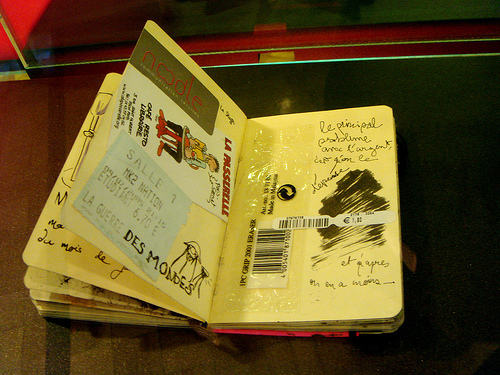
3. Keep a scrapbook

I’ve talked about this before. It’s good. Do it.

4. Every week, read a magazine you’ve never read before

Interesting people are interested in all sorts of things. That means they explore all kinds of worlds, they go places they wouldn’t expect to like and work out what’s good and interesting there. An easy way to do this is with magazines. Specialist magazines let you explore the solar system of human activities from your armchair. Try it, it’s fantastic.

5. Once a month interview someone for 20 minutes, work out how to make them interesting. Podcast it.

Again, being interesting is about being interested. Interviewing is about making the other person the star; finding out what they know or think that’s interesting. Could be anyone, a friend, a colleague, a stranger, anyone. Find out what’s compelling about them. Interviewing stops you butting in too much and forces you to listen. Good thing to practice. (And it's worth noticing the people who are good at it.) Podcasting is sharing. Sharing is something you must get used to.

Dsc03442_1

6. Collect something

It could be anything. It could be pictures of things. But become an expert in something unexpected and unregarded. Develop a passion. Learn how to communicate that to other people without scaring them off. Find the other few people who share your interest. Learn how to be useful in that community.

57760368_ccd5555053

7. Once a week sit in a coffee-shop or cafe for an hour and listen to other people’s conversations. Take notes. Blog about it. (Carefully)

Take little dips in other people’s lives. Listen to their speech patterns and their concerns. Try and get them down on paper. (Don’t let them see. Try not to get beaten up.) Don’t force it, don’t hop from table to table in search of better eavesdropping, just bask in the conversations that come your way.
66787101_3240431725

8. Every month write 50 words about one piece of visual art, one piece of writing, one piece of music and one piece of film or TV. Do other art forms if you can. Blog about it

If you want to work in a creative business (and before long most businesses will be creative businesses) you’ll have to get used to having a point of view on artistic stuff. Even if it’s not very artistic. You’ll have to be comfortable with expressing an opinion on things you don’t know how to make or do, like music or writing. You get better at that through practice. And through sharing what you’ve written.

9. Make something

Do something with your hands. Create something from nothing. It could be knots, it could be whittling, Lego, cake or knitting. Take some time to get outside your head. Ideally, make something you have no idea how to do. Get something from Make and try it, assuming you’ll screw it up the first time. People love people who can make things. Making’s the new thinking. Share your things on the your blog, or, if you’re brilliant maybe you can share them on etsy.

287893613_f5dc7ee953

10. Read:

Understanding Comics - Scott McCloud
The Mezzanine - Nicholson Baker
The Visual Display Of Quantitative Information - Edward Tufte

All these books are good for their own reasons but they’re also good examples of people who are really interested in stuff that others think of as banal and who explain it in a way that makes you share their passion. That's good.

And that's it.

Anyone got any others?
November 07, 2006 in the job | Permalink | Comments (69) | TrackBack (22)

cawfee

Dsc01098

We had a modest but lovely coffee morning in Portland on Saturday, at Byways. The first lovely surprise is when Patty and Emma popped by to say hello. They were friends when we lived in Portland, I haven't seen them since, but Patty read on the blog that I was going to be in Byways and they came by and said hi. (And they brought a gift for Anne, who they really like, I'm mostly just a conduit). Patty's the target audience for all the pictures of Arthur.

But I love the way that sharing your whereabouts increases the likelihood of great moments like this happening. So I'm going to be sharing some of my life via twitter from now on. Just to see what happens.

Dsc01099

Dsc01100

A little later, after Patty and Emma had gone, I was joined by Noel, Dave, Stephen and Sudeep. Just the right size of group for the modest booths at Byways. Had a great chat, ranged far and wide. The exciting thing is that the Opus guys are planning to start a Portland coffee morning. Go and join them if you can. Details here. Makes me feel like Johnny Appleseed.

Also excellent to see other coffees happening around the world; London, Sydney, Toronto.  Anywhere else?  Did I miss a meeting?

November 07, 2006 in coffee morning | Permalink | Comments (4) | TrackBack (0)

building creative generalists

Dsc00950_1

I’ve just spent the last week at the University of Oregon. Working with undergraduate students and faculty at the advertising programme at the school of journalism. I was being an ‘executive in residence’.

Eugene_1

The U of O is in Eugene, though it might make more sense to say the U of O is Eugene. It’s a lovely place. They spend a lot of time telling you about all the bits of Eugene that inspired various things on The Simpsons. (see above) And both the kids and the faculty were really nice and really welcoming. Smart kids too (is that too patronising?) Really engaged, enthusiastic and imaginative.

Dsc01080_1

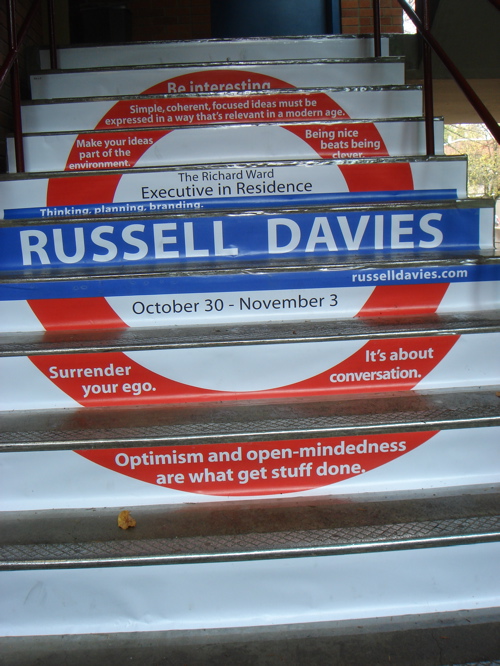
It’s very intimidating to arrive somewhere and come face to face with a large graphic of your name, with a collection of your 'sayings' like you’re a third world despot. Nice of them to make the effort though. (It’s also slightly embarrasing to be caught taking pictures of a graphic about yourself to put on your blog. That probably defines self-involved.)

Anyway, to the point.

It’s a long time since I’ve spent much time in an educational environment and it made me think about all sorts of things.

The students at the U of O are organised into a little volunteer ad agency called Allen Hall Advertising. They do pretty decent work for real clients and it must be an invaluable way to learn. They let me sit on an AHA meeting but it wasn’t long before I found myself starting to shatter their young dreams.

Because, in creating AHA, they’d very accurately recreated the infrastructure and heirachies of JWT in 1986. (Not specifically, but you know what I mean.) They were operating in a way that even big dumb agencies are trying to stop doing. They were preparing themselves for a world of work that doesn’t exist any more, or at least, won’t exist soon. I suggested, probably thoughtlessly, that they not worry about who was an ACD or an account person and start thinking about creative business problems they’d like to solve and start solving them. In small multi-disciplinary teams. Quickly.

And it soon becomes apparent that this issue goes a lot broader. Their course is designed to churn out mini-art directors, mini-account people, mini-planners for a world that increasingly just wants creative generalists. We have no idea what the world of work will be like or 5 or 10 years, but I suspect it won’t be like JWT in the 80s.

(Though I guess the lucky thing about advertising is it’s quite a flexible activity anyway so it’s not like they’re learning anything that won’t be useful. They’re not studying to be steam engineers or top hat makers, but it’s not so much about the skills they learn, it’s how they learn to apply them.)

Anyway.

The faculty at the U of O are smart enough to have figured this out and they’re working against the institutional friction to create something appropriate for the 21st century (I suspect they got me in to cause this sort of trouble, maybe even to write a post like this) but it’s going to be a struggle. We’re heading for a multi-disciplinary world and that butts right up against a university business model. If I were preparing myself for my job right now I’d do classes in film editing, poetry, statistics, anthropology, business administration, copyright law, psychology, drama, the history of art, design, coffee appreciation and a thousand other things. Colleges don’t want you doing that, that destroys all their efficiencies, but it’s what they’re going to have to work out.

(Good signs include a course that they're going to teach about Curiosity, that sounds like something I’d like to have done.)

I suggested the best thing they could do is get in touch with Steve at Creative Generalist and get his advice so Steve, you might be getting a call.

But everyone keep your eye on the U of O, with some good luck and some hard work they might transform themselves from a pretty decent ad school into a supplier of high-class creative generalists.

Interestingly, as well as having visited the U of O last week, I’m also on the board of VCU adcenter and I’ve been exchanging emails with people there about a similar dilemma. They’ve been watching the world change too and have created a new track called ‘Creative Brand Management’- this is a response to the idea that traditional MBAs are really poorly equipped to handle the increasingly creative requirements of the modern business world - having ideas, managing creative projects, working with aesthetic decisions, etc. In essence these are the brand managers, communications managers etc of the future. I guess they’re like regular marketing students but they’re more used to collaboration with creative people etc.

This seems like a smart idea to me but obviously it’s quite a new idea and most client organisations have never heard of adcenter so they’re looking for help and ideas in helping these people get out into the world. Where can they get internships? How should they market themselves? All that sort of stuff. One of the students is thinking about all this and emailed me with questions. Sadly my one year as a client doesn’t really equip me to answer them very well, so I said I’d try and help by putting some of the questions up  here.

If anyone has any views or suggestions I’d very grateful if you’d post them in the comments. These are the questions:

1. For the CBMs, part of the struggle is the relative anonymity of the Adcenter in the client world. From a typical client perspective, what do you think is the most attractive way to describe the educational process as it differs from traditional B-schools? Should this "sell" work its way onto a student's resume, or is there another way to make these points to an employer who may have zero prior knowledge? What types of materials should complement our resume as a track-information provider (i.e., a thorough Web site, a downloadable brochure, etc.)?

2. What, specifically, do you look for in the resume of someone who will work on your brand team? Do you expect a portfolio in addition to a resume? If so, what should be included?

3. We want to ensure that the title "Creative Brand Managers" isn't too limiting. Ideally, as graduates from this program, we will be equipped to manage a brand in myriad roles, including communication manager, marketing manager, project manager, brand analyst, among many others. Is the term "Creative Brand Manager" misleading to a recruiter? How explicit should we be with the title? What types of positions would you hire a student with a masters in "Creative Brand Management" for?

4. What are the skills mandatory from a new hire to work on anything that touches your brand? What are some ideal skills you'd like to see but rarely do?

5. In closing, how can we go about having companies find us in the future? What can we do to spread the word about this one-of-a-kind program?

So that's it. Any suggestions or thoughts very welcome.

November 06, 2006 in the job | Permalink | Comments (15) | TrackBack (3)

my relationship with football

Dsc01096

This is pretty much the extent of my relationship with Nottingham Forest now. They're never on the radio outside the Midlands and very rarely on the TV, and I'm never motivated enough to sit by the internet on a Saturday afternoon. So most weekends I'm buzzed by a series of texts telling me how they're getting on. It's kind of compelling, but it's more like mobile ceefax than anything else. And it illustrates why sport is such important content - it's because sport is live, and unpredictable. Sport is spectacle. And even this crappy text-based connection to it is actually important to me.

November 04, 2006 in diary | Permalink | Comments (3) | TrackBack (0)

yes

Dsc00953

November 04, 2006 in images | Permalink | Comments (1) | TrackBack (0)

literally the end of the world

Dsc01092

For years I've been complaining about the abuse of the word 'literally'; people using it to mean its opposite. But then I noticed this quote in today's New York Times and I reached a personal tipping point. I'm no longer bothered by it. Because I think it's started on an irrevocable journey to meaning something else. People aren't using it incorrectly. They're using it differently.

I know this kind of argument is as old as the hills and the pedants  will always fight with the ' there is no correct usage' people but this is my personal moment on this word. Just so you know.

November 04, 2006 in interesting | Permalink | Comments (8) | TrackBack (0)

this american life

Thislife_1I'm assuming all you Americans out there are already massive fans of This American Life. If you're not, what's wrong with you? But for all you non-Americans, you should know about this programme. Because it's, simply, the greatest radio programme ever. Even better than In Our Time.

They've got their entire archive online, and you've been able to subscribe  via  audible for ages. But now they're doing free podcasts - you should subscribe.

Some of my favourite episodes are these; about telephones, about 24 hours at a diner,  about classified advertising (featuring Jon Langford from The Mekons), about experimental phases, and this one, about prison. Which I think is the best single hour of radio ever. Make sure you listen to it through to the end.

November 04, 2006 in radio | Permalink | Comments (5) | TrackBack (0)

jobs

Pokeweb

Someone mentioned to me the other day that headhunters are starting to get really annoyed by everyone just mentioning their job openings on their blogs. I guess it's the flipside of the 'your blog is your resume' effect. With that in mind - Poke are looking for a creative director. Which must be one of the best jobs there is, and they've written one of the smartest, nicest job descriptions you could imagine.

November 03, 2006 in interesting | Permalink | Comments (1) | TrackBack (0)

sharing

Open_2

We're doing lots of thinking at the moment about how to work together across timezones. There are only really two hours a day when we're all awake.  We use backpack a lot, and email. And I assumed we'd use all sorts of fancy tools like skype and iChat (we're all on Macs) but they all seem to fall apart when you get to four people in four countries. So we're often falling back on a marvelous technology called the phone. It's great. Everyone has their own unique number and if you call it you can just talk to them using a system called 'voice'. We're also using freeconferencecall.com for weekly meetings.

We've dabbled with Second Life and other virtual environments, but they've not really worked. Apart from anything else I find that Second Life makes every conversation feel like you're flirting, and I'm not sure that's always appropriate. I think Croquet might be the answer, but we need to find someone who'd like to help us create something, and we've not done that yet.

Anyway, I still suspect that our original intention - to build a small global business using off-the-shelf consumer tools is still the right one, and with that in mind I was really drawn to this from Second Verse (found via Matt Jones). It's clearly not actually a useful thing yet, but I think it points at a way of doing asynchronous, rich collaboration - cheaply and easily. (And it uses gawker, which I love but have yet to find a good use for.)

This post will now just tail off with no real conclusion.

See.

November 03, 2006 in oia | Permalink | Comments (2) | TrackBack (0)

darren is stressed

 Darren

See here for details.

November 03, 2006 in images | Permalink | Comments (0) | TrackBack (0)

« Previous | Next »