 Matt pointed out this simple but effective offer from bandwagon. If you link to them, and display their logo before the official launch on Feb 22nd. They'll give you free service for a year. Not rocket science, but clever. It perhaps struck me more forcibly because I've just been looking again at Herd, wondering what tactics would emerge from it. And this is one I'm sure Mark would approve of. Plus, I might get free stuff.
more campaign questions
 Here's another message from Caroline at Campaign - she'd like your questions again. If you have any please stick them in the comments below.
The next Campaign Yahoo! Big Ideas interview is with Jill McDonald, Senior Vice President, Chief Marketing Officer for McDonald’s in Northern Europe. Jill joined McDonald's from British Airways, where she rose over 16 years from Brand Manager to Head of Global Marketing. In that role she launched the P.J.O'Rourke "Johnny Foreigner" advertising and spearheaded the Rugby World Cup Sponsorship. Caroline Marshall at Campaign would like to hear if you have any questions to put to Jill about her new role at McDonald’s.
monetise
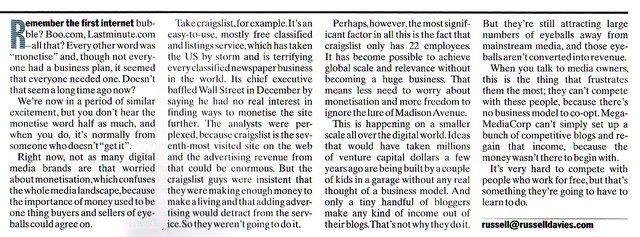
Here's the Campaign doodah from Feb 9th. And here's the text:
Remember the first internet bubble? Boo.com, Lastminute.com, all that? Every other word was 'monetise' and though not everyone had a business plan it seemed that everyone needed one. Doesn't that seem a long time ago now? We're now in a period of similar excitement but you don't hear the monetise word half as much, and when you do it's normally from someone who doesn't 'get it'. Right now, not as many digital media brands are that worried about monetisation, which confuses the whole media landscape, because the importance of money used to be one thing buyers and sellers of eyeballs could agree on.
Take craigslist for example. It's an easy to use, mostly free classified and listings service which has taken the States by storm and is terrifying every classified newspaper business in the world. Their CEO baffled Wall Street in December by saying he had no real interest in finding ways to further monetise the site. The analysts were perplexed because craigslist is the 7th most visited site on the web and the advertising revenue from that could be enormous. But the craigslist guys were insistent that they were making enough money to make a living and that adding advertising would detract from the service. So they weren't going to do it. But perhaps the most significant factor in all this is the fact craigslist only has 22 employees. (The next smallest company in the web's top ten is Yahoo! with 10,000 employees.) It has become possible to achieve global scale and relevance without becoming a huge business. That means less need to worry about monetisation and more freedom to ignore the lure of Madison Avenue.
This is happening on a smaller scale all over the digital world. Ideas that would have taken millions of VC dollars a few years ago are being built by a couple of kids in a garage without any real thought of a business model. And only a tiny handful of bloggers make any kind of income out of their blogs. That's not why they do it. But they're still attracting large numbers of eyeballs away from mainstream media, and those eyeballs aren't converted into revenue.
When you talk to media owners this is the thing that frustrates them the most; they can't compete with these people because there's no business model to co-opt. MegaMediaCorp can't simply set up a bunch of competitive blogs and regain that income because the money wasn't there to begin with. It's very hard to compete with people who work for free, but that's something they're going to have to learn to do.
janet wins
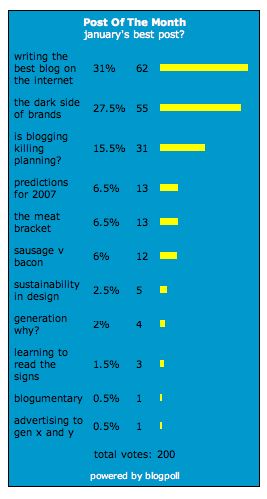
Mrs Belmot triumphs with writing the best blog on the internet. Faris and Richard did each other down in a Gore/Nader scenario. Mrs Belmot is now entitled to fly the Post Of The Month banner with pride. And, well, that's it really. Congratulations one and all. Go back to your constituencies and prepare for government.
bad ad science

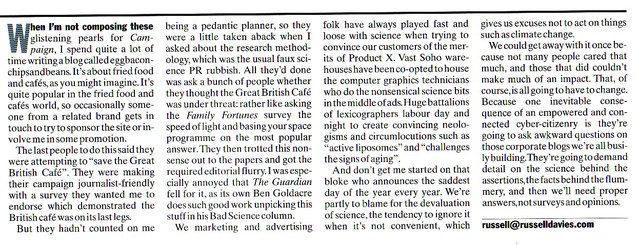
Here's the Campaign thing from a couple of weeks back. And here's the original text:
When I'm not composing these glistening pearls for Campaign I spend quite a lot of time writing a blog called eggbaconchipsandbeans. It's about fried food and cafes, as you might imagine. It's quite popular in the fried food and cafes world, so occasionally someone from a related brand gets in touch to try and sponsor the site or involve me in some ingenious promotion. The last people to do said they were attempting to 'save the Great British Cafe' (though it wasn't long after that they closed their Great British factory). They were making their campaign journalist-friendly with a survey they wanted me to endorse which demonstrated the British cafe was on its last legs. But they hadn't counted on me being a pedantic planner so were a little taken aback when I asked about the research methodology; which was the usual faux science PR rubbish. All they'd done was ask a bunch of people whether they themselves thought the Great British Cafe was under threat; rather like asking the Family Fortunes survey the speed of light and basing your space programme on the most popular answer. They then trotted this nonsense out to the papers and got the required editorial flurry. I was especially annoyed that The Guardian fell for it, as their own Ben Goldacre does such good work unpicking this stuff in his Bad Science column.
We marketing and advertising folk have always played fast and loose with science when trying to convince our customers of the merits of Product X. Vast Soho warehouses have been co-opted to house the computer graphics technicians who do the nonsensical science bits in the middle of ads. Huge battalions of lexicographers labour day and night to create convincing neologisms and circumlocutions like 'active liposomes' and 'challenges the signs of aging'. And don't get me started on that bloke who announces the saddest day of the year every year. We're partly to blame for the devaluation of science, the tendency to ignore it when it's not convenient, which give us excuses not to act on things like climate change.
We could get away with it once because not many people cared that much, and those that did couldn't really make much of an impact. That, of course, is all going to have to change. Because one inevitable consequence of an empowered and connected cyber-citizenry is they're going to ask awkward questions on those corporate blogs we're all busily building. They're going to demand detail on the science behind the assertions, the facts behind the flummery and then we'll all need to have proper answers, not surveys and opinions.
deadline looming

Don't forget. If you want to join in with Assignment 13, stuff has to be in before 10pm GMT on the 15th.
environmental thinking
So, on the 28th of March I'm supposed to be talking knowledgeably about 'branding and environmental issues', so I've been trying to think about a framework for it. There are tons of examples of great stuff that people are doing to make products more sustainable through recycling, thoughtful design etc but I thought I'd try and think about some other areas too, just to extend the argument a little. And probably to expose my own naivety.
The areas I've come up with are below. If anyone has any good thoughts or examples pertaining to any of these I'd love to hear about them. Though you've already done a ton of sterling work here.
1. Where branding/marketing makes some form of environmentally positive behaviour more desirable (and ideally does more than just preaches about/demonises bad behaviour).
I'm hoping that there are some examples which aren't just from governmental or charity organisations with an explicit mission to promote green behaviour. I'm hoping to find evidence of business using green ideas as part of its aspirational values. (That's a bit jargony but do you see what I mean?)
2. Where the consumption of branding/marketing/communications/media substitutes for the consumption of stuff.
This is the thing I talked about here (and which has interesting echoes here). I'm still not certain how this might work, but I think it'll reward some thought. And I'm working on a scheme/prize idea that might help flesh it out a little. More of that later.
3. Where packaging is dramatically re-evaluated, not just minimised.
This is horribly simplistic, but whenever I think about this I think about biscuit tins. Once upon a time packaging wasn't disposable, it was useful. We didn't think about recycling biscuit tins because we kept them, they were useful. And now they're even more valuable than they were. So I'm wondering if there's a way of thinking about packaging sustainability that makes it more valuable, not more recyclable. Does that make sense?
4. Where attitudes to consumption are changed through the renaissance of craft, making, etc. Especially relating to things like Make's ideas of repairability.
I guess this relates to point 3. Are there brands out there that are actively trying to build brand value in the idea that you can keep this product for a long time, play with it, alter it, repair it and never have to buy another one? And is this crossing-over from niche territories to the mainstream?
So, those are the areas I'm going to try and flesh out with examples, I'll report back as and when I have something.
But I also think there might be something bigger going on, I wonder if we're at a point where (in the West at least) mainstream society is trying to establish a new balance between rampant consumption and everything else. We're seeing an increasing resistance to brands and marketing invading every sphere of life and an increasing ability to tune them out (or regulate them out). I don't think this is something brand-owners should just bleat about (or should merely attempt to lobby against) - we should take it as a sign that there's something out of kilter about our relationship with people and society and that smart, relevant, effective brands will find new, more respectful ways to relate to the world. Sustainability will hopefully be a component of that stance.
So I'll try and flesh that out too. Any thoughts, very welcome.
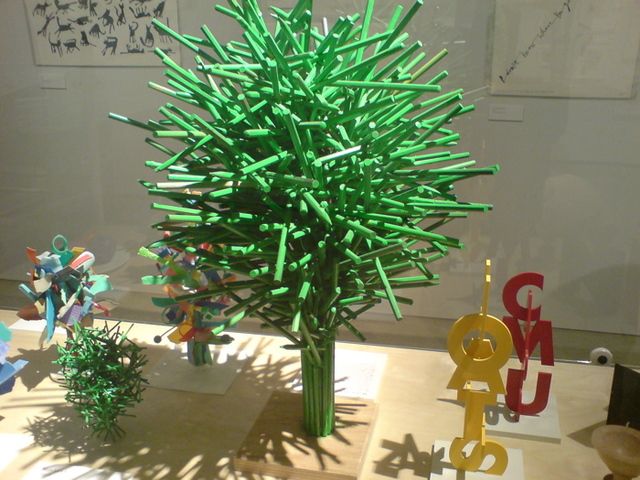
(The picture at the top is Alan Fletcher's pencil tree, from the Design Museum Exhibition)