
Any nominations for February's Post Of The Month? Please comment below.
Any nominations for February's Post Of The Month? Please comment below.

The APG is doing some great stuff at the moment. Much better than when I was doing it. The Creative Strategy Awards have had a smart overhaul and now feature a huge cash prize. I suggest you enter. And the evening meetings are going from strength to strength, first Jon Steel, then Megan Thompson talking about M&S and now Paul Feldwick talking about planning and poetry. Brilliant. Here's the description from the APG email:
Paul will discuss how poetry can reveal for planners some aspects of what we do in the ad business that we may not have fully appreciated. Including...
~ the nature of the imaginative or creative process, and how to encourage it
~ the possibilities of language – sounds, rhythm, rhyme, incantations, spells, laments….
~ how words can be used to create feelings and evoke all five senses
~ the power of ambiguity (and even nonsense) – the multivalent image
Paul Feldwick started his career as an account executive and became one of BMP's and London's most highly regarded planners. He went on to run the hugely successful planning function at BMP and over the years increasingly worked for DDB as a global network, developing a global framework for planning advertising and helping to found DDB University. He was Convenor of Judges for the IPA Effectiveness Awards in 1988/90, and has written and lectured extensively on how advertising works and brand equity, amongst other things. His book, What Is Brand Equity Anyway?, was published in 2002. Paul has also been Chairman of the APG and the AQR, and is a Fellow of the IPA and of the MRS.
Date: Thursday 8th March 2007
Time: 6.45pm for a 7pm start (finish about 8.15pm)
Venue: M&C Saatchi, 36 Golden Square, London W1
All welcome: but pls email so we can get an idea of numbers steve at apg.org.uk
If you can you must go to this. Mr Feldwick is the real planning deal, an ingenious, rigorous thinker and a nice man. Of course, I can't go, so can someone record it for me?
So well done the APG. The only remaining things to fix is the website, but I think that might actually be my fault.
Here's the feedback on Assignment 13. Thanks to everyone who entered.
Good Stuff
This was a much harder task than just throwing out some maple syrup thoughts. This required thought, investigation, some digging, some actual thinking. As such everyone who entered can be proud that they've got the kind of application and effort they'll need to be a good planner. Because I'm convinced that most of what makes people any good is there ability to work hard. So you've all done that. Brilliant.
There were some really interesting entries in here. Some people who'd managed to combine a decent amount of digging for useful data with some imagination and originality in your arguments. That's fantastic. Most of you didn't do both, you either presented me with lots of useful information and no interesting thinking. Or the other way round. That's not great but it's a decent start.
I really liked how global and diverse these entries are. I learned a lot about some different countries and none of you settled for some bland global solution. You all did something that was locally relevant and locally insightful. So, hurrah.
Bad Stuff
There was a load of typos and things in these documents. If English isn't your first language I'm going to forgive you for that and applaud you for communicating in another language. I can't do it. But if English is your first language then you should be ashamed of some of the typos in there. That's bad. And if your English isn't that strong just write less, use bullet points or diagrams, find a simpler way to communicate. It couldn't hurt anyway. But like I say anyone who's doing this in a second language - you have my admiration.
There was a lot of assertion without evidence in here. That's not necessarily a bad thing but if you're going to do that you have to explain what you're doing. If you're offering a personal point of view make that clear, and then make it very personal. Otherwise you should all spend some more time looking for actual facts and information on which to base your argument. This doesn't have to mean some quantitative research (thought that would be good) it just has to mean something out there in the real world; it could be the thoughts of journalists, it could be data from industry websites, it could be quotes from people on the internet, it could be a survey of people in your company. Otherwise you're just making stuff up and you're likely to get shot down in the client meeting. You've got to base your assertions and thinking on something.
On a similar note, though you all seemed to have done quite a lot of work on this it didn't seem that any of you actually went to a store, bought any similar product or tried it out. I didn't get any sense of visceral experience with the category. There's no substitute for trying it yourself. Do that. Take a few pictures, think about your personal experience and you've got a valid basis for a conversation. You should always start there. Not with google.
Caveats etc
Every time I do this I realise what a tricky task it is. I really want to be able to talk to you about what you've done, ask about the thinking behind it, discuss it, because I often get the sense that there's some great thinking hidden behind some awkward presentation. But I can only react to what you send me. And I can only do it with those snippy and perfunctory little comments. And it always seems easier to criticise than praise, and they inevitably get snippier as I get to the final entrants. So once again I apologise if I've been too harsh. But as I've said before, I don't think it's my comments that are the real value, I think you'll learn most by looking at everyone else's entry and seeing what they did that was different, better or worse than you.
Once again, huge thanks to everyone who joined in, you can be proud of yourselves. I've also recorded a discussion about this assignment with two titans of the plannersphere which I will post tomorrow and there'll be another task along shortly. cheers.
Download 13A.ppt Download 13B.ppt Download 13C.ppt Download 13D.ppt Download 13E.ppt Download 13F.ppt Download 13G.ppt Download 13H.ppt Download 13I.ppt Download 13J.ppt Download 13K.ppt Download 13L.ppt Download 13M.ppt

Two things always bug me when it comes to the typical blogrant/article/argument about brands, media, the future, all that stuff. The first is one we all recognise but find it hard to resist. It's the tendency to argue that they arrival of X will cause the total eradication of Y. The internet will destroy television. Phones will destroy MP3 players. Curry will destroy chips. (That didn't happen did it?)
We all do this. I do it. You get carried away with rhetoric and enthusiasm and forget that the likely scenario will be that everything will be a blurry munge like it was before, with this new element added in. This BusinessWeek article does a kind of variant on it - Stop Doing X Because Y Is The Answer - but it's forgivable because he's trying to make a persuasive point.
But it's the second fallacy (which probably has a name and if I knew anything about logic or rhetoric I'd tell you it) that really annoys me. It's the tendency to compare good examples from the category you like with the bad examples from the category you don't. So again, in the same article from BusinessWeek, Mr Gobe seems to be comparing AT&T/Cingular's marketing with Apple's product design and ethos. (He also chucks in Crispin's Orville Redenbacher stuff). He deduces from all this that Advertisers Still Don't Get It. Well, blimey, isn't that a bit of a leap? Isn't that a bit like comparing a really bad round of golf with a really great game of tennis at tennis and concluding that golf is a worse sport than tennis? Obviously AT&Ts advertising is worse than Apple's product design. That's not because advertising is inherently a worse thing to do than design a great product, it's because AT&T are bad at it. How about we compare Nike's advertising with Amstrad's product design? What would that tell us? Mr Gobe makes a bunch of good points about the value of an emotional connection built into the product but he spoils it all with his specious comparisons. I don't know maybe he's got a book to sell or something.
This happens in the new media/old media debate all the time. People compare Tribal's brilliant Monopoly campaign, say, with the average rubbishy TV toy ad and go ah-ha! look digital wins! digital's better! No - something that's good is better than something that's bad. Of course, this is like shooting fish in a barrel with advertising because so much of it's rubbish, but so is most digital stuff, so is most television and journalism and art and everything. And more digital stuff will become rubbish as it broadens, enters the mainstream and more of it is done by (by definition) more average people.
Maybe it's a sign that old media / new media debate is still immature and unformed that this still goes on. (And again, I bet I've done it). But I suspect if we really want to think hard about the best tools to use to serve customers, build brands, have fun, we're going to have to get used to comparing the very best in one channel with the very best in another. Not good with bad. Maybe that doesn't happen because there's not enough talent around for a single organisation to be able to offer the very best in multiple channels but if I were a brand-owner that's what I'd like to see offered to me.

There are some things coming together which I think are adding up to an interesting and useful way to approach brands.
There's John's enthusiasm thoughts (and here), which maybe relate to the Y&R Brand Asset Valuator ideas of Brand Energy - as Mark pointed out. And you can see it developing through Mark McGuinness's thoughts about Enthusiasm vs Confidence. I know Mark's talking about people not brands but I always used to hate seeing 'confident' in a list of brand values on a creative brief or somewhere. It didn't seem to tell you anything useful. Enthusiastic seems much better - because it demands to be tied to something - enthusiastic about what?
And maybe the 'enthusiastic about what?' question is answered by Richard's Brand Idea model. And with all that energy and enthusiasm safely directed then maybe deploying a stream of ideas makes some sort of sense (which is like John's molecule but with some added energy and direction).
This is what I like about the blogosphere, some useful new thoughts can be spun up very quickly without being co-opted by proprietary agency methodologies. And this energy/enthusiasm thing hasn't solidified yet, but it's going somewhere good.

A correspondent wonders if anyone has any thoughts on these questions. Any comments gratefully received:
When you think of "innovation" what do you think of?
What kind of companies?
What is innovative in your mind?
What does the idea conjure up (or not)?


 These badges from the Order Of The Science Scouts of Exemplary Repute and Above Average Physique are genius. (via spurgeonblog) Someone should do some planning equivalents. I only qualify for these three. Which is a bit pathetic for any self-proclaimed generalist. I'd love to how many any of you lot can lay claim to. Any real scientists out there?

Every now and then I find myself swamped by things I've been meaning to blog about but haven't got round to and the moment is rapidly passing. So here's a bunch of them, all together in one convenient package.
Firstly, if you've not seen John's Brief And Unreliable History of Planning you should do. Plus many of the other 'what is planning?' links at the plannersphere. Then there's Richard and what colour is news? and the AdLads interview with the prize-winning Mrs Belmot. Whatever you do you should read Scamp's Tuesday Tips for creatives, I especially like number 11. And you should think about adding something to Ben's Design Disease Flickr Pool.
There's Schulze and Webb and The Hills Are Alive With The Sound Of Interaction Design, which contains more thoughts on experience hooks, and I guarantee you you'll be using Experience Hooks as jargon in the next 12 months. This piece on the background to buzz is worth reading, as is The Economist on The Union Of Television And T'Internet. This is the perfect way for qual researchers and planners to pass their time on a plane and this will help you determine whether x is the new y.
And I'd forgotten about these two splendid and intertwined pieces from Serendipity Book and Max Kalehoff about the negative effect bad research can have on your customers. I've always thought so much research is like strip-mining people's heads, we don't pay enough attention to the fact that the person we're talking to is very likely to be a very important customer - bang in the middle of our target demographic if we've got the recruitment right - and the research experience is invariably a negative brand contact.
Then there's this smart piece on Kids, The Internet and Privacy and here the redoubtable Malcolm Garrett will tell you what he thinks of interactive stuff and whether he wishes he'd done it. And a comment there from Martyn Ware, reminds me that I must try and go to The Future Of Sound gigs. And speaking of musical genius, Dino manages to unite twitter and creole in a single post. And HBR's Breakthrough Ideas are always worth looking at.
I really liked reading about week one at monocle (even if I may have inadvertently provoked Mr Hill into posting). And about how your camera doesn't matter, via (i like). And a little piece from Helen about a writer's bible which hints at all sorts of good practise for brands.
And, I couldn't end without pointing out that Stefan is closing in on his 100th monster and if you haven't seen any of them yet you really should. It's a phenomenon.
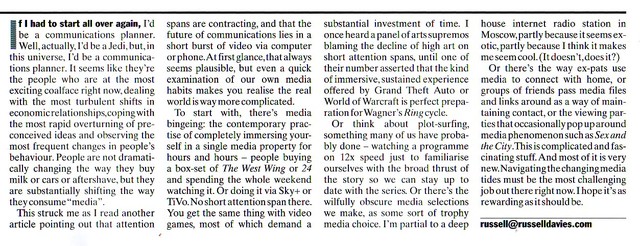
Campaign from last week, and below is for people not equipped with bionic vision:
If I had to start all over again I'd be a Communications Planner. Well actually I'd be a Jedi, but in this universe I'd be a Communications Planner. It seems like they're the people who are at the most exciting coalface right now, dealing with the most turbulent shifts in economic relationships, coping with the most rapid overturning of preconceived ideas and observing the most frequent changes in people's behaviour. People are not dramatically changing the way they buy milk or cars or aftershave (unless I'm missing something) but they are substantially shifting the way they consume 'media'.
This struck me as I read another article pointing out that attention spans are contracting and the future of communications lies in a short burst of video via computer or phone. At first glance that always seems plausible, but even a quick examination of our own media habits makes you realise the real world is way more complicated.
To start with there's media binging; the contemporary practise of completely immersing yourself in a single media property for hours and hours; people buying a box-set of The West Wing or 24 and spending the whole weekend watching it. Or doing it via Sky+ or Tivo. No short attention span there. You get the same thing with video games, most of which demand a substantial investment of time. I once heard a panel of arts supremos blaming the decline of high art on short attention spans until one of their number asserted that the kind of immersive, sustained experience offered by Grand Theft Auto or World Of Warcraft is perfect preparation for Wagner's Ring Cycle.
Or think about plot-surfing, something many of us have probably done - watching a programme on 12x speed just to familiarise ourselves with the broad thrust of the story so we can stay up to date with the series. Or there's the willfully obscure media selections we make, as some sort of trophy media choice. I'm partial to a Deep House internet radio station in Moscow partly because it seems exotic, partly because I think it makes me seem cool. (It doesn't does it?) Or there's the way ex-pats use media to connect with home, or groups of friends pass media files and links around as a way of maintaining contact, or the viewing parties that occasionally pop up around media phenomenon like Sex In The City. This is complicated and fascinating stuff. And most of it's very new. Navigating the changing media tides must be the most challenging job out there right now, I hope it's as rewarding as it should be.
Well, the plannersphere seems to be coming on nicely. But after the initial flurry the pace of change has slowed somewhat and I thought it'd be nice to have another burst. So maybe we should have a barn-raising party on a single section. Really work at it for a couple of days and make it comprehensive and useful. My suggestion would be creative briefs. We could work at that and make it a very handy resource, hoovering up great stuff like this from Daniel, but what does anyone else think?